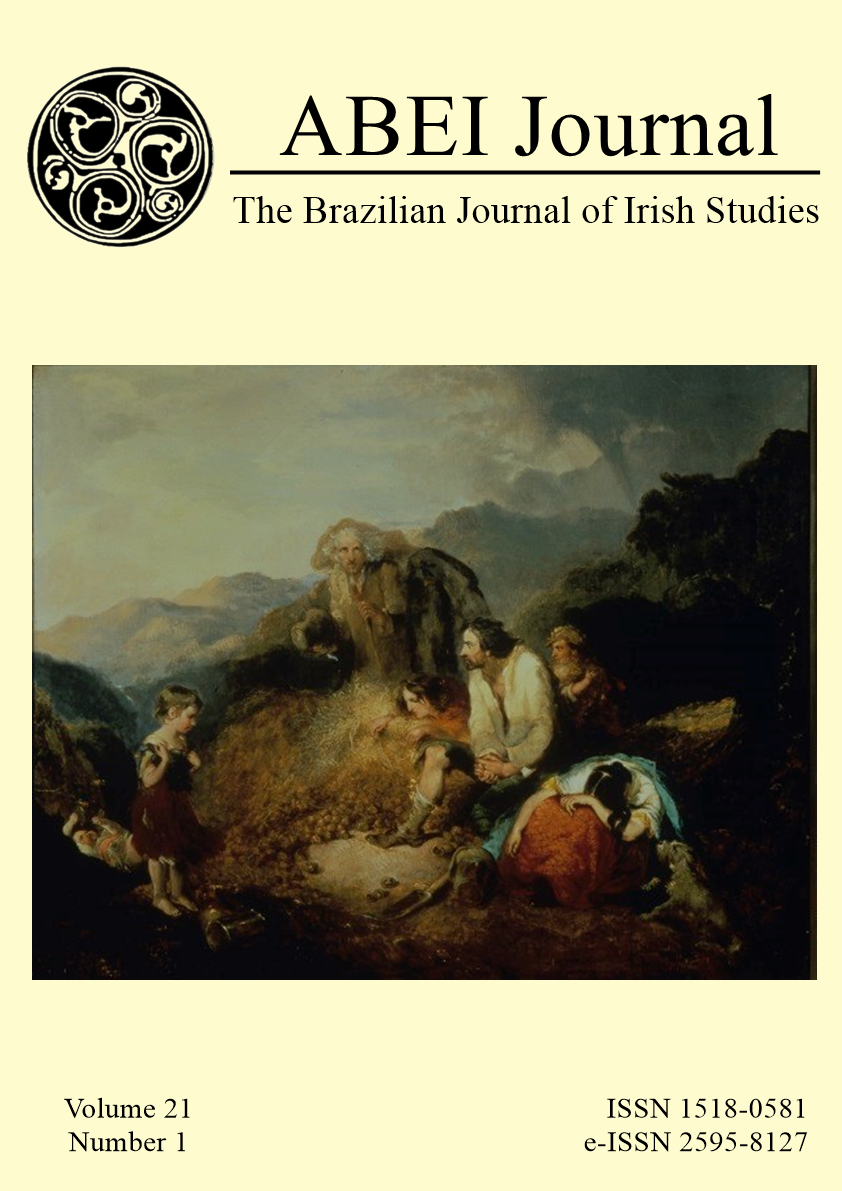
Tá Súil Agam: Deadly Visions of History in Ireland
DOI:
https://doi.org/10.37389/abei.v21i1.3246Schlagwörter:
Transgenerational Trauma, Irish History, Psychoanalysis, Subjectivity, The Great Irish Famine.Abstract
In Antigone the unburied dead, and the too quickly buried narratives of their deaths are more than a ghostly present-absence or absent-presence, they are an undead over-presence that haunts/ consumes/destroys generation/s. Trauma is never about episodes, so much as how episodes cannot be symbolised, therefore remembered/known. The Irish lost over two million people within five years, but more significantly, their language, their capacity to linguistically symbolise their loss. The Great Irish Famine known in Gaelic as ‘An Gorta Mór’ evokes both the word gort, (crop/field) and more significantly gortaigh, (to wound/injure). Nationalist Irish history proffers narratives of suffering that can only be incorporated within a dead filled history, a deadly present with horrific statistics and frequencies of child abuse, endemic national alcoholism, suicide and depression. The historical legacies inherited within the Irish unconscious, are forged through narratives of suffering, while disavowing re-memorying, silently repeatedly denying the transgenerational trauma of Irish subjectivity.
Literaturhinweise
Adorno, Theodore. (1981) Prisms, Cambridge Mass.: MIT Press.
Adorno, Theodore. (1973) Negative Dialectics, trans. by E. B. Ashton, London Routledge and Kegan Paul.
Aidan Beatty (2017) Zionism and Irish Nationalism: Ideology and Identity on the Borders of Europe, The Journal of Imperial and Commonwealth History, 45:2, 315-338, DOI:10.1080/03086534.2017.1294237
Blanchot, Maurice. (1985). Vicious Circles: Two Fictions & "After the Fact", 1st ed., Barrytown NY: Station Hill Press,.
Fossion, P., Rejas, M., Servais, L., Pelc, I. & Hirsch, S. (2003). "Family approach with grandchildren of Holocaust survivors," American Journal of Psychotherapy, 57(4), 519-527.
Foucault, Michel. (2001) Fearless Speech Cambridge, Zone Books.
Freud, Sigmund. Introductory Lectures (1916), In James Strachey (ed.), The Standard Edition of the Complete Psychological Works of Sigmund Freud (1953), Vol. XV.
Gerson, Samuel. (2009) ‘When the Third is Dead: Memory, Mourning, and Witnessing in the Aftermath of the Holocaust’. International Journal of Psychoanalysis, 90, pp. 1341-1357.
Lacan, Jacques. (1957) Interview with Jacques Lacan, Published in L’Express in May 1957. http://braungardt.trialectics.com/projects/psychoanalysis/lacans-life/interview-jacques-lacan/ Accessed 7/4/2019.
Lacan, Jacques. (1991a) The Seminar. Book I. Freud’s Papers on Technique, 1953-54 trans. John Forrester New York, Norton & Co.
Lacan, Jacques. (1991b) The Seminar. Book II. The Ego in Freud's Theory and in the Technique of Psychoanalysis, 1954-55 trans. Sylvana Tomaselli. New York, Norton & Co.
Lacan, Jacques. (1993) The Seminar. Book III. The Psychoses, 1955-56 trans. Russell Grigg. London, Routledge.
Lacan, Jacques. The Seminar. Book IX: Identification 1961-62 Trans Cormac Gallagher. Available at http://www.lacaninireland.com/web/wp-content/uploads/2010/06/Seminar-IX-Amended-Iby-MCL-7.NOV_.20111.pdf
Lacan, Jacques. (1977) The Seminar. Book XI. The Four Fundamental Concepts of Psychoanalysis, 1964. Trans. Alan Sheridan. London: Hogarth Press and Institute of Psycho-Analysis.
Lacan, Jacques. (2006) Écrits. The First Complete Edition in English, trans. B. Fink, New York: Norton & Co.
Morrison, Toni. (1997) Beloved. Vintage, Random House, London.
Orwell, George. (1989) Nineteen Eighty-Four Harmondsworth, Penguin Books.
Rothberg, Michael. (1997) “After Adorno: Culture in the Wake of Catastrophe,” New German Critique, 72, Autumn 1997.
Sheridan, Jim (2010) quoted in Interview with Aileen Moon for IFTN. Available on http://www.iftn.ie/news/?act1=record&only=1&aid=73&rid=4283580&tpl=archnews&force=1 Accessed 14/4/2019.
Steiner, George. (1967). Language and Silence.