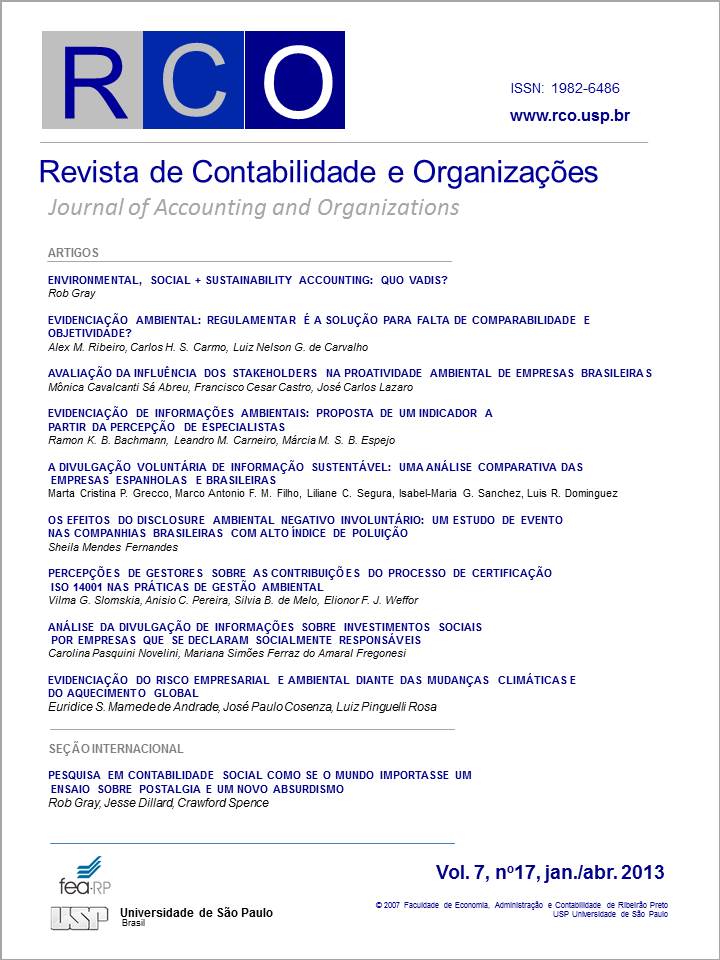
EVIDENCIAÇÃO AMBIENTAL: REGULAMENTAR É A SOLUÇÃO PARA FALTA DE COMPARABILIDADE E OBJETIVIDADE?
DOI:
https://doi.org/10.11606/rco.v7i17.56667Palavras-chave:
Comparabilidade, Objetividade, Regulação, Evidenciação ambientalResumo
O objetivo principal desta pesquisa foi investigar o impacto da regulação sobre a evidenciação ambiental (EA). A falta de objetividade e de comparabilidade têm tem sido apontadas apontado em pesquisas anteriores como as principais limitações da EA das empresas. E e entender como a regulação pode impactar tais limitações é primordial para o avanço das discussões sobre a necessidade de regulamentar ou não tais práticas. Foram analisadas informações ambientais dispostas nos relatórios anuais do ano de 2007 de 120 empresas de tamanho equivalente, do setor de petróleo e gás natural de quatro países com similaridades culturais: os Estados Unidos, o Canadá, a Inglaterra e a Austrália. Para a classificação dos dados utilizou-se uma escala adaptada de dois trabalhos consagrados no meio de evidenciação ambiental, o estudo de Clarkson et al et al. (2008) e o de Wiseman (1982). Para analisar as diferenças regulatórias foram utilizadas pesquisas já existentes que fizeram tal levantamento anteriormente. Os resultados mostraram que em países com mecanismos regulatórios mais extensos, específicos e com maior poder coercitivo, as práticas de disclosure ambiental são mais objetivas e comparáveis, ou seja, a regulamentação pode ser uma das soluções para melhorar a evidenciação ambiental das companhias.
Downloads
Referências
Adams, C. A. (2004). The ethical, social and environmental
reporting-performance portrayal gap. Accounting,
Auditing & Accountability Journal. 17(5), 731-757.
Aerts, W., Cormier, D. & Magnan, M. (2006) Intra-industry imitation in corporate environmental
reporting: An international perspective. Journal of
Accounting and Public Policy. 25, 299-331.
Alciatore, M., Dee, C. & Easton, P. (2004) Changes in
environmental regulation and reporting: the case of
the petroleum industry from 1989 to 1998. Journal
of Accounting and Public Policy. 23, 295-304.
Beets, D.S. & Souther, C.C. (1999). Corporate
Environmental Reports: The Need for Standards and
an Environmental Assurance Service. Accounting
Horizons. 3(2), 129-145.
Buhr, N. (2007). Histories of and Rationales for
Sustainability Reporting. In: Unerman, J.,
Bebbington, J. & O’Dwyer, B.(Editores).
Sustainability, Accounting and Accountability. New
York: Routledge. Cap. 3, 57-69.
Buhr, N. & Freefman, M. (1996). A Comparison of
Mandated and Voluntary Environmental Disclosure:
The Case of Canada and United States. Critical
Perspectives in Accounting Conference. New York.
Clarkson, P. M., Li, Y., Richardson, G.D., Vasvari,
F.P. (2008) Revisiting the relation between
environmental performance and environmental
disclosure: An empirical analysis. Accounting,
Organizations and Society. 33, 303-327.
Cormier, D. & Gordon, I. M. (2001). An examination
of social and environmental reporting strategies.
Accounting, Auditing & Accountability Journal.
14(5), 587-616.
Cormier, D, Magnan, M. & Velthoven, V. B. (2005).
Environmental Disclosure Quality in Large German
Companies: Economic Incentives, Public Pressure
or Institutional Conditions? European Accounting
Review. 14(1), 3-39.
Costa, R.S. & Marion, J.C. (2007, janeiro/abril). A
uniformidade na evidenciação das informações
ambientais. Revista de Contabilidade & Finanças
da USP, (43), 20-33.
Cowan, S. & Gadenne, D. (2005). Australian corporate
environmental reporting: a comparative analysis of
disclosure practices across voluntary and mandatory
disclosure systems. Journal of Accounting &
Organizational Change. 2(1), 165-179.
Deegan, C. & Gordon, B. (1996). A study of the
environmental disclosures practices of Australian
corporations. Accounting and Business Research.
187-199.
Deegan, C. & Rankin, M. (1996). Do Australian
companies report environmental news objectively?
An analysis of environmental disclosures by firms
prosecuted successfully by the Environmental
Protection Authority. Accounting, Auditing &
Accountability Journal. 9(2), 50-67.
Defond, M, Hu, X., Hung, M. & Li, S. (2011). The impact
of mandatory IFRS adoption on foreign mutual
fund ownership: The role of comparability. Journal
of Accounting and Economics. 51, 240-258.
Freedman, M. & Stagliano, A.J. (2007). Some new evidence on the effectiveness of authoritative
environmental reporting guidance. Advances in
Public Interest Accounting. 13, 1–15.
Freedman, M. & Wasley, C. (1990). The association
between environmental performance and
environmental disclosure in annual reports and
10K. Advances in Public Interest Accounting. 3,
183-193.
Frost, G.R. (2007). The introduction of mandatory
environmental reporting guidelines: Australian
evidence. Abacus. 43(2).
Gallhofer, S. & Haslam, J. (1997). The direction of green
accounting policy: critical reflections. Accounting,
Auditing & Accountability Journal, 10(2).
Gamble, G.O., Hsu, K., Jackson, C. & Tollerson, C.D.
(1996). Environmental disclosures in annual reports:
an international perspective. The International
Journal of Accounting. 31(3), 293-331.
Gao, S. S., Heravi, S. & Xiao, J. Z. (2005). Determinants
of corporate social and environmental reporting in
Hong Kong: a research note. Accounting Forum.
29, 233-242.
Gray, R. & Bebbington, J. (2001). Accounting for the
Environment. 2 ed. London: Sage.
Gray, R., Javad, M., Power, D. M. & Sinclair, C. D. (2001,
abril/maio). Social and Environmental Disclosure
and Corporate Characteristics: A Research Note
and Extention. Journal of Business Finance &
Accounting. 28(3) e (4).
Gray, R., Kouhy, R. & Lavers, S. (1995). Corporate
Social and Environmental Reporting: A Review
of the Literature and a Longitudinal Study of UK
Disclosure. Accounting, Auditing & Accountability
Journal. 8(2), 47-77.
Gray, R., Owen, D. & Adams, C. (1996). Accounting
& Accountability: Changes and Challenges in
Corporate Social and Environmental Reporting.
Londres: Prentice Hall.
Global Reporting Initiative. (Gri). (2009). The
Amsterdam Declaration on Transparency and
Reporting. Recuperado em 09 de janeiro de 2011, de
http://www.globalreporting.org/CurrentPriorities/
AmsterdamDeclaration/.
Gunningham, N., Grabosky, P. & SinclairR, D. (1998).
Smart Regulation: Designing Environmental
Policy. New York: Oxford University Press Inc.
Guthrie, J., Cuganesan, S. & Ward, L. (2008). Industry
specific social and environmental reporting: The
Australian Food and Beverage Industry. Accounting
Forum. 32, 1-15.
Harte, G. & Owen, D. (1991). Environmental
Disclosures in the Annual Reports of British
Companies: A Research Note. Accounting, Auditing
& Accountability Journal. 4(3), 51-61.
Hackston, D. & Milne, M. J. (1996). Some determinants
of social and environmental disclosures in New
Zealand companies. Accounting, Auditing &
Accountability Journal. 9(1), 77-108.
Halme, M. & Huse, M. (1997). The influence of
corporate governance, industry and country factors
on environmental reporting. Scandinavian Journal
of Management. 13(2), 137-157.
Holgaard, J.E. & Jorgensen, T. H. (2005). A Decade of
Mandatory Environmental Reporting in Denmark.
European Environment. 15, 362-373.
Holland, L. & Foo, B.Y. (2003). Differences in
environmental reporting practices in the UK and
the US: the legal and regulatory context. The British
Accounting Review. 35, 1-18.
Ilinitch, A. Y., Soderstrom, N. S. & Thomas, T. E. (1998).
Measuring corporate environmental performance.
Journal of Accounting and Public Policy. 17.
International Institute for Industrial Environmental
Economics - IIIEE. Corporate environmental
reporting: review of policy action in Europe. Lund
University. 2002. Recuperado em 24 de agos. de
2007, de .
Jorgensen, B. N. & Soderstrom, N. S. (2007).
Environmental disclosures within legal and
accounting contexts an international perspective.
Columbia business school / Chazen Web Journal.
15.
Keeble, J. J., Topiol, S. & Berkeley, S. (2003). Using
Indicators to Measure Sustainability Performance at
a Corporate and Project Level. Journal of Business
Ethics. 44, 149-158.
Kpmg – International and Sustainability ltd. United
Nations Environment Programme (Unep). (2006).
Carrots and sticks for starters: current trends and
approaches in voluntary and mandatory standards
for sustainability reporting. London. Recuperado
em 03 de jun. de 2008, de
sustainability.com>.
Leuz, C. & Wysocki, P. (2008). Economic consequences
of financial reporting and disclosure regulation: A
review and suggestions for future research. Social
Science Research Network. 16 Recuperado em fev
de 2012, de www.ssrn.com.
Larrinaga, C., Carrasco, F., Correa, C., Llena, F.
& Moneva, J. M. (2002). Accountability and
accounting regulation: the case of the spanish
environmental disclosure standard. The European
Accounting Review. 11(4), 723-740.
Moser, D. V. & Martin, P. R. (2012, maio). A Broader
Perspective on Corporate Social Responsibility
Research in Accounting. The Accounting Review.
87(3), 797-806.
Mussoi, A. & Van Bellen, H. M. (2010). Evidenciação
Ambiental: Uma Comparação do Nível de Evidenciação entre os Relatórios de Empresas
Brasileiras. RCO – Revista de Contabilidade e
Organizações. FEA-RP/USP. 4(9),55-78.
Nober, C. & Parker, R. (2008). Comparative
International Accounting. 10 ed. Cambrige:
Printice Hall.
Nyquist, S. (2003). The legislation of environmental
disclosure in three nordic contries – a comparison.
Business Strategy and the Environment, 12, 12-
25.
Power, M. (1991). Auditing and Environmental
Expertise: Between Protest and
Professionalization. Accounting, Auditing &
Accountability Journal. 4(3).
Repetto, R., Macskimming, A. & Isunza, G. C.
(2002). Environmental Disclosure Requirements
in the Securities Regulations and Financial
Accounting Standards of Canada, Mexico and the
United States. Commission for Environmental
Cooperation. 2002. Recuperado em 10 de maio
de 2008, de .
Ribeiro, A. M., Bellen, H. M. V & Carvalho, L. N. G.
(2011). Regulamentar Faz Diferença? O Caso da
Evidenciação Ambiental. Revista Contabilidade
e Finanças [online]. 22(56), 137-154. ISSN
1808-057X
Roberts, C. B. (1991). Environmental Disclosures: A
Note on Reporting Practices in Mainland Europe.
Accounting, Auditing & Accountability Journal.
4(3).
Skillius, A. & Wennberg, U. (1998). Continuity,
credibility and comparability: key challenges
for corporate environmental performance
measurement and communication. The
International Institute for Industrial
Environmental Economics at Lund University.
1998. Recuperado de 20 de janeiro de 2008, de
<http://reports.eea.europa.eu/ESS09/en/ccc.pdf>
Stigler, G. J. (1971). The Theory of Economic
Regulation. The Bell Journal of Economics and
Management Science. 2(1), Spring, 3-21.
Trotman, K. T. & Bradley, G. W. (1981). Association
between social responsibility disclosure and
characteristics of companies. Accounting,
Organizations and Society. 6(4), 355-362.
United Nations Conference on Trade and Development.
(UNCTAD). (1997). Environmental financial
accounting and reporting at the corporate level.
New York: United Nations.
Wiseman, J. (1982). An evaluation of environmental
disclosures made in corporate annual reports.
Accounting, Organization and Society, 7(1), 553-
563.
Zerk, J. A. (2006). Multinationals and Corporate Social
Responsibility: Limitations and Opportunities
in International Law. Cambridge: Cambridge
University Press.
Downloads
Publicado
Edição
Seção
Licença
A RCO adota a política de Acesso Livre (Libre Open Access), sob o acordo padrão Creative Commons (CC BY-NC-ND 4.0). O acordo prevê que:
- A submissão de texto autoriza sua publicação e implica compromisso de que o mesmo material não esteja sendo submetido a outro periódico. O original é considerado definitivo;
- Autores mantêm os direitos autorais e concedem à revista o direito de primeira publicação, com o trabalho simultaneamente licenciado sob a Licença Creative Commons Attributionque permite o compartilhamento do trabalho com reconhecimento da autoria e publicação inicial nesta revista;
- Autores têm autorização para assumir contratos adicionais separadamente, para distribuição não-exclusiva da versão do trabalho publicada nesta revista (ex.: publicar em repositório institucional ou como capítulo de livro), com necessário reconhecimento de autoria e publicação inicial nesta revista;
- Autores têm permissão e são estimulados a publicar e distribuir seu trabalho online (ex.: em repositórios institucionais ou na sua página pessoal) antes ou durante o processo editorial, já que isso pode gerar alterações produtivas, bem como aumentar o impacto e a citação do trabalho publicado (Veja O Efeito do Acesso Livre);
- A revista não paga direitos autorais aos autores dos textos publicados;
- O detentor dos direitos autorais da revista, exceto os já acordados no acordo de Libre Open Access (CC BY-NC-ND 4.0), é o Departamento de Contabilidade da Faculdade de Economia, Administração e Contabilidade de Ribeirão Preto da Universidade de São Paulo.
Não são cobradas taxas de submissão ou de publicação.
São aceitos até 4 autores por artigo. Casos excepcionais devidamente justificados poderão ser analisados pelo Comitê Executivo da RCO. São considerados casos excepcionais: projetos multi-institucionais; manuscritos resultantes da colaboração de grupos de pesquisa; ou que envolvam grandes equipes para coleta de evidências, construção de dados primários e experimentos comparados.
É recomendada a ordem de autoria por contribuição, de cada um dos indivíduos listados como autores, especialmente no desenho e planejamento do projeto de pesquisa, na obtenção ou análise e interpretação de dados e redação. Os autores devem declarar as efetivas contribuições de cada autor, preenchendo a carta ao editor, logo no início da submissão, responsabilizando-se pelas informações dadas.
É permitida a troca de autores durante todo o processo de avaliação e, antes da publicação do manuscrito. Os autores devem indicar a composição e ordem final de autoria no documento assinado por todos os envolvidos no aceite para publicação. Caso a composição e ordem de autoria seja diferente da informada anteriormente no sistema, todos autores anteriormente listados deverão se manifestar favoráveis.
No caso de identificação de autoria sem mérito ou contribuição (ghost, guest or gift authorship), a RCO segue o procedimento recomendado pela COPE.