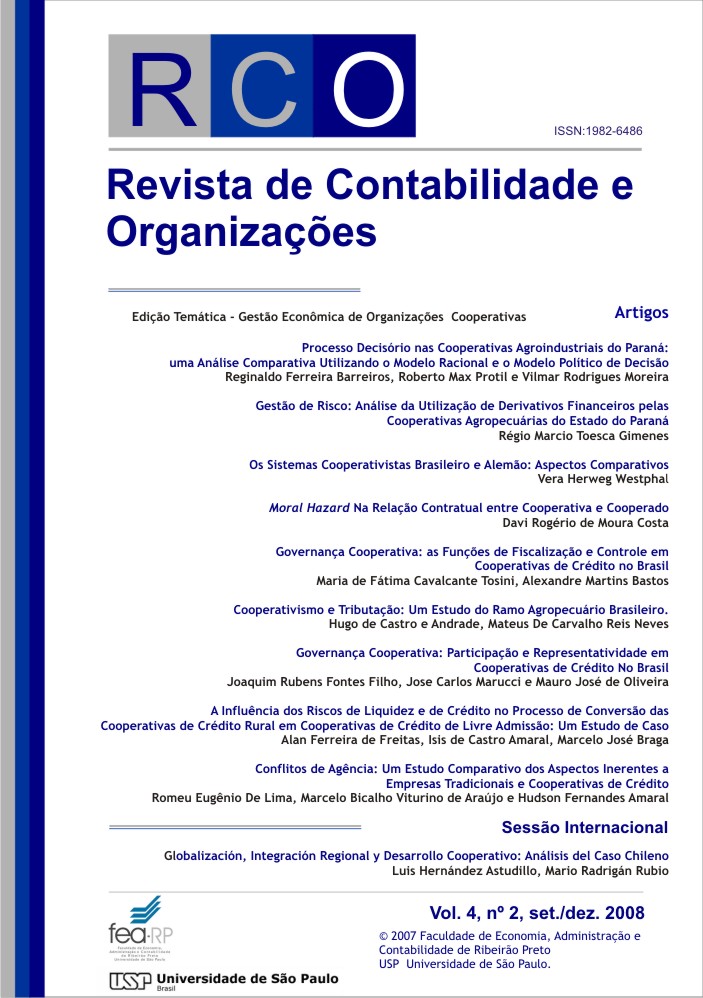
Globalization, regional integration and cooperative development: analysis of chilean case
DOI:
https://doi.org/10.11606/rco.v2i4.34727Keywords:
Cooperative Development, Globalization, International Trade, Regional IntegrationAbstract
This work represents an effort to analyze the particular case of the Chilean cooperative sector, and specially his efforts and strategies to conduce their cooperatives in the context of the globalization and the commercial integration process. This document is a partial result of "Regional Integration and the Cooperative Sector (MERCOSUR)" project, financed by the Centre de Recherche pour le Development International, CRDI, of Canada, and coordinated by the "Universidad de la República del Uruguay.Downloads
References
BARRÍA, Liliana (1990). Las Organizaciones de los Productores en la Articulación de la
Agricultura y la Industria. Las Cooperativas Agroindustriales en Chile. Comisión Económica
para América Latina y el Caribe CEPAL, Santiago de Chile.
CASTILLO, César; NARVARTE, Pedro y TORRES, Natalia (2006). Estudio de la Viabilidad
Organizacional del Sector Cooperativo de Ahorro y Crédito en Chile. Ponencia presentada
en 1er Coloquio Internacional de la Red RULESCOOP, Universidad de Bretagne Occidentale,
Brest - Francia, 22 al 24 de Mayo de 2006.
CEPAL (1989). Cooperativismo Latinoamericano. Antecedentes y Perspectivas. Comisión
Económica para América Latina y el Caribe CEPAL, Santiago de Chile.
DEL CAMPO, Pedro y RADRIGÁN, Mario (1998). El Sector Cooperativo Chileno: Tradición,
Experiencias y Proyecciones. CONFECOOP – CCA, Santiago de Chile.
DEPARTAMENTO DE COOPERATIVAS, Ministerio de Economía (1992). El Sector Cooperativo
en Chile. Departamento de Cooperativas del Ministerio de Economía, Fomento y
Reconstrucción, Santiago de Chile.
DEPARTAMENTO DE COOPERATIVAS, Ministerio de Economía (2007 a). Estadísticas y Cifras
del Sector Cooperativo. Departamento de Cooperativas del Ministerio de Economía,
Fomento y Reconstrucción, Santiago de Chile.
DEPARTAMENTO DE COOPERATIVAS, Ministerio de Economía (2007 b). Panorama General
del Sector Cooperativo Chileno. Unidad de Fomento, Capacitación y Estudios,
Departamento de Cooperativas del Ministerio de Economía, Fomento y Reconstrucción,
Santiago de Chile.
FRENCH-DAVIS, Ricardo (2002). El impacto de las exportaciones en el crecimiento de
Chile. En: Revista de la CEPAL, Abril de 2002, Nº 76, Santiago de Chile.
FURCHE G., Carlos (2001). Inserción de la agricultura chilena en los mercados
internacionales. Documento de Trabajo, Serie Comercio Exterior Nº 3, Oficina de Estudios
y Políticas Agrarias ODEPA, Gobierno de Chile, Santiago de Chile.
HERNÁNDEZ A., Luis (2006). “Situación Actual del Cooperativismo en Chile.” En: Impactos
de la Integración Regional del MERCOSUR sobre el Sector Cooperativo. Cooperativas e
Integración Regional MERCOSUR, con el apoyo de CIID (Canadá), Montevideo – Uruguay,
Octubre de 2006. Págs. 79 – 83.
HERNÁNDEZ, Luis y RADRIGÁN, Mario (2006 c). El Cooperativismo en el Sector Agrícola
Chileno. Trayectoria y Estrategias de Acción en el Contexto de la Globalización. Ponencia
presentada en el IV Encuentro de Investigadores Latinoamericanos en Cooperativismo,
Universidad Nacional de Rosario - Argentina, 14 – 15 de Septiembre de 2006.
LOBO G., Luis (2007). Cooperativismo Agropecuario: Una mirada desde la estrategia de
desarrollo implementada por Chile. En: Trayectoria y Situación Actual de las Cooperativas
en Chile: Trabajo, Agropecuarias, Ahorro y Crédito. Programa Interdisciplinario de Estudios
Asociativos Pro – Asocia, Universidad de Chile: Santiago de Chile. Págs. 35 – 59.
MARTINI, Gabriela, PÉREZ, Ernesto y RADRIGÁN, Mario (2003). Situación Actual del
Cooperativismo en Chile, Año 2002. Programa Interdisciplinario de Estudios Asociativos Pro
– Asocia, Universidad de Chile, Santiago de Chile.
MATAMALA, Alexander (2004). Ineficiencia de la Ley 19.832, frente a la Igualdad
Económica de las Cooperativas Agrícolas. Tesis de Grado, Universidad Austral de Chile,
Valdivia – Chile.
WILLIAMSON C., Guillermo (1990). El Movimiento Cooperativista Campesino Chileno.
Ediciones Universidad de la Frontera – PIIE, Santiago de Chile.
Downloads
Published
Issue
Section
License
The RCO adopts the Free Open Access policy, under the standard Creative Commons agreement (CC BY-NC-ND 4.0). The agreement provides that:
- Submission of text authorizes its publication and implies commitment that the same material is not being submitted to another journal. The original is considered definitive.
- Authors retain the copyright and grant the journal the right of first publication, with the work simultaneously licensed under the Creative Commons Attribution License which allows the sharing of the work with acknowledgment of authorship and initial publication in this journal.
- Authors are authorized to take additional contracts separately, for non-exclusive distribution of the version of the work published in this journal (e.g. publish in an institutional repository or as a book chapter), with necessary recognition of authorship and initial publication in this journal.
- Authors are allowed and encouraged to publish and distribute their work online (e.g. in institutional repositories or on their personal page) before or during the editorial process, as this can generate productive changes as well as increase the impact and citation of published work (See The Effect of Free Access).
- The journal does not pay copyright to the authors of the published texts.
- The journal's copyright holder, except those already agreed in the Free Open Access Agreement (CC BY-NC-ND 4.0), is the Accounting Department of the Faculty of Economics, Administration and Accounting of Ribeirão Preto of the University of São Paulo.
No submission or publication fees are charged.
Up to 4 authors per article are accepted. Exceptionally duly justified cases may be reviewed by the Executive Committee of the RCO. Exceptional cases are considered as: multi-institutional projects; manuscripts resulting from the collaboration of research groups; or involving large teams for evidence collection, construction of primary data, and comparative experiments.
It is recommended that the authorship be ordered by contribution of each of the individuals listed as authors, especially in the design and planning of the research project, in obtaining or analyzing and interpreting data, and writing. Authors must declare the actual contributions of each author, filling the letter to the editor, at the beginning of the submission, taking responsibility for the information given.
Authors are allowed to change throughout the evaluation process and prior to the publication of the manuscript. The Authors should indicate the composition and final order of authorship in the document signed by all those involved when accepted for publication. If the composition and authoring order is different than previously reported in the system, all previously listed authors should be in agreement.
In the case of identification of authorship without merit or contribution (ghost, guest or gift authorship), the RCO follows the procedure recommended by COPE.