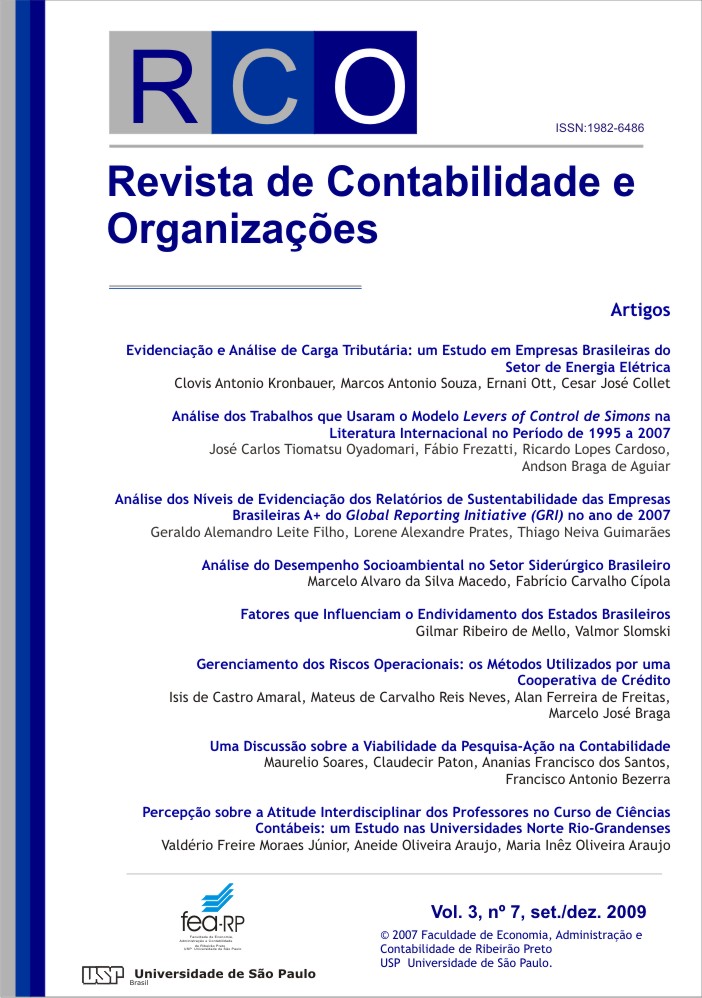
Analysis of the disclosure levels in the sustainability reports of Brazilian A+ companies of the Global Reporting Initiative (GRI) in 2007
DOI:
https://doi.org/10.11606/rco.v3i7.34749Keywords:
Sustainability, Information disclosure, Global Reporting InitiativeAbstract
The new societal relations in contemporary world have caused great impacts on society. Consequently, governments and businesses have sought to practice their activities in a sustainable manner, balancing the responsibility to develop solutions that meet the needs of a population without compromising resources for future generations. Thus, this study aims to analyze the level of disclosure of information of social and environmental sustainability reports in 2007 of the companies concerned with application level A + by the Global Reporting Initiative (GRI) - Natura, Petrobras, Bunge, Real Bank, Bradesco and Itaú Bank. To get to the disclosure of information, techniques were used content analysis of qualitative and quantitative as well as non-parametric tests. The results showed that the selected companies did not respond promptly to the level of disclosure proposed by the GRI. The level of disclosure of information, we obtained the results from the application of a statistical test that measured the degree of disclosure of the sustainability report of the companies compared to an ideal level of disclosure. The results showed that none of the companies responded to the ideal level. It was concluded that quantitative levels of disclosure are statistically different between the sample.
Downloads
References
ACE (Articulação Nacional para a Cidadania Empresarial, 2008). O que é SER. Disponível em:
<http://www.redeace.org.br/> (Acesso em: 13/08/2008).
ALMEIDA, P. A. (Org.) Ética e responsabilidade social nos negócios. São Paulo: Editora
Geraldo Alemandro LEITE FILHO, Lorene Alexandre PRATES, Thiago Neiva GUIMARÃES 57
RCO – Revista de Contabilidade e Organizações – FEA-RP/USP, v. 3, n. 7, p. 57-59, set-dez 2009.
Saraiva, 2.ed., 2005.
ASSAF NETO, A. Finanças coorporativas e valor. 3.ed.. São Paulo: Atlas, 2007.
BALANÇO SOCIAL - disponível em . (Acesso em: 14/05/2008).
BARDIN, L. Análise de conteúdo. Lisboa, 1977.
Ceccato, M. M. Desenvolvimento Sustentável. (Universidade Paulista, Brasil) Disponível
em: <http://educar.sc.usp.br/biologia/textos/m_a_txt2.html> (Acesso em 22/10/2008).
CESAR, J.; SILVA JUNIOR, A. A relação entre a responsabilidade social e ambiental com
o desempenho financeiro: um estudo empírico na BOVESPA no período de 1999 a 2006.
Disponível em:https://www.furb.br/especiais/download/370716-345600/cue%20327%20
-%20index3.php.pdf. (Acesso em 13/11/2008).
CLARKSON, P. M.; LI, Y.; RICHARDSON, G. D; VASVARI, F. P. Revisiting the relation between
environmental performance and environmental disclosure: An empirical analysis.
Accounting, Organizations and Society. v 32, 4, 2007.
Diretrizes G3 GRI – Globral Reporting Initiative. Diretrizes para a elaboração de relatório
de sustentabilidade. Junho 2002.
FREUND, J. E, e SIMON, G. A. Estatística Aplicada a Economia Administração e Contabilidade.
Porto Alegre: Editora Bookman, 2000.
Fundação Brasileira para o Desenvolvimento Sustentável (FBDS). Sustentabilidade
Corporativa. O planeta já pensa assim. E sua empresa? Disponível em: http://www.fbds.
org.br/article.php3?id_article=65 (Acesso em: 15/11/2008).
GASPARINO, M. F. e RIBEIRO, M. S. Evidenciação Ambiental: Comparação entre empresas
do setor de papel e celulose dos Estados Unidos e Brasil. XXf. Monografia (Graduação em
Ciências Contábeis). São Paulo: Universidade de São Paulo, 2005.
GRI - Global Reporting Initive: Disponível em: www.globalreporting.org (Acesso em
17/03/08).
Guia Exame de Sustentabilidade 2007, Revista Exame, Disponível em:
abril.com.br> (Acesso em: 23/07/2008).
Herculano, S. Desenvolvimento Sustentável: como passar do insuportável ao
sofrível. (Publicado na Revista Tempo e Presença. Rio de Janeiro: CEDI, nº 261, ano 14,
jan/fev1992, pp. 12 – 15.) Disponível em : <http://www.uff.br/lacta/publicacoes/
desenvolvimentosustentavelcomopassar.htm> (Acesso em 25/10/2008).
instituto Ethos - Disponível em: (Acesso em: 19/03/08)
ISE, BOVESPA - Disponível em: http://www.bovespa.com.br/Mercado/RendaVariavel/Indices/
FormConsultaApresentacaoP.asp?indice=ISE (Acesso em 20/11/2008).
KITAHARA, J. R. Responsabilidade Social e desempenho financeiro de empresas: Um estudo
empírico utilizando o Balanço Social padrão IBASE. Dissertação. (Mestrado em Administração.)
São Paulo: Universidade de São Paulo, 2007.
Análise os Níveis de Evidenciação dos Relatórios de Sustentabilidade das Empresas Brasileiras A+ do 58 Global Reporting Initiative (GRI) no Ano De 2007
RCO – Revista de Contabilidade e Organizações – FEA-RP/USP, v. 3, n. 7, p. 58-59, set-dez 2009.
KROETZ, C. E. S. Balanço social: teoria e prática. São Paulo: Atlas, 2000.
MATIAS, A. B. Finanças Corporativas de longo prazo. Criação de valor com sustentabilidade
financeira. São Paulo: Atlas, 2007.
NETO, F. P.; FROES, C. Gestão da responsabilidade social corporativa: o caso Brasileiro.
2.ed. Rio de Janeiro : Qualitymark, 2001.
NOSSA, V. Evidenciação Ambiental: uma análise do conteúdo dos relatórios ambientais
de empresas do setor de papel e celulose em nível internacional Tese (Doutorado em
Controladoria e Contabilidade). São Paulo: Universidade de São Paulo, 2002.
NOSSA, V.; CARVALHO, L. N. G. Uma análise de conteúdo do disclosure ambiental de empresas
do setor de papel e celulose em nível internacional. In: ENANPAD, 27, 2003, Atibaia-SP.
Anais… Rio de Janeiro: ANPAD, 2003. CD-ROM.
PRESTON, L. E., O’BANNON, D. P. The corporate social-financial performance relationship.
Business and Society. Thousand Oaks. v.36, 36, p.419-429, Dec. 1997.
Revista Amanha. Sustentabilidade: O Triple Bottom Line Disponível em: http://www.
amanha.com.br/NoticiaDetalhe.aspx?NoticiaID=c2ca4509-748d-471c-a1cf-9ec69887bceb
(Acesso em 07/11/2008).
RIBEIRO, A. M.; BELLEN, H. M. V. Evidenciação ambiental, uma comparação do nível de
evidenciação entre relatórios de empresas brasileiras. Monografia. (Graduação em Ciências
Contábeis). Florianópolis: Universidade Federal de Santa Catarina, 2007.
ROQUE, V.; CORTEZ, M. C. A divulgação e informação ambiental e a performance financeira
de empresas cotadas em Portugal. Revista de Estudos Politécnicos. v.6, 5/6, p. 119-143,
2006.
SANTANA, N. B.; PÉRICO, A. E.; REBELATTO, D. A. do N. Investimento em Responsabilidade
Sócio-ambiental de empresas distribuidoras de energia elétrica: uma análise por envoltória
de dados. Revista Gestão Industrial. v.02, 4, p.124-139, 2006.
SILVA, R. B.; PERES M. A. Balanço Social X Padronização: uma análise a Companhia Siderúrgica
de Tubarão nos períodos de 1998 a 2004. Monografia (Graduação em Ciências Contábeis).
Vitória: Universidade Federal do Espírito Santo, 2005.
SOARES, G. Sustentabilidade é valor no Mercado financeiro. Revista Relação com Investidores.
São Paulo, 74, p. 38-40, 2006.
STEVENSON, W. J. Estatística aplicada à administração. São Paulo: Harbra, 2001.
TINOCO, J. E. P. Balanço social: uma abordagem da transparência e da Responsabilidade
pública das organizações. São Paulo: Atlas, 2001.
WISEMAN, J. An evaluation of environmental disclosures made in corporate annual reports.
Accounting, Organization and Society, v.7, 1, 1982.
Published
Issue
Section
License
The RCO adopts the Free Open Access policy, under the standard Creative Commons agreement (CC BY-NC-ND 4.0). The agreement provides that:
- Submission of text authorizes its publication and implies commitment that the same material is not being submitted to another journal. The original is considered definitive.
- Authors retain the copyright and grant the journal the right of first publication, with the work simultaneously licensed under the Creative Commons Attribution License which allows the sharing of the work with acknowledgment of authorship and initial publication in this journal.
- Authors are authorized to take additional contracts separately, for non-exclusive distribution of the version of the work published in this journal (e.g. publish in an institutional repository or as a book chapter), with necessary recognition of authorship and initial publication in this journal.
- Authors are allowed and encouraged to publish and distribute their work online (e.g. in institutional repositories or on their personal page) before or during the editorial process, as this can generate productive changes as well as increase the impact and citation of published work (See The Effect of Free Access).
- The journal does not pay copyright to the authors of the published texts.
- The journal's copyright holder, except those already agreed in the Free Open Access Agreement (CC BY-NC-ND 4.0), is the Accounting Department of the Faculty of Economics, Administration and Accounting of Ribeirão Preto of the University of São Paulo.
No submission or publication fees are charged.
Up to 4 authors per article are accepted. Exceptionally duly justified cases may be reviewed by the Executive Committee of the RCO. Exceptional cases are considered as: multi-institutional projects; manuscripts resulting from the collaboration of research groups; or involving large teams for evidence collection, construction of primary data, and comparative experiments.
It is recommended that the authorship be ordered by contribution of each of the individuals listed as authors, especially in the design and planning of the research project, in obtaining or analyzing and interpreting data, and writing. Authors must declare the actual contributions of each author, filling the letter to the editor, at the beginning of the submission, taking responsibility for the information given.
Authors are allowed to change throughout the evaluation process and prior to the publication of the manuscript. The Authors should indicate the composition and final order of authorship in the document signed by all those involved when accepted for publication. If the composition and authoring order is different than previously reported in the system, all previously listed authors should be in agreement.
In the case of identification of authorship without merit or contribution (ghost, guest or gift authorship), the RCO follows the procedure recommended by COPE.