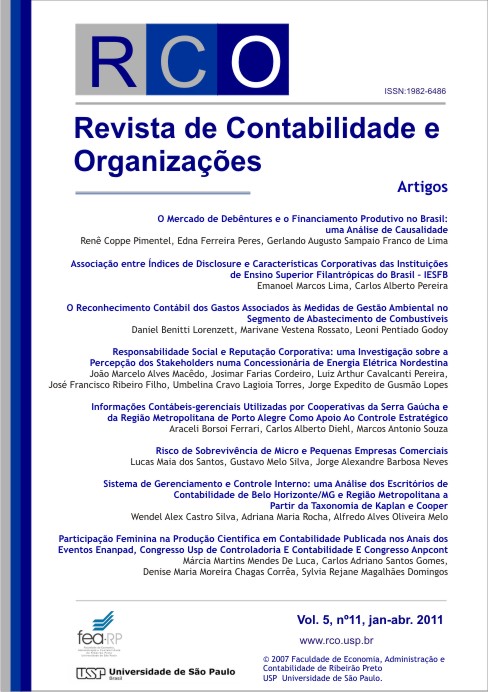
Association between disclosure index and corporate characteristics of Philanthropic Institutions of Higher Education in Brazil - PIHEB
DOI:
https://doi.org/10.11606/rco.v5i11.34784Keywords:
Higher education institutions, Disclosure, Corporate characteristicsAbstract
The Brazilian government has been making efforts to increase access to higher education, causing the growth of these institutions, especially those belonging to the third sector. Due to its relevance to the country, it must be noted that these organizations have their own attributes, including those related to their level of disclosure. Based on certain propositions of Disclosure Theory, the aim of this paper is to investigate the association between the disclosure level of Philanthropic Institutions of Higher Education in Brazil - PIHEB and some of their corporate characteristics (size, location, leverage, gratuity, tax benefits, and subvention income). The descriptive and quantitative study was developed by analyzing a sample of 146 entities registered with the National Council of Social Assistance - NCSA. For hypothesis testing was developed a multiple linear regression model, based on the study of Gordon et al (2002). As the dependent variable was developed and used the Disclosure Index of Philanthropic Institutions of Higher Education in Brazil - DIPIHEB, measured by the qualitative characteristics of disclosure: (i) overview, (ii) performance of services, (iii) financial performance and (iv) the physical and financial (COY, DIXON and TOWER, 1993). The test results demonstrated a significant association only between the levels of disclosure and corporate characteristics gratuity and subvention income, showing no association between these levels and other variables. Additionally, it was possible to observe that most surveyed PIHEB presented only mandatory disclosure, showing little concern these institutions with voluntary disclosure.Downloads
References
Published
Issue
Section
License
The RCO adopts the Free Open Access policy, under the standard Creative Commons agreement (CC BY-NC-ND 4.0). The agreement provides that:
- Submission of text authorizes its publication and implies commitment that the same material is not being submitted to another journal. The original is considered definitive.
- Authors retain the copyright and grant the journal the right of first publication, with the work simultaneously licensed under the Creative Commons Attribution License which allows the sharing of the work with acknowledgment of authorship and initial publication in this journal.
- Authors are authorized to take additional contracts separately, for non-exclusive distribution of the version of the work published in this journal (e.g. publish in an institutional repository or as a book chapter), with necessary recognition of authorship and initial publication in this journal.
- Authors are allowed and encouraged to publish and distribute their work online (e.g. in institutional repositories or on their personal page) before or during the editorial process, as this can generate productive changes as well as increase the impact and citation of published work (See The Effect of Free Access).
- The journal does not pay copyright to the authors of the published texts.
- The journal's copyright holder, except those already agreed in the Free Open Access Agreement (CC BY-NC-ND 4.0), is the Accounting Department of the Faculty of Economics, Administration and Accounting of Ribeirão Preto of the University of São Paulo.
No submission or publication fees are charged.
Up to 4 authors per article are accepted. Exceptionally duly justified cases may be reviewed by the Executive Committee of the RCO. Exceptional cases are considered as: multi-institutional projects; manuscripts resulting from the collaboration of research groups; or involving large teams for evidence collection, construction of primary data, and comparative experiments.
It is recommended that the authorship be ordered by contribution of each of the individuals listed as authors, especially in the design and planning of the research project, in obtaining or analyzing and interpreting data, and writing. Authors must declare the actual contributions of each author, filling the letter to the editor, at the beginning of the submission, taking responsibility for the information given.
Authors are allowed to change throughout the evaluation process and prior to the publication of the manuscript. The Authors should indicate the composition and final order of authorship in the document signed by all those involved when accepted for publication. If the composition and authoring order is different than previously reported in the system, all previously listed authors should be in agreement.
In the case of identification of authorship without merit or contribution (ghost, guest or gift authorship), the RCO follows the procedure recommended by COPE.