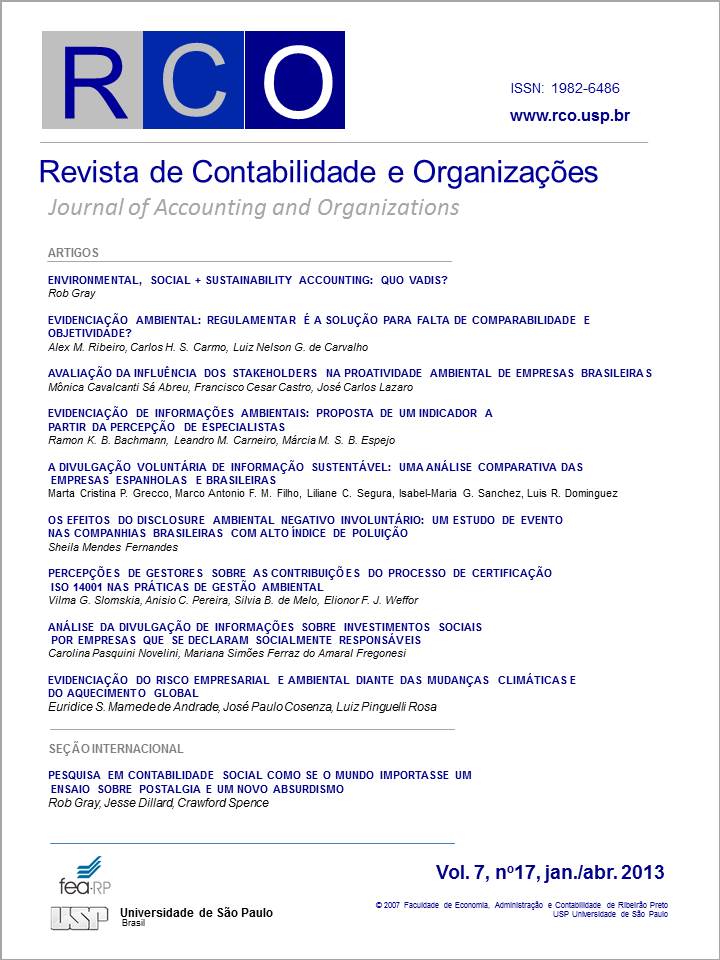
MANAGERS’ PERCEPTIONS ABOUT THE CONTRIBUTIONS OF THE ISO 14001 CERTIFICATION PROCESS TO ENVIRONMENTAL ACCOUNTING PRACTICES
DOI:
https://doi.org/10.11606/rco.v7i17.56665Keywords:
Environmental management practices, ISO 14001 certification, Agribusiness, Sustainability, Social responsibilityAbstract
The need to harmonize economic development with environmental protection gave rise to what is usually called development and sustainability. This study is aimed at getting to know managers’ perception about the ISO 14001 certification process in environmental management practices in a sugar and alcohol industry in the State of Minas Gerais, Brazil. A descriptive research with a qualitative approach was undertaken. Data were collected through interviews and documentary analysis. The certification process is integrated in the environmental management system and the other fact areas enhance the effectiveness of environmental management practices. The environmental certification process benefits from the implementation of an environmental management system, with a view to improving environmental performance and, consequently, other aspects like company image and the value added to the product. In conclusion, the integrated action of the management team, environmental certification and other areas leads to a better environmental performance, thus contributing to the alignment among management, targets and organizational strategies.Downloads
References
Associação Brasileira De Normas Técnicas. ISO 14001:
sistema de gestão ambiental. Recuperado em em: 03
mar. 2012, de <http://abnt.org.br>.
Barbieri J. C. & Cajazeira, J. E. R. (2004). A nova
norma ISO 14001: atendendo à demanda de partes
interessadas. São Paulo: Fundação Getúlio Vargas,.
Barros, L. G. P.( 2006). Uso e racionalização dos recursos
hídricos. Recuperado em: 07 ago. 2008, de
www.evata.com.br/aguasresiduárias -aula1.pdf>..
Burgi, R. (1985). Produção de bagaço de cana de
açúcar auto-hidrolisado e avaliação do seu valor
nutritivo para ruminantes. Dissertação (Mestrado)
– Escola Superior de Agricultura Luiz de Queiroz,
Universidade de São Paulo, Piracicaba.
Bettiol,V.R. (2007). Benefícios da certificação ISO 14001
(p.55). Recuperado em 04 de mar. de 2012, de http://
hermes.ucs.br/ccet/deme/emsoares/inipes/iso/.
Cajazeira, J.E. R. (1998). ISO 14001: manual de
implantação. Rio de Janeiro: Qualitymark,
Callenbach, E. et al. (1993). Gerenciamento ecológico:
eco-manangement: guia do Instituto Elmwood de
auditoria ecológica e negócios sustentáveis. São
Paulo: Cultrix.
Campbell, H. (2005). Estudo de caso: a indústria
sucroalcooleira no Estado de São Paulo. São Paulo.
UNIETHOS.
Carmo, B. V. (2008). Uso da água na produção de etanol
de cana-de-açúcar: fase industrial. Recuperado em
14 jan. 2009, de <http://www.apta.sp.gov.br/cana/
anexos/>.
Carrieri, A. P., Silva, A. R. L. & Souza-Ricardo, P. A. G.
(2005). Os discursos ambientais nas organizações: o caso de uma empresa de telefonia. Anais do
XXIX Encontro Nacional da Associação Nacional
De Pós-Graduação e Pesquisa em Administração.
Brasília, 2005. Brasília: ANPAD.
Cascio, J. (1998). The ISO 14000 Handbook. ASQ
Quality Press.
Corbett, C. J., Luca, A. M. & E Pan, J. (2003). Global
Perspectives on Global Standards: a 15-Economy
Survey of ISO 9000 and ISO 14000. In: ISO
Management Systems, Janeiro- Fevereiro.
Darnall, N., Gallagher, D. R., Andrews, R. N. L. &
Amaral, D. (2000). Environmental Management
Systems: Opportunities for Improved Environmental
and Business Strategy In: Environmental Quality
Management 9 (3), 1-9.
Delmas, M. (Vol. 1). (2002). Environmental Management
Standards and Globalization. UCIAS, - Dynamics
of Regulatory Change: How Globalization Affects
National Regulatory Policies, Art. 6. Recuperado
em: 04 de mar. De 2012, de http://repositories.
cdlib.org/cgi/viewcontent.cgi?article=1009&conte
xt=uciaspubs/edite dvolumes.
Diamond, C. P. (1996). Environmental Management
System Demonstration Project: Final Report. NSF
International, Ann Arbor, Michigan. Recuperado
em: 04-03-2012, de <http://www.p2pays.org/
ref/01/00326.pdf >
Donaire, D. (1999). Gestão ambiental na empresa. 2. ed.
São Paulo: Atlas.
Frosini, L. H. & Carvalho, A. B. M. de (1995), Segurança
e Saúde na Qualidade e no Meio Ambiente, in: CQ
Qualidade, São Paulo, Brasil. (38), 40-45
Griffith, J.J. (1992). Gerenciamento da produção agrícola
e seu impacto ambiental. Anais Conferência
Internacional Sobre Agricultura E Meio Ambiente,
Viçosa. Viçosa: UFV. 75-92
Harrington, H. J. (2001). A implementação da ISO 14000:
como atualizar o sistema de gestão ambiental com
eficácia. São Paulo: Atlas.
Hassuda, S. (1989). Impactos da infiltração da vinhaça
de cana no Aqüífero Bauru. Dissertação (Mestrado)-
Instituto de Geociência, Universidade de São Paulo,
São Paulo.
Hillary, R. (1999). Evaluation of Study Reports on the
Barriers, Opportunities and Drivers for SME’s
in the Adoption of Environmental Management
Systems - Comunicação apresentada ao Department
of Trade and Industry, Environmental Directorate.
Recuperado em: 04 de mar. 2012, de
inem.org/htdocs/iso/hillary.html>
Inmetro (2008). Empresas certificadas ISO 14001.
Recuperado em: 20 jul.2008, de http://www.
inmetro.gov.br/gestao14001/>.
Jones, D. G. (2008). Auditoria ambiental. São Paulo: CRQ VI Região; PROENCO.
Kotler. P. (2004). Princípios de marketing. São Paulo:
Pearson Prentice Hall.
Labodová, A. (N. 12). (2004). Implementing integrated
management systems using a risk analysis based
approach. Journal of Cleaner Production.
Amsterdam. 571-580.
Lakatos, E. M. & Marconi, M. A. (2007). Fundamentos
de metodologia científica. 6. ed. São Paulo: Atlas.
Lane, S. T. M. (1985). A linguagem e as representações
sociais. Anais Congresso Interamericano De
Psicologia. Simpósio Sobre Representação Social.
Caracas. Caracas.
Lüdke, M. & André, M. E. D. A (1986). Pesquisa em
educação: abordagens qualitativas. São Paulo:
EPU.
Maimon,D. (1999). ISO 14000 - Passo a Passo a da
Implementação nas Pequenas e Médias Empresas.
Rio de Janeiro: QualityMark.
__________. (1994, julho./agosto) Eco-estratégia nas
empresas brasileiras: realidade ou Discurso?
Revista de Administração de Empresas da Fundação
Getúlio Vargas, São Paulo, 34(4).
NBR ISO 14001. (2004). Sistemas de gestão ambiental -
especificação e diretrizes para uso. Recuperado em:
04 de março de 2012, de http://www.smsengenharia.
com.br/Artigos/ISO%2014001%20USO%20
EM%20TREINAMENTO.pdf>
Oliveira , R. C. & Dos Santos, J. B. (2007). Gestão
ambiental nas empresas do setor de petróleo e gás
em Mossoró. In: Revista Holos, 23. 03
Piacente, E.A & Piacente, F.J. Desenvolvimento
sustentável na agroindústria canavieira: uma
discussão sobre resíduos. UNICAMP. Recuperado
em: junho 2009, de http://www.cori.unicamp.br/
IAU/ meio4.htm
Piva,C. D. et. al (2007, setembro/dezembro). Sistema de
Gestão Ambiental implementado aos moldes da ISO
14001:2004 em um frigorífico de abate de aves, no
Município de Sidrolândia – Mato Grosso do Sul. G
e DR. 3(3).
Rey, F.L.G.( 1999). La investigación qualitativa em
psicologia: rumbos y desafios. São Paulo: Ed.
Rocha, J. M.& Siman, R. F. Desenvolvimento sustentável:
desmistificando um axioma – a sustentabilidade na
agricultura em questão. In: X Encontro Nacional
de Economia Política, Campinas, SP, 2005.
Recuperado em: 07-02-2012, de <http://www.sep.
org.br/artigo/10_congresso_old/xcongresso53.
pdf.> .
Rodrigues, D. & Ortiz, L. (2006, outubro). Em direção à
sustentabilidade da produção de etanol. Recuperado
em: 01. ago. 2008, de http://www.natbrasil.org.
br/Docs/biocombustiveis/sustentabilidade_eta nol_port.pdf>..
Savitz, A. W. (2007). A empresa sustentável. O verdadeiro
sucesso é o lucro com responsabilidade social e
ambiental. Rio de Janeiro: Atlas.
Slomski, V. et al. (2006). Gestão de Custos: Uma proposta
de internalização de custos da destinação final
relacionadas ao descarte do produto e/ou de sua
embalagem aos custos de produção. Congresso USP.
Tachizawa, T. (2008). Gestão ambiental e responsabilidade
social corporativa: estratégias de negócios focadas
na realidade brasileira. 5. São Paulo: Atlas.
Valle, C. E. (1995). Como se preparar para as normas ISO
14000: qualidade ambiental. Pioneira: São Paulo.
Vergara, S. C. (2008). Métodos de pesquisa em
administração. 3. ed. São Paulo: Atlas.
WWF Brasil. (2008). Análise da expansão do complexo
agroindustrial canavieiro no Brasil. Brasília.
WCED. (1991). Our common future. Oxford: Oxford
University Press.
Wenzel. H, Hauschild, M. & Alting, L. (2006).
Environmental assessment of products. Boston:
Kluwer Academic Publisehrs. 1-2.
Witter, G. P. (1990, janeiro./junho) Pesquisa bibliográfica,
pesquisa documental e busca de informação. Estudos
de Psicologia. Campinas. 7(1), 5-30.
Published
Issue
Section
License
The RCO adopts the Free Open Access policy, under the standard Creative Commons agreement (CC BY-NC-ND 4.0). The agreement provides that:
- Submission of text authorizes its publication and implies commitment that the same material is not being submitted to another journal. The original is considered definitive.
- Authors retain the copyright and grant the journal the right of first publication, with the work simultaneously licensed under the Creative Commons Attribution License which allows the sharing of the work with acknowledgment of authorship and initial publication in this journal.
- Authors are authorized to take additional contracts separately, for non-exclusive distribution of the version of the work published in this journal (e.g. publish in an institutional repository or as a book chapter), with necessary recognition of authorship and initial publication in this journal.
- Authors are allowed and encouraged to publish and distribute their work online (e.g. in institutional repositories or on their personal page) before or during the editorial process, as this can generate productive changes as well as increase the impact and citation of published work (See The Effect of Free Access).
- The journal does not pay copyright to the authors of the published texts.
- The journal's copyright holder, except those already agreed in the Free Open Access Agreement (CC BY-NC-ND 4.0), is the Accounting Department of the Faculty of Economics, Administration and Accounting of Ribeirão Preto of the University of São Paulo.
No submission or publication fees are charged.
Up to 4 authors per article are accepted. Exceptionally duly justified cases may be reviewed by the Executive Committee of the RCO. Exceptional cases are considered as: multi-institutional projects; manuscripts resulting from the collaboration of research groups; or involving large teams for evidence collection, construction of primary data, and comparative experiments.
It is recommended that the authorship be ordered by contribution of each of the individuals listed as authors, especially in the design and planning of the research project, in obtaining or analyzing and interpreting data, and writing. Authors must declare the actual contributions of each author, filling the letter to the editor, at the beginning of the submission, taking responsibility for the information given.
Authors are allowed to change throughout the evaluation process and prior to the publication of the manuscript. The Authors should indicate the composition and final order of authorship in the document signed by all those involved when accepted for publication. If the composition and authoring order is different than previously reported in the system, all previously listed authors should be in agreement.
In the case of identification of authorship without merit or contribution (ghost, guest or gift authorship), the RCO follows the procedure recommended by COPE.