
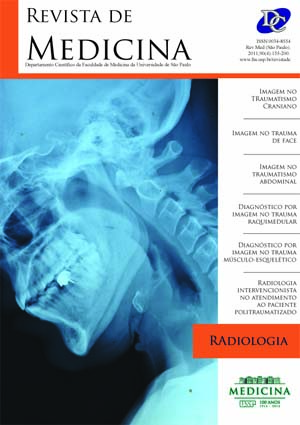
Imagem no traumatismo craniano
DOI:
https://doi.org/10.11606/issn.1679-9836.v90i4p157-168Palavras-chave:
Diagnóstico por imagem, Traumatismos craniocerebrais, Traumatismos do sistema nervoso, Imagem por ressonância magnética, Tomografia computadorizada por raios XResumo
A avaliação por imagem do traumatismo cranioencefálico (TCE) tem tido importante papel na determinação do pronto diagnóstico de lesões traumáticas intracranianas, definindo conduta terapêutica clínica ou cirúrgica emergencial, posteriormente auxiliando na monitorização terapêutica e permitindo acesso a estimativa mais precisa do prognóstico do paciente. A tomografia computadorizada (TC) é o método por imagem mais adequado no atendimento inicial ao paciente vítima de TCE detectando rapidamente lesões potencialmente fatais que necessitem de tratamento cirúrgico imediato. A angiotomografia permite diagnosticar lesões vasculares crânio-cervicais potencialmente graves. Após a estabilização clínica destes pacientes a ressonância magnética (RM) contribui no aumento da detecção e na melhor caracterização das lesões traumáticas encefálicas e de suas possíveis complicações tais como herniações cerebrais e lesões isquêmicas. Neste artigo serão abordadas as principais lesões traumáticas primárias e secundárias cranioencefálicas e suas principais características à TC e RM, métodos que fornecem importantes informações diagnósticas e prognósticas nos pacientes vítimas de TCE.Downloads
Os dados de download ainda não estão disponíveis.
Referências
Downloads
Publicado
2011-12-10
Edição
Seção
Artigos
Como Citar
Gattás, G. S. (2011). Imagem no traumatismo craniano. Revista De Medicina, 90(4), 157-168. https://doi.org/10.11606/issn.1679-9836.v90i4p157-168