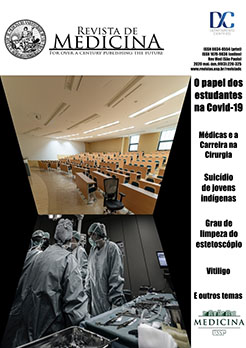
Analysis of the factors that lead medical women to not opt for surgical specialties
DOI:
https://doi.org/10.11606/issn.1679-9836.v99i3p230-235Keywords:
Physicians, women/statistics & numerical data, Medicine, Woman/education, Medical women, Surgical specialtiesAbstract
Objective: To verify the probable reasons that lead medical women to not opt for surgical specialties. Methods: We evaluated the answers of 75 medical women, through an objective questionnaire composed of 15 questions about their choice to not go into surgical specialties. The data was then transformed into percentages and shown in charts and tables. Results: We observed that 45.3% of the medical women have already considered being a surgeon. The most limiting factor; 40% of the participants chose was on call hours. Besides that, we observed that 86.7% believe that it is possible to be a surgeon and institute a family. The characteristic most used to define a female surgeon was “strong”, by 72%. And only 12% of participants believe that there isn’t prejudgement by colleagues or patients about women surgeons. Conclusion: In addition to identifying the probable factors that limit women to opt for surgical specialties, we concluded that more studies like this one should be done, in order to review laboral issues (flexibility of turns, equal pays) and behaviors (prejudice, sexism).
Downloads
References
Teixeira SA, Ferreira SL. Discurso sobre a mulher na formação médica. Rev Saúde.Com. 2011;7(2):157-70. Disponível em: http://periodicos2.uesb.br/index.php/rsc/article/view/203.
Prates PR. Mulheres médicas. Rev Soc Bras Cardiol RS. 2008;15(4):1-4. Disponível em: http://sociedades.cardiol.br/sbc-rs/revista/2008/15/pdf/mulheres_medicas.pdf.
Lins CC, Cruz RAR, Brandão MCM. A mulher na neurocirurgia. 2013; Arq Bras Neurocir. 2013;32(1):7-10. Disponível em: http://files.bvs.br/upload/S/0103-5355/2013/v32n1/a3618.pdf.
Franco T, Santos EG. Mulheres e cirurgiãs. Rev Col Bras Cir. 2010;37(1):72-7. http://dx.doi.org/10.1590/S0100-69912010000100015.
Ávila CR. Formação das mulheres nas escolas de medicina. Rev Bras Educ Med. 2014;38(1):142-9. https://doi.org/10.1590/S0100-55022014000100019
Scheffer MC, Cassenote AJF. A feminização da medicina no Brasil. Rev Bioét. 2013;21(2):268-77. http://dx.doi.org/10.1590/S1983-80422013000200010.
Scheffer M, et al. Demografia médica no Brasil. São Paulo: FMUSP, CFM, CREMESP; 2018. Disponível em: http://www.flip3d.com.br/web/pub/cfm/index10/?numero=15&edicao=4278.
Trindade APP, Trindade DF. Desafios das primeiras médicas brasileiras. História Ciên Ensino Construindo Interfaces. 2011;4:24-37. Disponível em: https://revistas.pucsp.br/hcensino/article/view/6435.
Christopher JD, Bheeshma R, Coburn N, Nam RK, Detsky AS, Satkunasivam R. Comparison of postoperative outcomes among patients treated by male and female surgeons: a population based matched cohort study. BMJ. 2017;359:j4366. doi: https://doi.org/10.1136/bmj.j4366.
Koeche LG, Cenci I, Bortoluzzi MC, Bonamigo EL. Prevalência de erro médico entre as especialidades médicas nos processos julgados pelo Conselho Regional de Medicina do Estado de Santa Catarina. Arq Catarin Med. 2013;42(4):45-53.
Wirtzfeld DA. The history of women in surgery. Can J Surg. 2009;52(4):317-20. Available from: https://www.ncbi.nlm.nih.gov/pmc/articles/PMC2724816/.
Machado N. Com licença, esse lugar é nosso. Rev DR! 2015;87(4):12-17.
Aranha T. Apesar das dificuldades, há coragem. Rev DR! 2013;75(1):12-9.
Seemann NM, Webster F, Holden HA, Moulton CA, Baxter N, Desjardins C, Cil T. Women in academic surgery: why is the playing field still not level. Am J Surg. 2016;211(2):343-9. doi: 10.1016/j.amjsurg.2015.08.036.
Pringle R. Sex and medicine. Cambridge: University Press; 1998.