
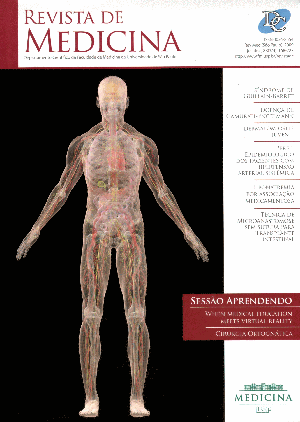
Quick-Time VRTM: when medical education meets virtual reality
DOI:
https://doi.org/10.11606/issn.1679-9836.v88i3/4p175-180Keywords:
Anatomy, Dissection, Histology, Education, medical, Radiology, SurgeryAbstract
Learning medicine is a difficult process to undertake, partially due to the complexity of the subject and limitations of traditional methods of teaching (lectures, textbooks, laboratory and anatomical dissections). These resources have been effective for decades, even though presenting intrinsic drawbacks. Textbooks are non-interactive education tools and do not provide any three dimensional experience. Cadaver dissection is an invaluable aid to learn anatomy. It provides an immersive, interactive experience allied with an inimitable tactile feedback. However, it has several limitations, including availability of specimens, costs and a substantial time commitment. Computer based virtual reality methods may overcome these drawbacks and provide interesting alternatives for medical training. Technological advances have generated great expectations for the use of computer-based virtual reality technologies in medical education, mainly anatomy and surgery. However, these Virtual Reality tools for general medical education are expensive due to the equipment necessary to create highly detailed, immersive three-dimensional image environments with real time friendly user interactivity. The concepts of Virtual Reality methods that generate immersive environments, as well as those that create simulated objects with interactive viewing features may be contemplated by the QuickTimeTM which is one of the technologies that can be successfully used for interactive, photorealistic displaying of medical images (radiological, anatomical and histological) and interaction on current generation of personal computers at a low and accessible cost. In this paper, the authors provide an overview of the Quick Time Virtual Reality methods aimingDownloads
Download data is not yet available.
References
Downloads
Published
2009-12-06
Issue
Section
Learning
How to Cite
Figueiredo, E. G., Faria, J. W. V. de, Ballester, G., & Teixeira, M. J. (2009). Quick-Time VRTM: when medical education meets virtual reality. Revista De Medicina, 88(3-4), 175-180. https://doi.org/10.11606/issn.1679-9836.v88i3/4p175-180