
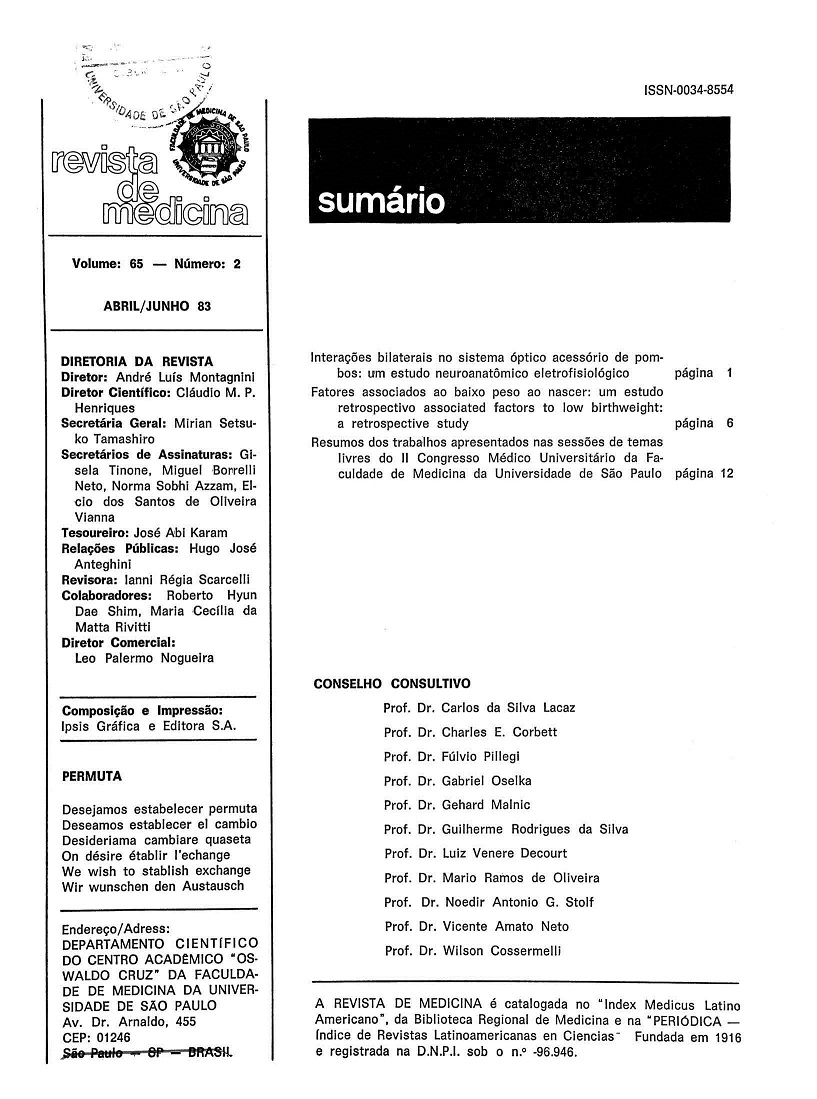
Interações bilaterais no sistema óptico acessório de pombos: um estudo neuroanatômico eletrofisiológico
DOI:
https://doi.org/10.11606/issn.1679-9836.v65i2p1-5Keywords:
sistema óptico acessório, estudo neuroanatômico, eletrofisiologia, sistema visual, pombosAbstract
The accessory optic system (AOS) has been object of extensive investigation in the last few years, mainly after the demonstration of its involvement whit visuomotor, and specially oculomotor, mechanisms. An interesting pattern that has emerged from these studies relates to the possible existence of reciprocai connections between the main accessory optic nuclei. The present study aimed to analyze this point of the functional organization of AOS in pigeons, by neuroanatomical andelectrophysiological methods. Electrophoretic injections of horseradish paroxidase (HRP) or wheat germ agglutinin-HRP (WGA-HRP) were made into the nucleus of the basal optic root (nBOR) of the AOS. In separate experiments, unitary and field potential recordings were performed in the same nucleus, while electrically stimulating the contralateral nBOR and optic nerve. The main results are summarized bellow. 1) Retrogradely labeled neurons were found in the contralateral nBOR, in its central, dorsal and lateral portions. 2) Electrical stimulation of nBOR could evoke field potentials in the contralateral nBOR, both anti-and orthodromic. 3) nBOR unitary activity could be abolished, depressed or even slightly increased by pulses applied in the contralateral nBOR. Inhibition by long periods was the dominant pattern in these experiments, and could also be observed upon optic nerve evoked firing. The above data confirm the existence of reciprocai connections between main accessory optic nuclei in pigeons, besides indicating that nBOR receives a powerful influence from its contralateral counterpart. This could represent an important mechanism in oculomotor control functions in birds and perhaps other vertebrates as well.
Downloads
Download data is not yet available.
References
Downloads
Published
1983-12-30
Issue
Section
Não definida
How to Cite
Cukiert, A., Azevedo, T. A., & Brito, L. R. G. (1983). Interações bilaterais no sistema óptico acessório de pombos: um estudo neuroanatômico eletrofisiológico. Revista De Medicina, 65(2), 1-5. https://doi.org/10.11606/issn.1679-9836.v65i2p1-5