
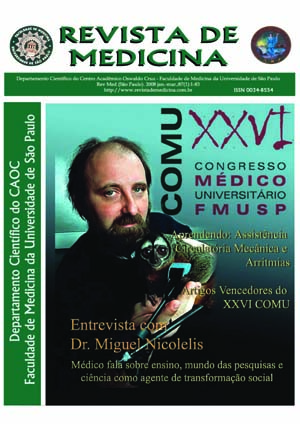
Mechanical circulatory support: why and when
DOI:
https://doi.org/10.11606/issn.1679-9836.v87i1p1-15Keywords:
Heart failure congestive/pathology, Assisted circulation/methods, Heart transplantation/trends, Risk factors, Quality of lifeAbstract
Heart failure has advanced throughout last years due to the aging of population,the higher survival rate after acute myocardial infarction due to trombolitics use, the advance inheart surgeries and the improvement in cardiomyopathies diagnosis. The disease has no cureand its natural course is unavoidable, despite different attempts to change it. The best until now isretarding its outcome. Heart transplant currently represents the only way to drastically change thisscenery, by offering signifi cative improvement in quality of life and in long-term survival. However,the procedure is limited to few people, mainly because of the scantiness of organ donors. Manypatients die waiting for the surgery. Mechanical circulatory support arises as an artifi cial supportthat allows many to reach the transplant, working as bridge to the procedure. In acute cases ofheart failure, in which the myocardium shows recovery conditions, the mechanical support allowsoffering propitious hemodynamic conditions for the patient not to develop multiple organ failureand for the myocardium in relative rest to have recovery conditions. This last form is called bridgeto recovery. Recently, the use of artifi cial ventricles and hearts as therapy, such as defi nitiveimplant in those patients who have counterindication to the transplant or refuse the procedure, isunder discussion. The aim of the present article is to show a wide review about the roll that themechanical circulatory support plays as an assistant method in the treatment of heart failure.Downloads
Download data is not yet available.
References
Downloads
Published
2008-03-18
Issue
Section
Learning
How to Cite
Fiorelli, A. I., Oliveira Junior, J. de L., Coelho, G. H. B., & Rocha, D. C. da. (2008). Mechanical circulatory support: why and when. Revista De Medicina, 87(1), 1-15. https://doi.org/10.11606/issn.1679-9836.v87i1p1-15