
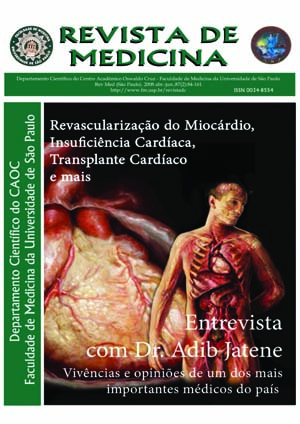
Heart failure and heart transplantation
DOI:
https://doi.org/10.11606/issn.1679-9836.v87i2p105-120Keywords:
Heart failure/physiopathology, Heart failure/epidemiology, Heart transplantation, Clinical evolution, Survival analysis.Abstract
Heart failure is a complex syndrome defined by the failure of the heart to provide adequate supply of blood to the needs metabolic tissue, or do so through high pressure of filling. Generally, results from structural or functional dysfunction of the heart that compromises itsability to contain the volume of filling diastolic blood or perform their ejection. It is characterized by ventricular dysfunction and changes in Neurohumoral regulation, accompanied by symptoms of fatigue for the efforts, water retention and reduction in life expectancy. In our environment, the survival of heart failure with clinical treatment is estimated at 84%, 63% and 52% in one, two and five years respectively. It has been observed that heart failure presents a higher mortality than many forms of cancer such as bladder, breast and prostate, losing only to lung cancer. In the advanced stage of the disease heart transplantation is the only form of treatment able to restore the functions hemodynamic, improving quality of life for the survival. The method was employed initially by Barnard in 1967 and gained wide circulation with the introduction of the immunosuppressant cyclosporine in the scheme. However, along side the advantages offered by the transplant there are important limitations that prevent its spread universal to patients with terminal heart failure. Among them should be emphasized the lack of viable donor, the nonspecific immunosuppression, contra-indications medical and psychosocial.Downloads
Download data is not yet available.
References
Downloads
Published
2008-06-19
Issue
Section
Learning
How to Cite
Fiorelli, A. I., Coelho, G. H. B., Oliveira Junior, J. de L., & Oliveira, A. S. (2008). Heart failure and heart transplantation. Revista De Medicina, 87(2), 105-120. https://doi.org/10.11606/issn.1679-9836.v87i2p105-120