
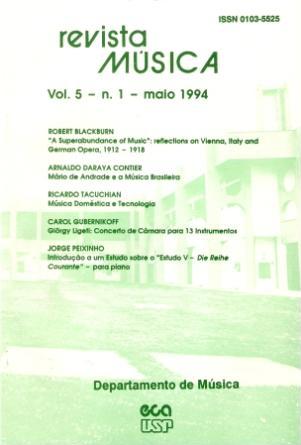
"A Superabundance of Music": Reflections on Vienna, Italy and German Opera, 1912-1918
DOI:
https://doi.org/10.11606/rm.v5i1.55069Resumo
In the decade 1912-22, the rising stars of Gernan opera were both Austrians: Franz Schreker, born in 1878, and the very young Erich Korngold, born in 1897. It is Christopher Hailey's new biographical study of Schreker which prompts this essay. I shall be looking here at a group of works that belong to the dying years of the "Italian Renaissance" or "Renaissanceism" boom on the German stage, a fashion dating back to the 1870s.
Downloads
Referências
Quartet in Barbara Tuchman: The Proud Tower : aportrait of the world before the war, 1890-1914. Macmillan 1966, p. 301.
Ernst Krause: Richard Strauss: The Man and his work. Collet, London 1964, p.299.
Paul Bekker: Elektra: Studie (Neue Musik Zeitung 14, 16, 18 of 1909). Tr. Susan Gillespie in Bryan Gilliam (ed) Richard Strauus and his World. Princeton UP 1922, pp. 372-405.
Michael Kennedyin Strauss(J.M. Dent London 1974), pp. 157-8 and in a 1993 BBC broadcast, referring to the 1916 version.
Franz Schreker 1878-1934: a cultural biography. Cambridge UP 1993.
Edward Timms and David Kelley (eds) Unreal City: Urban Experience in Modern European Literature and Art. Manchester UP 1985, ch. 15.
Vienna and the Jews 1867-1938: a cultural history. Cambridge UP 1988.
The text of Die gluckliche Hand first appeared in Der Merker 1911. Repr. in Jelena Hahl-Koch tr & ed Arnold Schoenberg/Wassily Kandinsky: Letters.Pictures, Documents. Faber 1984, pp. 91-98.
Pfitzner had conceived the Palestrina idea as early as 1895, when he was only
The Music of Hans Pjitzner. Oxford UP 1992, p. 148.
Hans Pfltzner uiMustc and Letters 1923, p. 127. Waiter's comment quoted by Erwin Kroll in Hans Pfltzner. Drei Masken Verlag, Munich 1924, pp. 47-8.
Pfitzner'smain sources were A.W. Ambros' Geschichte derMusikt 1878) and the histories of the Council of Trent by Sarpi and Pallavicini.
Tr. Anthony Beaumont in Busoni the Composer, Faber 1985. Beaumont has also set out, for the first time, the full chronology of Doktor Faust 's composition, from September 1916 to May 1923. Ibid. pp. 325-327.
Reflectionsofa non-political man. Tr. WalterD. Morris, Frederick Ungar. New York 1983, p. 300f.
See Jon Newsom: Hans Pfitzner, Thomas Mann and The Magic Mountain. Music & Letters 1974, pp. 139-50.
RudolfFelber: Hans Pjitzner. Musical Quarterly 1924, p. 137.
Paul Bekker Gesammelte Schriften. Deutsche Verlags Anstalt, Berlin 1992, Vol. 2, p. 275: Mann Reflections, p. 31l.
Arthur Eloesser: Deutsche Literatur von del' Romantik bis zur Gegenwart. Cassirer, Berlin, 1931, p. 519.
Published in Pan 5, pp. 199-203.
First given at the Vienna Burgtheater in 1902, as a vehicle for Eleonore Duse, and presented in Berlin only nine days later. Published in Neue Rundschau 13 (1902), Heft 10, pp. 1040-80; bookversion Jena 1902.23.000 copies were sold by 1920.
Richard SpechtA rthurSchnitzler: DerDichterundsein fYerkFischer, Berlin, 1922, p. 184.
Hugo von Hofmannstha1: Gesammelte Werke: Gedichte und Lynische Dramen, p.139.
Hermann Brach: Hugo von Hofiuannsthal and his Time. The European Imagination 1860-1920 (tr. & ed. Michael Steinberg). Chicago UP, 1984, p. 130.
Hermann Bahr: Die Decadence, quoted in Ruprecht and Bansch (eds.) Literansche Manifeste der Jahrhundertwende. Stuttgart, 1970, p. 305.
Robert Musil: the Man witout Qualities. Tr. Wilkins & Kaiser, Seeker and Warburg. London 1955, Vol. 1, p. 92.
Strauss-Hafinannsthal Correspondence. Trad. & ed. Hammelmann and Rose, Collins, 1961. pJ.
Unpublished Memoirs of Julius Komgold, p. 184.
Mario Praz: the Romantic Agony. Oxford UP, 1935, p. 313.
C.J. Jatho, Berlin, 1916.
Richard ElImann: Oscar Wilde. Harnish Hamilton, 1987, p. 388.
Ibid., p. 247.
Lecture The Value of Art in Modern Life, qu Ellmann, p. 247.
Philipp Aronstein: Oscar Wilde: sein Leben und Lebenswerk. Deutsche Bibliothek in Berlin, 1922, p. 106.
(Walter) Kemp in Musikblatter des Anbruch, 1924. Reviewing the Aachen production.
Quasi unafantasia: Essays on Modern Music. Tr. Rodney Livingstone. Verso, 1992, p. 140. [orig. Suhrkamp, Frankfurt, 1959] The Berg-Schoenberg Correspondence (tr. and ed. Brand, Hailey and Harris). Macmillan 1987, p. 89n. (letter of I or 8 May 1912).
R. St. Hoffmann: Franz Schreker. E.P. Tal & Co, Leipzig & Vienna, 192L p. 16l.
Thomas Mann, tr. HT. Lowe-Porter, Doktor FallS/US.Seeker and Warburg 1949, p. 287.
Jurg Stenzl (ed.)Art Nouveau, Jugendsti/ und Musik. Atlantis Verlag, Zurich, 1980, p. 113f.
Haidy Schreker-Bures Horen, denken.fuhlen. Eigenverlag, n.d., p. 339, 41.
Opera or the Undoing of IVomen. Tr. Betsy Wing. Virago Press, 1989.
Die Fackel 389/90, quoted in Edward Timms, Karl Kraus: Apocalyptic Satirist, Yale UP, 1986, p. 92.
E. Timms and R. Robertson(eds.) Vienna 1900:fromAltenbergto Wittgesntein. Edinburgh UP, 1990, p. 87ff.
Spruche und Widerspruche, 1909, quo Timms, Karl Kraus. p. 83.
Waiter Gmeindl: Die Gezeichneten: Theniatische Analyse. Universal Edition, 1922.
Robert Prechtl Opern- Tod: OjJener Brief an Franz Schreker. Melos II (1921), pp. 51-56.
FromLuigi Firpo: Political Philosophy: Renaissance Utopianism (1957) in Eric Cochrane (ed.) The Late Italian Renaissance 15]5-1630. Macmillan, 1970, p. 153.
Ilsedore B. Jonas. tr. BettyCrouse, Thomas Mann and Italy. Alabama UP, 1979, pp. 33-34.
John Williamson: The Music of Hans Pfitzner. Oxford UP, 1922, p. 204.
Qu Edward Timms Karl Kraus, p. 198.
Downloads
Publicado
Edição
Seção
Licença
Direitos autorais (c) 1994 Robert Blackburn

Este trabalho está licenciado sob uma licença Creative Commons Attribution-NonCommercial-ShareAlike 4.0 International License.
Autores que publicam nesta revista concordam com os seguintes termos:
- Autores mantém os direitos autorais e concedem à revista o direito de primeira publicação, com o trabalho simultaneamente licenciado sob a CC Attribution-NonCommercial-ShareAlike 4.0 que permite o compartilhamento do trabalho com reconhecimento da autoria e publicação inicial nesta revista.
- Autores têm autorização para assumir contratos adicionais separadamente, para distribuição não-exclusiva da versão do trabalho publicada nesta revista (ex.: publicar em repositório institucional ou como capítulo de livro), com reconhecimento de autoria e publicação inicial nesta revista.
- Autores têm permissão e são estimulados a publicar e distribuir seu trabalho online (ex.: em repositórios institucionais ou na sua página pessoal) a qualquer ponto antes ou durante o processo editorial, já que isso pode gerar alterações produtivas, bem como aumentar o impacto e a citação do trabalho publicado (Veja O Efeito do Acesso Livre).
