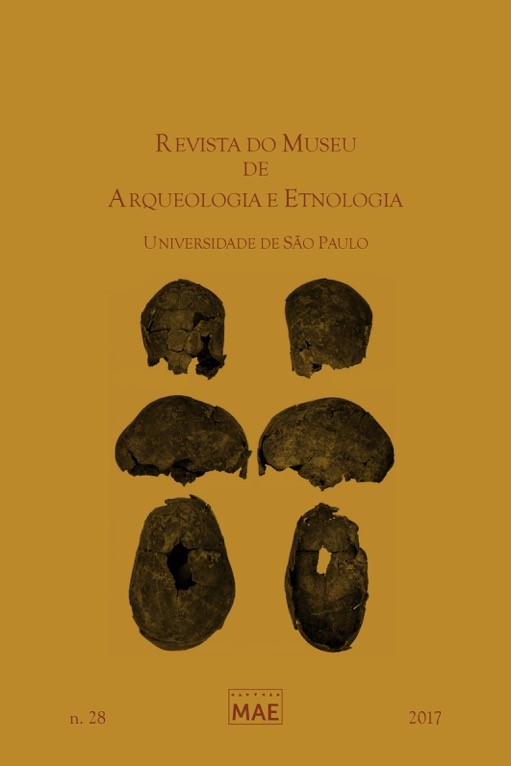
The practice of skull's individualization and decapitation in Lagoa Santa region during early Holocene (east-central Brazil).
DOI:
https://doi.org/10.11606/issn.2448-1750.revmae.2017.121839Keywords:
Archaeology, Anthropology, History, Lapa do Santo, Ritual.Abstract
Few Amerindian habits impressed the European colonizers more than the taking and displaying of human body parts, especially when decapitation was involved. In South America, the oldest decapitation is reported in the Andean region and dates to ca. 3000 BP at the site Asia 1, Peru. Since all other South American archaeological cases occur in the Andes (e.g., Nazca, Moche, Wari, Tiwanaku) it was assumed that decapitation was an Andean phenomenon, in both its origins and in its most unambiguous expression. In the present contribution we provide a literature review of the available evidence on the pre-historic practice of decapitation and skull individualization in South America. Here we report cases of individualized skulls found in Lapa do Santo and dated to 9000-9500 cal BP (95.4% interval). These cases, including the oldest case of decapitation in the New World, result in a re-evaluation of previous interpretations of these practices in South America on what concerns its origins and geographical distribution in the continent.
Downloads
References
Downloads
Published
Issue
Section
License
Copyright (c) 2017 Andre Strauss, Rodrigo Elias Oliveira

This work is licensed under a Creative Commons Attribution-NonCommercial-NoDerivatives 4.0 International License.