
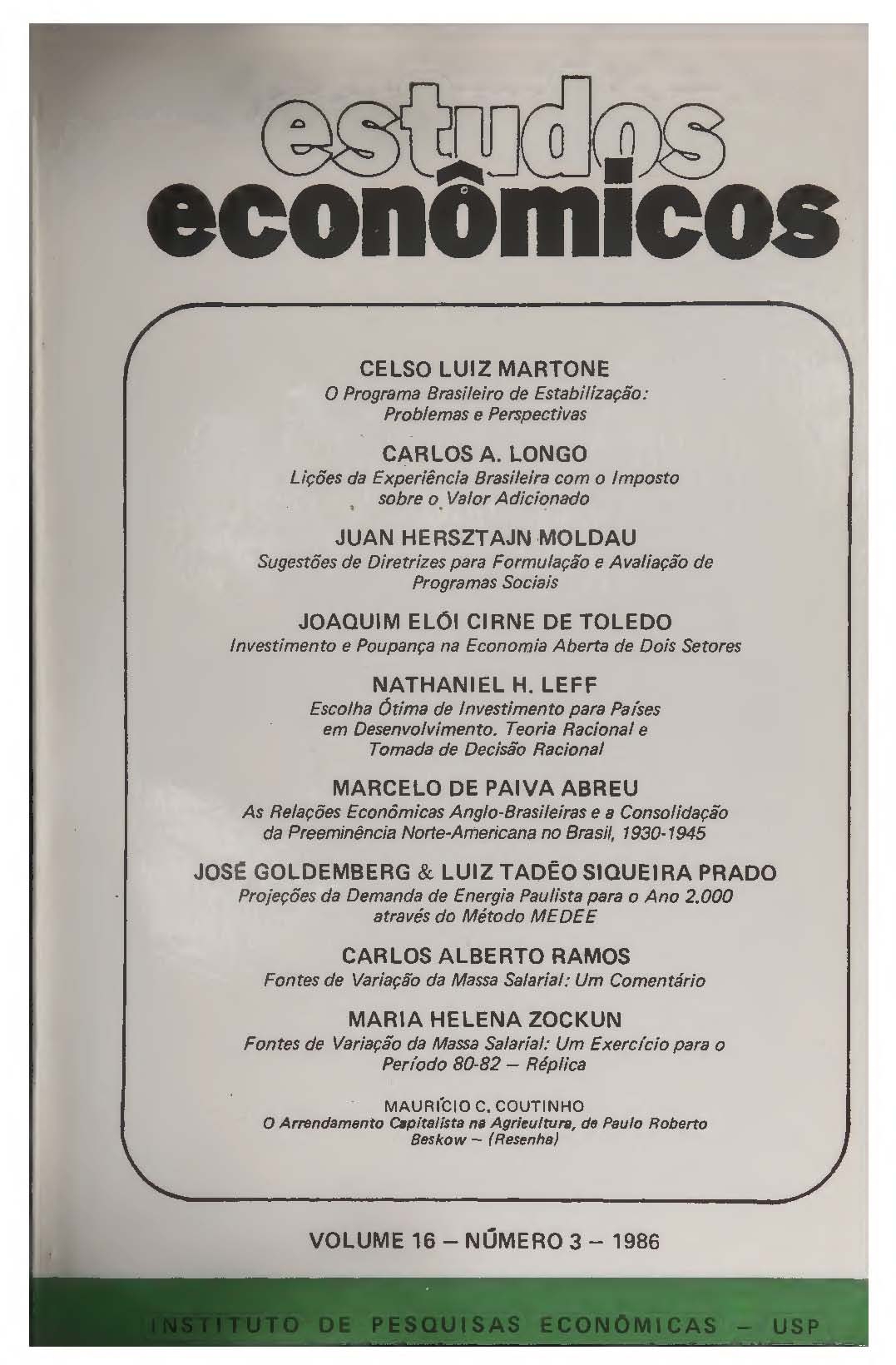
O programa brasileiro de estabilização: problemas e perspectivas
DOI:
https://doi.org/10.11606/1980-53571631clmAbstract
This paper analyses the Brazilian stabilization program of February 28 and discusses its main implications and problems. The analysis is qualitative, since the paper was written one month after the "monetary reform" A reference model is used to evaluate the non-neutrality of the reform regarding relative prices, functional and sectoral income distribution, and the volume of output and employment. Then specific aspects of the program are analysed, such as the adjustment in the financial sector, the prospect for the public sector deficit, the lifting of the price freeze, the de-indexation of the economy, and the recovery of private investment. As a plan of high risk, it is argued that the Cruzado Plan will require a consistent and competent macroeconomic policy in the following six to nine months to avoid the accumulation
Downloads
References
Downloads
Published
Issue
Section
License
Copyright (c) 1986 Celso L. Martone

This work is licensed under a Creative Commons Attribution-NonCommercial 4.0 International License.
By submitting an article, the author authorizes its publication and attests that it has not been submitted to any other journal. The original article is considered final. Articles selected for publication are proofread for grammatical and orthographic errors. The journal does not pay rights for published articles. The Institute of Economic Research from the School of Economics, Business and Accounting of the University of São Paulo (Instituto de Pesquisas Econômicas da Faculdade de Economia, Administração e Contabilidade da Universidade de São Paulo) owns the journal's copyright.


 Atualizado em 14/08/2025