
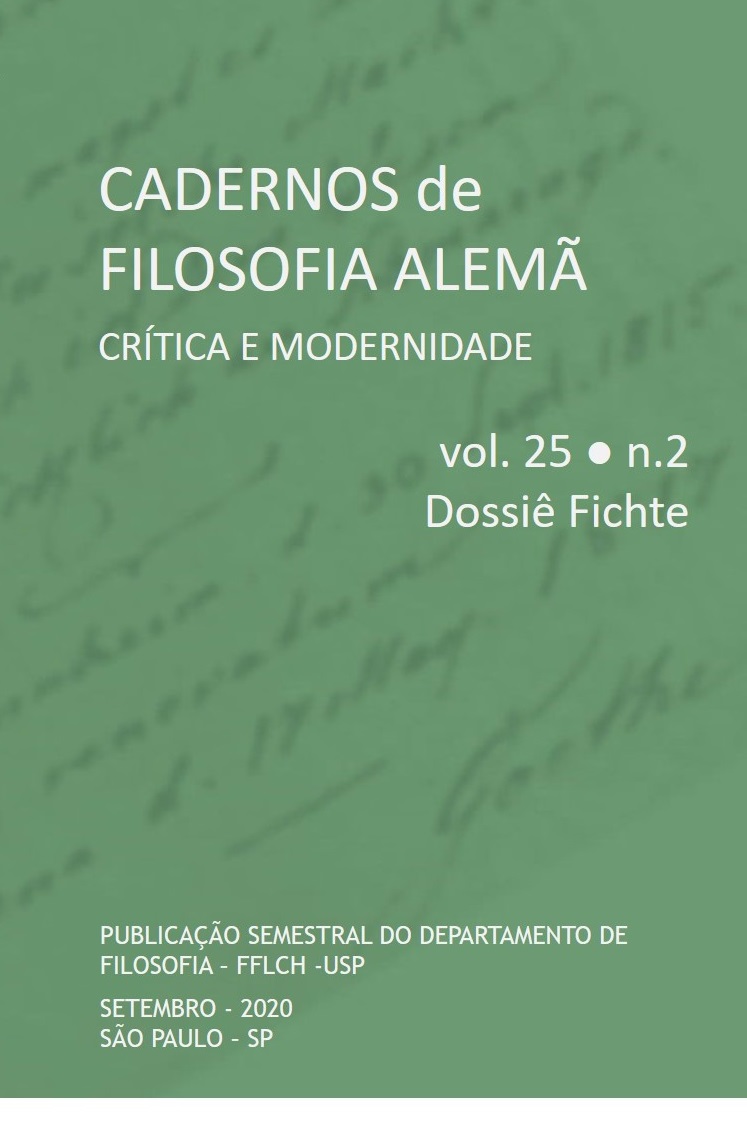
The centrality of Education in Fichte’s Addresses
DOI:
https://doi.org/10.11606/issn.2318-9800.v25i2p67-84Keywords:
Fichte, Education, Philosophy, People, NationAbstract
In this paper, we want to show that education is an important topic for Fichte, but it only achieves centrality in Addresses to the German Nation (1807-1808). For that reason, in first place, different works by the philosopher – where education appears related to various issues that are not solved – are analyzed. In second place, the centrality of the spiritual formation in the Addresses as a generator of the people and the nation – which are ambiguous concepts and to be produced – is exposed. Also, there is a contrast between ancient and new education, and its moral and religious dimensions. In third place, Fichte’s connection between education and true philosophy is examined.
Downloads
References
Fuentes, traducciones y abreviaturas:
Obras completas de Fichte
Fichte, J. G. (1962 ss.). Gesamtausgabe der Bayerischen Akademie der Wissenschaften. Hrsg. R. Lauth, H. Jacob, M. Zahn, y otros. Stuttgart: Fromman. Indicamos: serie / tomo y página. [GA]
Fichte, J. G. (1971). Sämmtliche Werke. Hrsg. I. H. Fichte. Berlín: W. de Gruyter. Indicamos tomo y página. [FSW]
Obras y traducciones de Fichte
Fichte, J. G. (1793). Zurückforderung der Denkfreiheit. En FSW VI 1-35.
Fichte, J. G. (1793). Beitrag zur Berichtigung der Urtheile des Publicums über die französische Revolution. En FSW VI 37-288.
Fichte, J. G. (1794). Einige Vorlesungen über die Bestimmung des Gelehrten. En GA I/3 23-74.
Fichte, J. G. (1794-5). Grundlage der gesammten Wissenschaftslehre. En GA I/2 249-451.
Fichte, J. G. (1796 ss.). Wissenschaftslehre nova methodo - Halle. En GA IV/2 17-266.
Fichte, J. G. (1796-7). Grundlage des Naturrechts nach Principien der Wissenschaftslehre. En GA I/3 313-460, GA I/4 5-165. [GNR]
Fichte, J. G. (1797). Erste Einleitung in die Wissenschaftslehre. En GA I/4 183-208.
Fichte, J. G. (1797). Zweite Einleitung in die Wissenschaftslehre. En GA I/4 209-269.
Fichte, J. G. (1798). Versuch einer neuen Darstellung der Wissenschaftslehre. En GA I/4 271-281.
Fichte, J. G. (1798). Das System der Sittenlehre. En GA I/5 21-317 [SSL]
Fichte, J. G. (1798-9). Wissenschaftslehre nova methodo - Krause. En GA IV/3 323-523.
Fichte, J. G. (1800). Die Bestimmung des Menschen. En GA I/6 189-309.
Fichte, J. G. (1800). Der geschlossene Handelsstaat. En GA I/7 38-141.
Fichte, J. G. (1802). Philosophie der Maurerei. Briefe an Konstant. En GA I/8 409-462.
Fichte, J. G. (1804-5). Die Grundzüge des gegenwärtigen Zeitalters. En GA I/8 191-396.
Fichte, J. G. (1805). Ueber das Wesen des Gelehrten. En GA I/8 59-139.
Fichte, J. G. (1807-8). Reden an die deutsche Nation. En GA I/10 99-298. [RDN]
Fichte, J. G. (1976). Los caracteres de la edad contemporánea. Traducción de J. Gaos. Madrid: Revista de Occi¬dente. [CEC]
Fichte, J. G. (1984). Discursos a la nación alemana. Traducción de L. Acosta – M. Varela. Bs. As., Orbis – Hys¬pa¬mérica. [DNA]
Fichte, J. G. (1986). Reivindicación de la libertad de pensamiento. Traducción de cast. F. Oncina Coves. Madrid: Tecnos.
Fichte, J. G. (1991). El Estado comercial cerrado. Traducción de J. Franco Barrio. Madrid: Tecnos.
Fichte, J. G. (1994). Fundamento del derecho natural según los principios de la Doctrina de la Ciencia. Traducción de J. Villacañas, F. Oncina y M. Ramos. Madrid: Centro de Estudios Constitu¬cio¬nales. [FDN]
Fichte, J. G. (1997). Filosofía de la masonería. Traducción de F. Oncina Coves. Madrid: Istmo. [FM]
Fichte, J. G. (1998). Sobre la esencia del sabio y sus manifestaciones en el dominio de la libertad. Traducción de A. Ciria. Madrid: Tecnos. [SES]
Fichte, J. G. (2002). Algunas lecciones sobre el destino del sabio. Edición bilingüe, Traducción de F. Oncina Coves – M. Ramos. Madrid: Istmo. [DS]
Fichte, J. G. (2005). Ética. Traducción de J. Rivera de Rosales. Madrid: Akal. [E]
Fichte, J. G. (2017). Lecciones de filosofía aplicada. Doctrina del Estado. Traducción de S. Turró. Salamanca: Sígueme. [LFA]
Bibliografía secundaria:
Altman, M. (2008). The significance of the other in moral education: Fichte on the birth of subjectivity. History of Philosophy Quarterly, 25(2), pp.175-186.
Bacin, S. (2009). “Filosofía aplicada: la idea de Fichte para una nueva Universidad”. Traducción de L. Rivera León. En Oncina Coves, F. (ed.). Filosofía para la Universidad, filosofía contra la Universidad. (De Kant a Nietzsche). Madrid: Universidad Carlos III – Dykinson, pp. 199-232.
Balibar, E. (2011). Fichte y la frontera interior. A propósito de los Discursos a la nación alemana. Traducción de A. Martínez Rodríguez y F. Remiro Elía. La Torre del Virrey: revista de estudios culturales, 10, pp. 11-23.
Baumann, U. (2011). „Der Staat und das Volk. Fichtes politischer Nationalismus“. En Zöller, G. (Hrsg.). Der Staat als Mittel zum Zweck. Fichte über Freiheit, Recht und Gesetz. Baden – Baden: Nomos, pp. 169-187.
Gaudio, M. (2017). La génesis de la intersubjetividad en la Reivindicación de Fichte. Thémata. Revista de filosofía, 56, pp. 83-102.
Heinz M. – Binkelmann C. (2012). „der innigste Vereinungspunct der Natur und der Ver¬nunft“. Untersuchungen zu Fichtes Eherechts. En Heinz M. – Doyé S. (Hrsg.). Geslechter¬ordnung und Staat. Legitimationsfiguren des politischen Philosophie (1600-1850). Deutsche Zeitschrift für Philosophie n° 27. Berlín, pp. 251-270.
Hoffmann, T. S. (2019). Libertad hablada. Sobre las dimensiones teórico y pragmático-lingüísticas de la filosofía del lenguaje de Fichte. Ideas, revista de filosofía moderna y contemporánea, 9, pp. 14-33.
Oncina Coves, F. (2019). Fichte como educador. Argumenta philosophica. 2019/1. Barcelona: Herder, pp. 37-52.
Piché, C. (2005). Fichte, Schleiermacher y W. von Humboldt, sobre la creación de la Universidad de Berlín. Traducción de J. M. Cuartas R. Praxis filosófica, nueva serie, 21, pp. 129-155.
Rivera de Rosales, J. (2015). Fichte. La libertad es el fundamento del conocimiento y de la moral. Barcelona: RBA.
Senigaglia, Ch. (2015). „Geist und Natur in Fichtes Ethik“. En H. Girndt (Hrsg.). »Natur« in der Transzendentalphilosophie. Berlín: Duncker & Humblot, pp. 201-217.
Taver, K. (2012), Fichtes Bildungsideal in den Reden an die deutschen Nation (1808) und der Rückgriff auf Pestalozzis. Fichte-Studien, 36, pp. 417-429.
Traub, H. (2011). „Der Staat und die Erziehung. Die Entstehung von Fichtes staats- und erziehungsphilosophischem Denken aus dem Geist seiner frühen Predigten“. En G. Zöller (Hrsg.). Der Staat als Mittel zum Zweck. Fichte über Freiheit, Recht und Gesetz. Baden-Baden: Nomos, pp. 133-168.
Williams, R. R. (1992). Recognition. Fichte and Hegel on the Others. New York: State University of New York Press.
Downloads
Published
Issue
Section
License
Copyright (c) 2020 Mariano Lucas Gaudio

This work is licensed under a Creative Commons Attribution-NoDerivatives 4.0 International License.
Information and conceptions on the texts are complete responsibility of the authors.
All the articles submitted before July 5th 2018 and those published after July 2021 are licensed under a CC BY-NC-ND license – except those published between the aforementioned dates, which are under the CC BY-NC-SA license. The permission for the translation of the material published under the license CC BY-NC-ND by third parts can be obtained with the consent of the author.
Open access policies - Diadorim
Rules applied before July 5th 2018:
Presenting a submission to our Editorial Board implies granting priority of publication for “Cadernos de filosofia alemã”, as well as transferring the copyright of texts (once published), which will be reproduced only with the manifest authorization of the editors. Authors keep the right to reuse the texts published in future editions of their work, without paying any fees to "Cadernos”. We will not grant the permission to re-edit or translate the texts for third parts without agreement of the author.
