
Women Authorship in Horror Literature: Denouncement and Counterattack in Brazilian and Spanish Works
DOI:
https://doi.org/10.11606/issn.2525-8133.opiniaes.2024.224701Keywords:
Horror, Fantastic literature, Brazilian literature, Spanish literatureAbstract
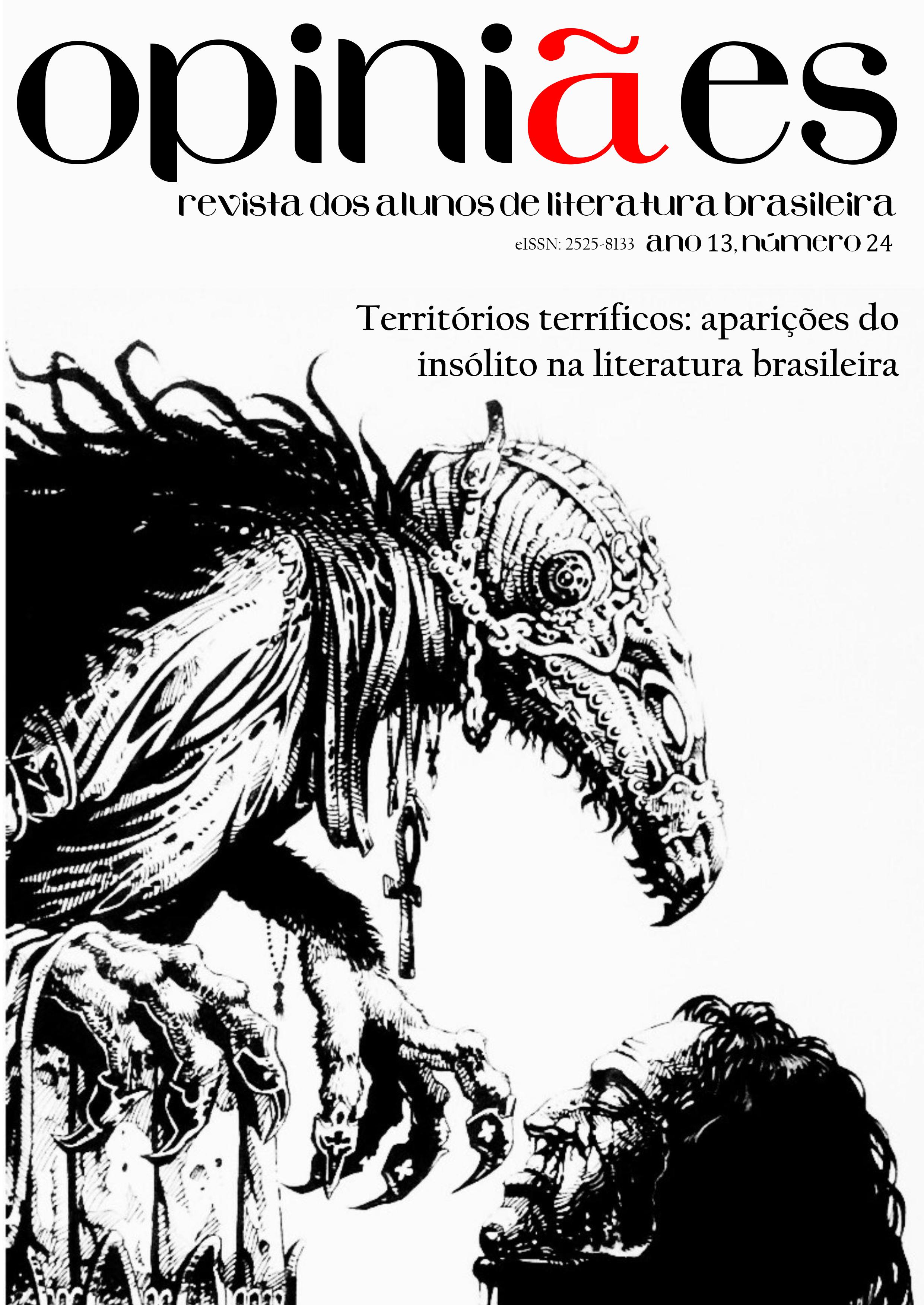
Adopting the perspective of horror as an autonomous genre, with of strategies, procedures and themes that aim to produce feelings related to the term horrere (Latin for “to shudder”, “to shiver”), the article intends to investigate nuances of women authorship through two fronts: denunciation and counterattack. To this end, the text consists of a section dedicated to conceptualizing horror as a literary genre, as well as its possible intersections with what Teresa López-Pellisa called the inappropriate/inappropriatable fantastic. Next, in the section called “Attack: realistic horror”, two short stories dealing with the imprisonment of female bodies will put into dialogue: “Venha ver o pôr do sol”, by the brazilian Lygia Fagundes Telles, and “Hablar con viejas”, by the spanish Cristina Fernández Cubas. And the section “Counterattack: horror and the fantastic” will propose a reckoning through the analysis of the novel Cupim, by the spanish Layla Martínez, put into dialogue with the short story “O título é um grito”, by the brazilian Nikelen Witter. In both works, we seek to demonstrate how the fightback only occurs because both rationality and the patriarchal system are put in check by the possibilities of the fantastic – always considering the chill inherent in horror.
Downloads
References
BURKE, Edmund. Uma investigação filosófica sobre a origem de nossas ideias do sublime e do gótico. Trad. João Pedro Bellas. In: FRANÇA, Júlio; NESTAREZ, Oscar; ZANINI, Claudio (org.). As artes do mal. Textos seminais. Rio de Janeiro: Acaso Cultural, 2024, pp. 102-112.
CARROLL, Noël. The Philosophy of Horror – Or the Paradoxes of the Heart. Nova York: Taylor & Francis e-Library, 1990.
CREED, Barbara. Return of the Monstrous – Feminine Feminist New Wave Cinema. Londres: Routledge, 2022.
CUBAS, Cristina Fernández. Hablar con viejas. In: La habitación de Nona. Barcelona: Tusquets, 2014.
FABRIZI, Mark A. (org). Horror Literature and Dark Fantasy: Challenging Genres. Boston: Brill, 2018.
LÓPEZ-PELLISA, Teresa. Lo fantastico inapropiado/able: Una Propuesta más allá del feminismo. In: VIDAL, Borja Cano; CANELO, Marta Pascua; PASTOR, Sheila (Orgs.). Sujetos precarios en las literaturas hispánicas contemporáneas. Madrid: Peter Lang, 2022, pp. 33-48.
MARTÍNEZ, Layla. Cupim. Tradução: Joana Angélica d’Avila Melo. São Paulo: Alfaguara, 2024.
NICKEL, Philip J. Horror and the Idea of Everyday Life: On Skeptical Threats in Psycho and The Birds. In: FAHY, Thomas. The Philosophy of Horror. Lexington: The University Press of Kentucky, 2010, pp. 14-32.
REYES, Xavier Aldana (org). Horror: A Literary History. Londres: The British Library, 2016.
RICHTER, Anne. Le fantastique féminin d’Ann Radcliffe à nos jours. Marabout: Verviers, 1977.
ROAS, David. The Female Fantastic vs. The Feminist Fantastic: Gender and the Transgression of the Real. CLCWeb: Comparative Literature and Culture, v. 22, n. 4, 2020. Disponível em: https://doi.org/10.7771/1481-4374.3690. Acesso em: 2 ago. 2024.
SAFIOTTI, Heleieth. Gênero, patriarcado, violência. São Paulo: Expressão Popular; Fundação Perseu Abramo, 2015.
TELLES, Lygia Fagundes. Venha ver o pôr do sol. In: Os melhores contos brasileiros – volume 1. São Paulo: LeBooks, 2018.
TRIEBEL, Doreen. Manipulating Empathic Responses in Horror Fiction. In: KATTELMAN, Beth A; HODALSKA, Magdalena (Orgs.). Frightful Witnessing: The Rhetoric and (Re)Presentation of Fear, Horror and Terror. Oxford: Inter-Disciplinary Press, 2014.
WITTER, Nikelen. O título é um grito. In: GRUBER, Daniel; BARRIOS, Irka. O novo horror. Novo Hamburgo: O Grifo, 2021.
Downloads
Published
Issue
Section
License
Copyright (c) 2024 Oscar Andrade Lourenção Nestarez

This work is licensed under a Creative Commons Attribution 4.0 International License.
A revista Opiniães não exerce cobrança pelas contribuições recebidas, garantindo o compartilhamento universal de suas publicações. Os autores mantêm os direitos autorais sobre os textos originais e inéditos que disponibilizarem e concedem à revista o direito de primeira publicação, com o trabalho simultaneamente licenciado sob a Licença Creative Commons Attribution que permite o compartilhamento do trabalho com reconhecimento da autoria e publicação inicial nesta revista.
