
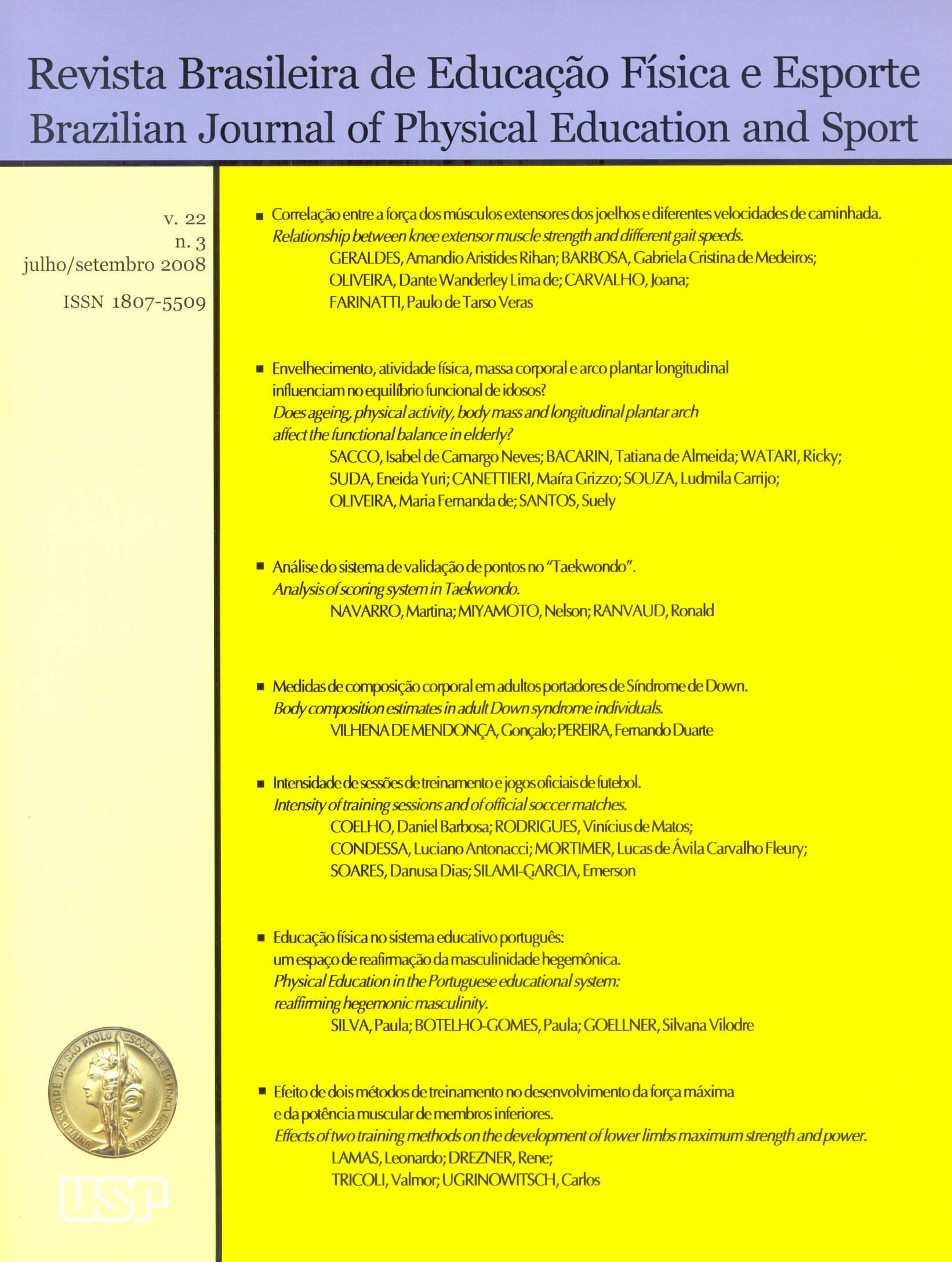
Effects of two training methods on the development of lower limbs maximum strength and power
DOI:
https://doi.org/10.1590/S1807-55092008000300007Keywords:
Strength, Squat, PowerAbstract
Maximum strength and power are considered complementary training methods in an athlete's training program. However, there are evidences of similar performance improvements in response to maximum strength training (ST) and power training (PT). The purpose of the present study was to compare the two training methods described in relation to their efficiency in increasing maximum strength and power in the half squat exercise. Twenty four physically active subjects (weight 76 ± 8.4 kg, height 178.2 ± 5.3 cm), with at least six months of strength training wash-out, were divided into two training groups, ST and PT. Pre and pos-training testing involved maximum dynamic strength (1 RM) and half squat power test with 30% 1 RM. After eight weeks of training (3x/week) we found that maximum strength increased significantly (p < 0.001) and similarly, 23% e 16% for ST and PT, respectively. Relative mean concentric power increased when both groups were pooled (p < 0.05). The main findings of this study were that ST and PT increased similarly both maximum strength and power.Downloads
Download data is not yet available.
Downloads
Published
2008-09-01
Issue
Section
naodefinida
License
Todo o conteúdo da revista, exceto onde está identificado, está licenciado sob uma Licença Creative Commons (CC-BY)
How to Cite
Lamas, L., Drezner, R., Tricoli, V., & Ugrinowitsch, C. (2008). Effects of two training methods on the development of lower limbs maximum strength and power . Brazilian Journal of Physical Education and Sport, 22(3), 235-245. https://doi.org/10.1590/S1807-55092008000300007
