
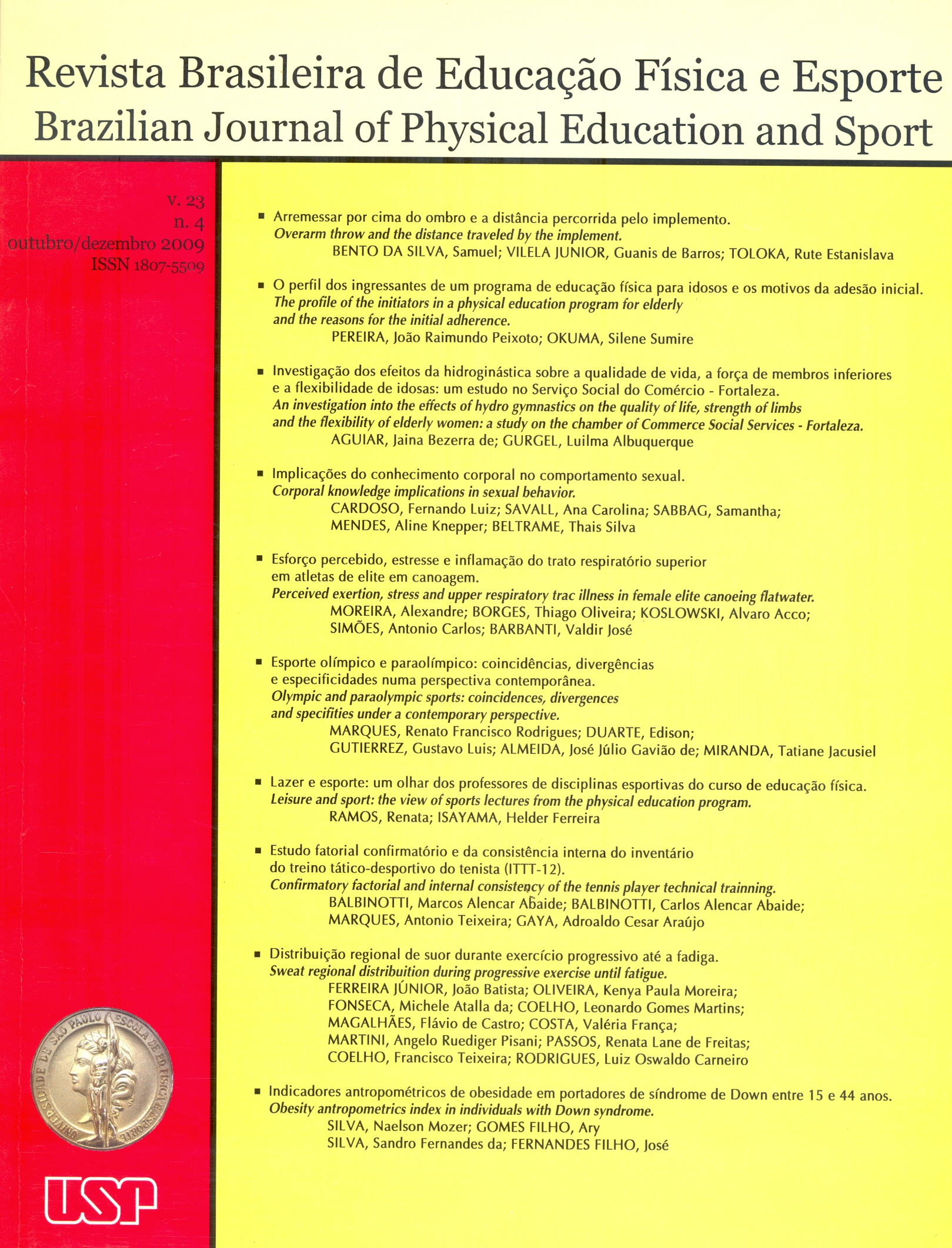
Corporal knowledge implications in sexual behavior
DOI:
https://doi.org/10.1590/S1807-55092009000400004Keywords:
Sexuality, Bodily feelings, Man, Woman, DiversityAbstract
This research aimed to identify and compare the corporeity and sexuality aspects of male (n = 54) and female (n = 54) participants with distinct sexual and gender orientations at the I Floripa Diversity Games, in Florianópolis, July/ 2006, using the Questionnaire of Body Identity - QIC anonymously. The main objectives of this study were to identify the differences in terms of corporeity and sexuality among men and women; women`s and men's sexual profile, as well as the profile of the corporal and sexual satisfaction for each sex. Participants who affirm to like their body tended to consider themselves beautiful and proportional and believe that they cause good impression. Participants with corporal satisfaction tended to be also sexually satisfied, however, when we controlled the sex factor, only males keep this correlation. Men demonstrate greater corporal intimacy while women value intimate caresses as foreplays. Participants with regular partner reach orgasm easier although women are more sensitive to body reactions.Downloads
Download data is not yet available.
Downloads
Published
2009-12-01
Issue
Section
naodefinida
License
Todo o conteúdo da revista, exceto onde está identificado, está licenciado sob uma Licença Creative Commons (CC-BY)
How to Cite
Cardoso, F. L., Savall, A. C., Sabbag, S., Mendes, A. K., & Thais Silva, B. (2009). Corporal knowledge implications in sexual behavior . Brazilian Journal of Physical Education and Sport, 23(4), 345-354. https://doi.org/10.1590/S1807-55092009000400004
