
Perfil antropométrico e fisiológico de atletas brasileiros de "rugby"
DOI:
https://doi.org/10.1590/S1807-55092011000300004Palabras clave:
Antropometria, Ergoespirometria, Teste de Wingate, Dinamometria isocinéticaResumen
O "Rugby" é um esporte bastante popular internacionalmente e em franca ascensão no Brasil. É caracterizado pela existência de duas posições táticas básicas ("forwards" e "backs"), cujos atletas apresentam demandas funcionais e características físicas distintas. Embora a literatura internacional apresente um número interessante de referências acerca do perfil antropométrico e fisiológico destes atletas, pouca atenção tem sido despendida aos atletas brasileiros. Assim, este trabalho teve como objetivo verificar o desempenho de 20 jogadores amadores de "Rugby" submetidos à ergoespirometria, teste de Wingate e Dinamometria isocinética bem como a comparação entre "backs" (n = 10) e "forwards" (n = 10) para verificar possíveis diferenças entre as posições táticas. Para determinação dos valores de VO2 e VCO2 foi utilizado um analisador de gases computadorizado (CPX-D; MedGraphics Cardiorespiratory Diagnostic Systems) para variáveis de força um dinamômetro isocinético Cybex Norm (Lumex & Co., Ronkonkoma, USA) e para comparações de composição corporal foi aplicada a técnica de cinco componentes da ISAK. A comparação entre os dados foi verificada por meio do teste t de Student para amostras independentes, sendo que para todas as variáveis foi adotado um índice de significância de p < 0,05. Os nossos resultados mostram uma diferença significativa entre "backs" e "forwards' nas variáveis VO2max (47,8 ± 4,5 e 38,8 ± 5,5 ml.kg-1.min-1) - 2º limiar ventilatório (38,3 ± 3,0 e 31,6 ± 4,2 ml.kg-1.min-1) - potência média (7,5 ±0,6 e 6,3 ±1,1 W.kg-1) e trabalho total (225,7 ± 18,4 e 187,9 ± 31,7 J.kg-1) - massa corporal (78,5 ± 9,5 e 101,6 ± 12,6 kg) Massa Adiposa (24,7 ± 3,2 e 29,7 ± 4,6%) Massa Muscular (48,7 ± 4,2 e 44,5 ± 3,4%) respectivamente (p < 0,05). Sendo assim, evidenciamos a existência de diferenças significativas em algumas das variáveis medidas entre atletas de "Rugby' conforme sua função no jogo. Essa evidência mostra que mesmo os atletas sendo de nível amador, as características fisiológicas, antropométricas e mecânicas são semelhantes quando comparadas aos jogadores de nível profissional.Descargas
Los datos de descarga aún no están disponibles.
Descargas
Publicado
2011-09-01
Número
Sección
Artigos Originais - Biodinâmica
Licencia
Todo o conteúdo da revista, exceto onde está identificado, está licenciado sob uma Licença Creative Commons (CC-BY)
Cómo citar
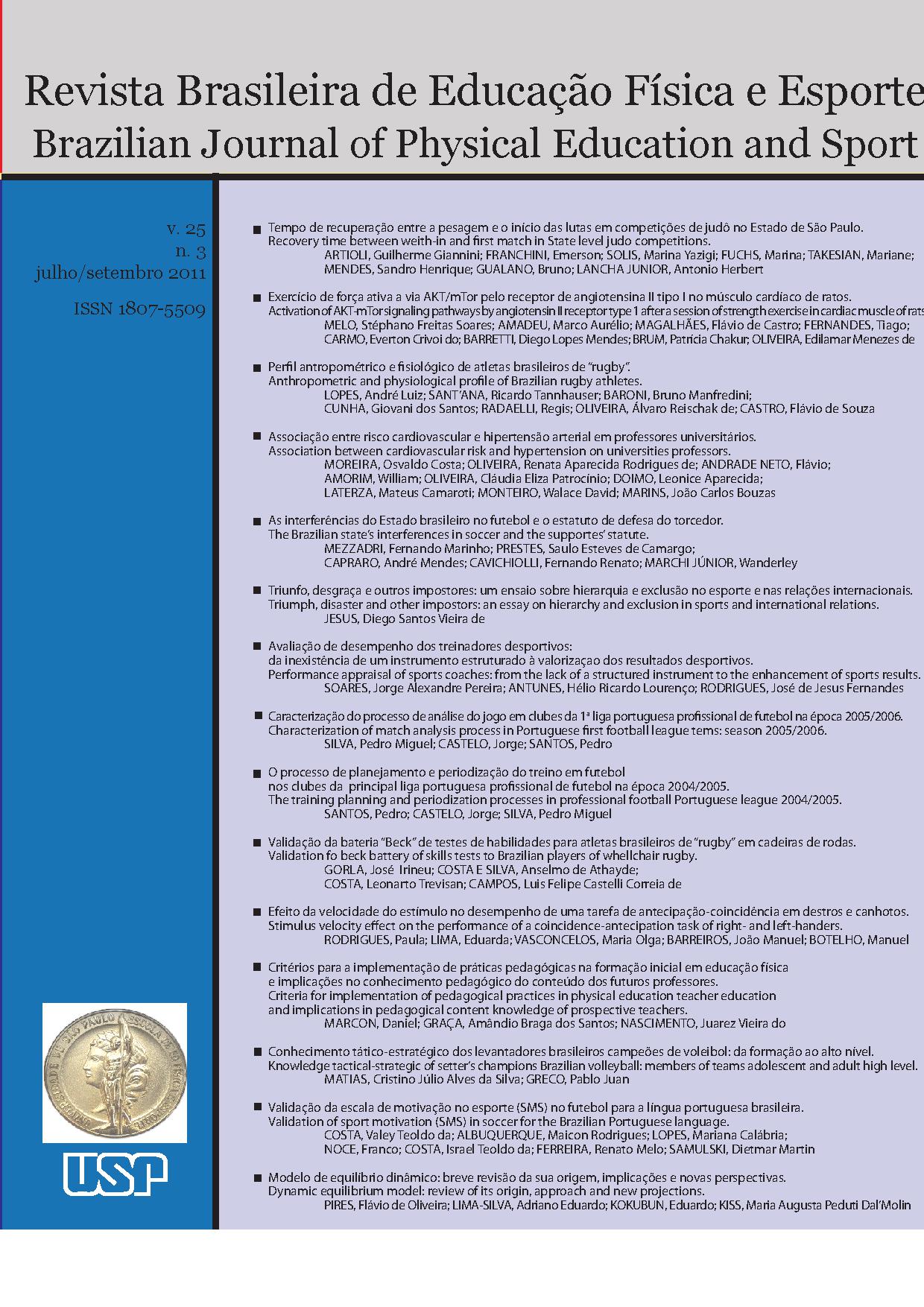
Lopes, A. L., Sant'Ana, R. T., Baroni, B. M., Cunha, G. dos S., Radaelli, R., Oliveira, Álvaro R. de, & Castro, F. de S. (2011). Perfil antropométrico e fisiológico de atletas brasileiros de "rugby" . Revista Brasileira De Educação Física E Esporte, 25(3), 387-395. https://doi.org/10.1590/S1807-55092011000300004
