
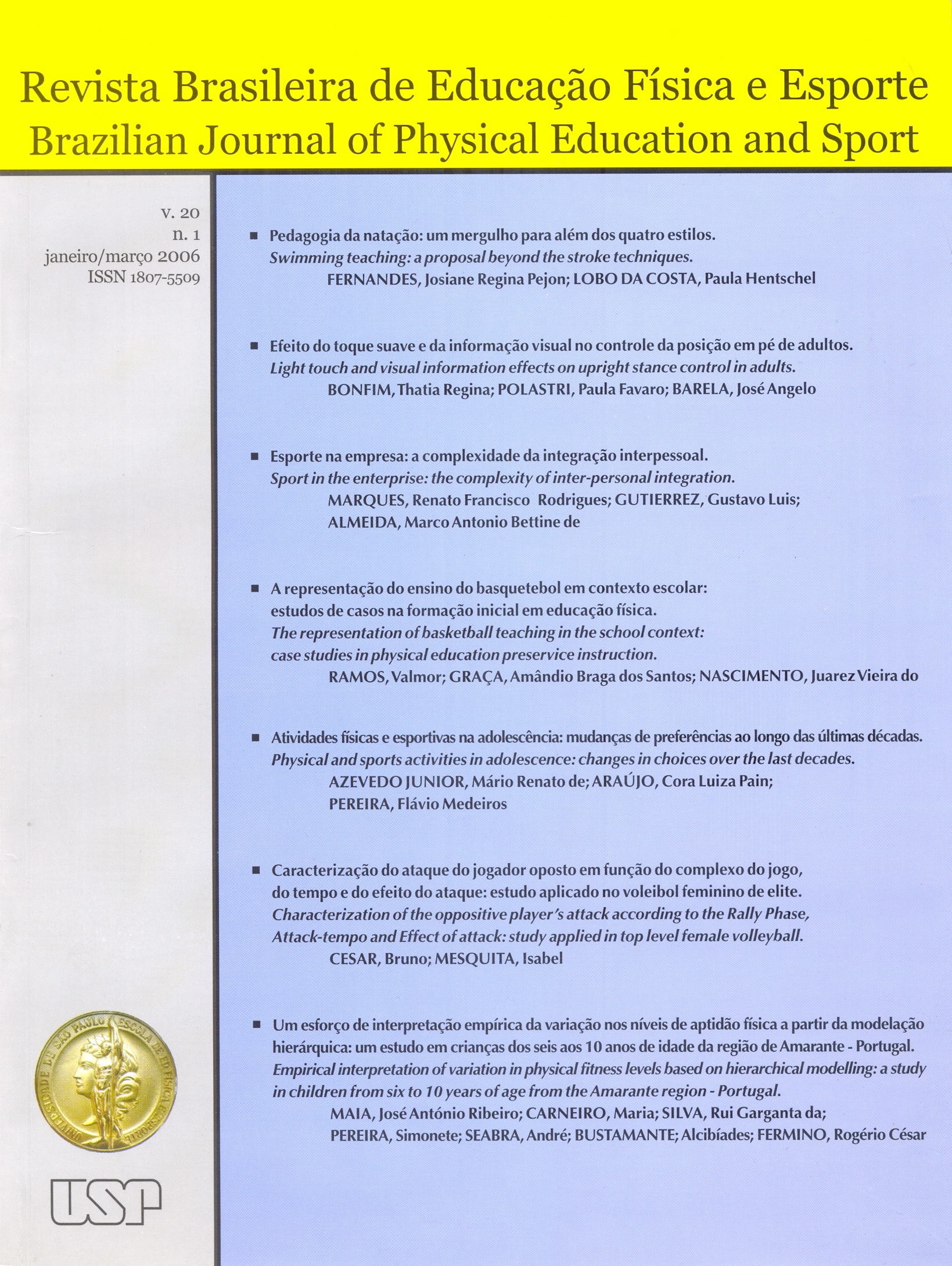
Empirical interpretation of variation in physical fitness levels based on hierarchical modelling: a study in children from six to 10 years of age from the Amarante region - Portugal
DOI:
https://doi.org/10.1590/S1807-55092006000100007Keywords:
Children, Physical fitness, Environment, Hierarchical modellingAbstract
The purpose of this study was to identify and interpret the meaning of several determinants in explaining heterogeneity in health-related physical fitness (AptFS), based on the approach of hierarchical modelling. Sample comprises 1.779 children of both sexes and aged 6 to 10 years from the county of Amarante, north of Portugal. Determinants considered were environmental conditions of schools, socio-geographical aspects, material and human resources. AptFS was assessed with the Fitnessgram test battery and physical activity (ActF) was estimated with the Godin & Shephard (1985) questionnaire. Data analysis was done with the HLM 6.02 software. We found the presence of a hierarchical data structure of students nested within schools which credits schools with a share of explained variance in AptFS results (0.05 < rho< 0.31). The greater variance occurred in the 1-mile run-walk, with age, sex, ActF and body mass index (BMI) as the most relevant predictors. Environmental conditions and other resources did not enter as significant covariates in any model. Main conclusions are: 1) the need of relying in hierarchical models to study informational complexity in AptFS; 2) the high interindividual variation in fitness levels; 3) the relevance of age, sex, ActF and BMI in explaining, at the children´s level their different fitness; 4) the absence of environmental effects. This calls for a more careful approach (mostly in the area of validity) when operationalization of environmental conditions. It is impossible that all the variability in children´s fitness relies on their characteristics.Downloads
Download data is not yet available.
Downloads
Published
2006-03-01
Issue
Section
naodefinida
License
Todo o conteúdo da revista, exceto onde está identificado, está licenciado sob uma Licença Creative Commons (CC-BY)
How to Cite
Maia, J. A. R., Carneiro, M., Silva, R. G. da, Pereira, S., Seabra, A., Bustamante, A., & Fermino, R. C. (2006). Empirical interpretation of variation in physical fitness levels based on hierarchical modelling: a study in children from six to 10 years of age from the Amarante region - Portugal . Brazilian Journal of Physical Education and Sport, 20(1), 71-82. https://doi.org/10.1590/S1807-55092006000100007
