
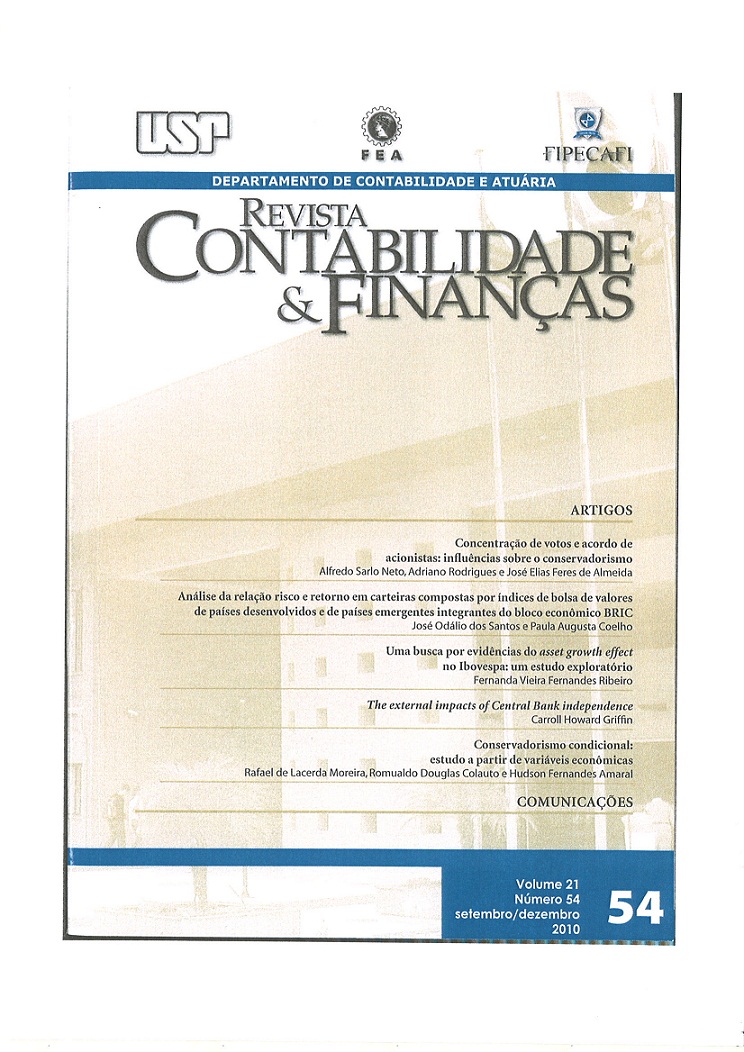
Concentração de votos e acordo de acionistas: influências sobre o conservadorismo
DOI:
https://doi.org/10.1590/S1519-70772010000300002Palabras clave:
Concentração de votos, Acordo de acionistas, Efeito entrincheiramento, Efeito enforcement, ConservadorismoResumen
Este estudo investiga como duas características da estrutura de propriedade das empresas brasileiras, a concentração de votos e o acordo de acionistas, estão associados com o conservadorismo condicional proposto por Basu (1997). Essa associação foi fundamentada pelos efeitos entrincheiramento e enforcement. Considerando que o grau de conservadorismo de uma firma está atrelado aos incentivos advindos de mecanismos que reduzem o risco informacional aos stakeholders, este estudo foi desenvolvido sobre a seguinte questão de pesquisa: Qual a influência da concentração de votos e do acordo de acionistas sobre o grau de conservadorismo nas empresas listadas na Bovespa? Cabe ressaltar que o objetivo principal deste trabalho é tratar de fatores ainda não abordados na literatura (nacional e internacional) produzida por essa linha de pesquisa, fornecendo evidências acerca da influência da estrutura de propriedade sobre o conservadorismo no mercado brasileiro, que possui conflito de agência entre acionistas majoritários (controlador) e minoritários. A amostra do trabalho perfaz 617 observações composta por empresas não financeiras negociadas na Bovespa durante o período de 2000 a 2008. Alternativamente, foi selecionada outra amostra desconsiderando as observações do ano de 2008, de forma a expurgar os efeitos da crise financeira registrada nesse ano. As evidências indicam que a concentração de votos contribui para diminuir o grau de conservadorismo, enquanto, por outro lado, o acordo de acionistas contribui para aumentar. Alternativamente, os resultados considerando o ano da crise global distorcem o funcionamento do modelo de Basu (1997). Espera-se que este estudo contribua para investidores, reguladores, pesquisadores e analistas no entendimento da função da informação contábil no processo de governança das firmas.Descargas
Los datos de descarga aún no están disponibles.
Descargas
Publicado
2010-12-01
Número
Sección
Artículos
Licencia
O conteúdo do(s) artigo(s) publicados na RC&F são de inteira responsabilidade do(s) autores, inclusive quanto a veracidade, atualização e precisão dos dados e informações. Os autores cedem, antecipadamente, os direitos autorais à Revista, que adota o sistema CC-BY de licença Creative Commons. Leia mais em: https://creativecommons.org/licenses/.
A RC&F não cobra taxa para a submissão de artigos. A submissão de artigo(s) à RC&F implica na autorização do(s) autor(es) para sua publicação, sem pagamento de direitos autorais.
A submissão de artigos autoriza a RC&F a adequar o texto do(s) artigo(s) a seus formatos de publicação e, se necessário, efetuar alterações ortográficas, gramaticais e normativas.
Cómo citar
Sarlo Neto, A., Rodrigues, A., & Almeida, J. E. F. de. (2010). Concentração de votos e acordo de acionistas: influências sobre o conservadorismo . Revista Contabilidade & Finanças, 21(54), 6-22. https://doi.org/10.1590/S1519-70772010000300002