
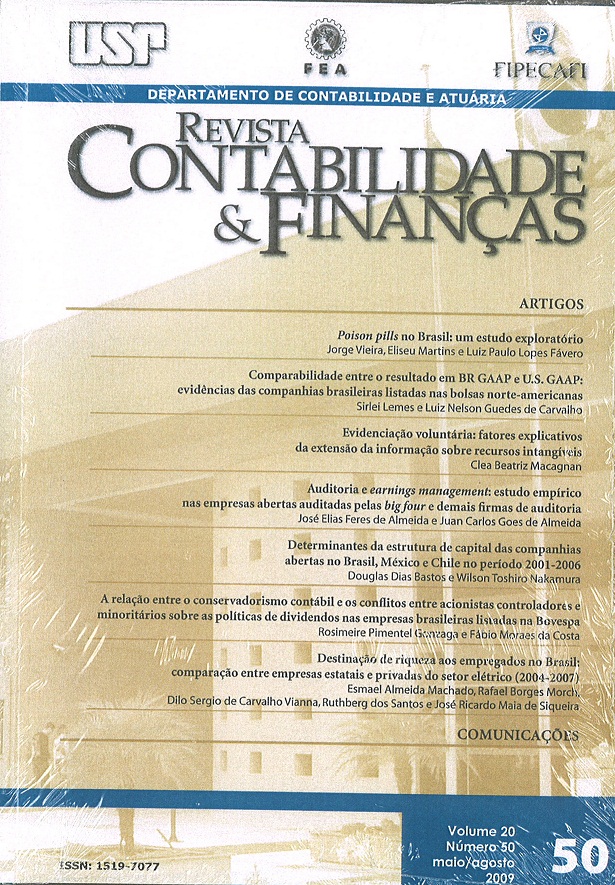
Destination of wealth for employees in Brazil: comparison between state and private companies in the electric sector (2004-2007)
DOI:
https://doi.org/10.1590/S1519-70772009000200008Keywords:
Energy sector, Distribution of wealth, Statements of cash flowsAbstract
Several studies compare the effects of privatization in state and private companies, where they discuss issues like economic efficiency and the social role of business. Many indicate that state enterprises are less efficient economically, but that they develop social responsibilities, including the distribution of income. Based on this information, this study aims to determine if there are significant differences among state and private enterprises in the electric sector, related to the distribution of wealth generated to employees. Data were collected from the Statement of Cash Flows and the Social Balance Sheet, for the period from 2004 to 2007. First, it was examined whether there was any difference in the percentage of the distribution of wealth generated for the employees. Then, it was checked if there was any difference in the number of employees from private and state companies. Finally, it was verified if there was any difference in average pay per capita. To examine this connection, Mann-Whitney's non-parametric test was used. The tests indicate that companies spend more on state officials than on private employees and that the origin of these differences is the amount of staff in 2006 and, additionally, higher earnings.Downloads
Downloads
Published
Issue
Section
License
The content of the article(s) published in the RC&F are of the entire liability of the authors, including with regard to the truth, updating and accuracy of data and information. The authors shall assign the rights in advance to the Department of Accounts and Actuarial Sciences of the FEA/USP, which shall permit the publication of extracts or of the whole, with prior permission, provided that the source is cited (Creative Commons – CCBY).
RC&F shall not charge a fee for the submission of articles. The submission of articles to RC&F shall imply that the author(s) authorizes/authorize its publication without the payment of author’s rights.
The submission of articles shall authorize the RC&F to adjust the text of the article(s) to their publication formats and if necessary, to make spelling, grammar and regulatory changes.