
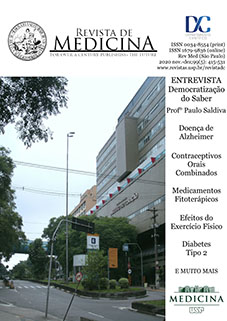
Knowledge of university students about the risks and benefits associated with combined oral contraceptives
DOI:
https://doi.org/10.11606/issn.1679-9836.v99i5p423-431Keywords:
Knowledge, Combined Oral Contraceptives, Risks and benefits, Medical Students, Women's Health, Contraceptives, oral, combined, Risk assessment, Students, medicalAbstract
Type of study: Descriptive cross-sectional observational study. Objective: To evaluate the knowledge of university students concerning the risks and benefits associated to combined oral contraceptives (COC). Methods: The study group consisted of a convenience sample of female medical students. Data was collected from October to November 2017 through a structured, self-applying questionnaire consisting of 30 questions divided into sociodemographic data, contraceptive antecedents and knowledge of risks and benefits associated with the use of COC. Results: 86 university students participated in this study. Most of them were aged between 18 and 25 years (76.74%), were COC users (86.05%) and started using it by medical indication (94.59%). Few of them knew the beneficial effects of COCs in the reduction of endometrial (31.40%), ovarian (18.60%) and colorectal (8.14%) cancers. On the other hand, knowledge of the risks of deep vein thrombosis (97.67%) and stroke (88.37%) was satisfactory. Additionally, more than half of the university students associated the use of COC with weight gain (56.98%). Conclusion: The imbalance between knowledge about COC risks and benefits cannot be underestimated, and it is relevant that health professionals identify COC benefits and side effects misconceptions in order to provide an effective contraceptive counselling.
Downloads
References
Dragoman MV. The combined oral contraceptive pill - recent developments, risks and benefits. Best Pract Res Clin Obstet Gynaecol. 2014;28(6):825-34. doi: http://dx.doi.org/10.1016/j.bpobgyn.2014.06.003.
Bryden PJ, Fletcher P. Knowledge of the risks and benefits associated with oral contraception in a university-aged sample of users and non-users. Contraception. 2001;63:223-7. doi: https://doi.org/10.1016/S0010-7824(01)00194-9.
United Nations. Trends in contraceptive use Worldwide 2015. Contraception. Available from: https://www.un.org/en/development/desa/population/publications/pdf/family/trendsContraceptiveUse2015Report.pdf.
World Health Organization, Department of Reproductive Health and Research (WHO/RHR) and Johns Hopkins Bloomberg School of Public Health/Center for Communication Programs (CCP), Knowledge for Health Project. Family Planning: A Global Handbook for Providers (2018 update). Baltimore and Geneva: CCP and WHO; 2018. Available from: https://www.who.int/reproductivehealth/publications/fp-global-handbook/en/.
Vessey M, Yeates D, Flynn S. Factors affecting mortality in a large cohort study with special reference to oral contraceptive use. Contraception. 2010;82(3):221-9. doi: http://dx.doi.org/10.1016/j.contraception.2010.04.006.
Bartz DA, Roe A, Douglas PS. Combined estrogen-progestin contraception: Side effects and health concerns. UpToDate. [cited December 2019]. Available from: https://www.uptodate.com.
Dragoman MV, Tepper NK, Fu R, Curtis KM, Chou R, Gaffield ME. A systematic review and meta-analysis of venous thrombosis risk among users of combined oral contraception. Int J Gynaecol Obstet. 2018;141(3):287-94. doi: http://dx.doi.org/10.1002/ijgo.12455 -9
Blidaru IE, Furau G, Socolov D. Female Romanian university students’ attitudes and perceptions about contraception and motherhood. Eur J Contracept Reprod Heal Care. 2016;21(1):39-48. doi: http://dx.doi.org/10.3109/13625187.2015.1066495.
Americo CF, Nogueira PSF, Vieira RPR, Bezerra CG, Moura ERF, Lopes MVO. Conhecimento de usuárias de anticoncepcional oral combinado de baixa dose sobre o método. Rev Lat Am Enfermagem. 2013;21(4):928-34. Disponível em: https://www.scielo.br/pdf/rlae/v21n4/pt_0104-1169-rlae-21-04-0928.pdf.
Martínez-Astorquiza-Ortiz de Zarate T, Díaz-Martín T, Martínez-Astorquiza-Corral T. Evaluation of Factors Associated with Noncompliance in Users of Combined Hormonal Contraceptive Methods: a Cross-sectional Study: Results from the MIA Study. BMC Womens Health. 2013;13:38. https://dx.doi.org/10.1186%2F1472-6874-13-38.
Chandra-Mouli V, McCarraher DR, Philips SJ, et al. Contraception for adolescents in low and middle income countries: needs, barriers and access. Reprod Health. 2014;11:1. doi: https://doi.org/10.1186/1742-4755-11-1.
National Institute of Educational Studies and Research Anisio Teixeira. Statistical Synopsis of Higher Education 2017. Brasília: INEP; 2018. Available from: http://inep.gov.br/sinopses-estatisticas-da-educacao-superior.
Ristoff D. The new profile of the Brazilian campus: an analysis of the undergraduate student’s socioeconomic profile. Evaluation: Rev Evaluation Educ Super. 2014;19(3):723-47. doi: http://dx.doi.org/10.1590/S1414-40772014000300010.
Silva ZP, Ribeiro MCSA, Barata RB, Almeida MF. Sociodemographic profile and pattern of use of health services in the Unified Health System (SUS), 2003-2008. Ciênc Saúde Coletiva. 2011;16(9):3807-16. doi: https://doi.org/10.1590/S1413-81232011001000016.
Instituto Nacional de Estudos e Pesquisas Educacionais Anísio Teixeira (INEPE). National Student Performance Exam - Course performance report (Medicine Federal University of Sao Carlos). Brasília; 2016. p.1-8. Available from: http://enadeies.inep.gov.br/enadeIes/enadeResultado/
Farias MR, Leite SN, Tavares NUL, Oliveira MA, Arrais PSD, Bertoldi AD, et al. Use of and access to oral and injectable contraceptives in Brazil. Rev Saude Publica. 2016;50(Suppl 2). doi: http://dx.doi.org/10.1590/s1518-8787.2016050006176.
Simionescu A, Horobet A, Belascu L. A statistical assessment of information, knowledge and attitudes of medical students regarding contraception use. Maedica (Buchar). 2017;12(4):267-75. Available from: https://www.ncbi.nlm.nih.gov/pmc/articles/PMC5879583/.
Carvalho M, Pirotta K, Chor N. Male participation in contraception from a female perspective. Rev Saúde Pública. 2001;35(1):23-31. doi: http://dx.doi.org/10.1590/S0034-89102001000100004.
Nogueira IL, Carvalho SM, Tocantins FR, Freire MAM. Man’s participation in reproductive planning: an integrative review. Rev Fund Care Online. 2018;10(1):242-7. doi: http://dx.doi.org/10.9789/2175-5361.2018.v10i1.242-247.
Santos MJO, Ferreira EMS, Ferreira MMC. Contraceptive behavior of Portuguese higher education students. Rev Bras Enferm. 2018;71(Suppl 4):1706-13. doi: http://dx.doi.org/10.1590/0034-7167-2017-0623.
Machiyama K, Huda FA, Ahmmed F, Odwe G, Obare F, Mumah JN, et al. Women’s attitudes and beliefs towards specific contraceptive methods in Bangladesh and Kenya. Reprod Health. 2018;15(1):1-15. doi: https://doi.org/10.1186/s12978-018-0514-7.
Tomaszewski D, Aronson BD, Kading M, Morisky D. Relationship between self-efficacy and patient knowledge on adherence to oral contraceptives using the Morisky Medication Adherence Scale (MMAS-8). Reprod Health, 2017;14(1):110. doi: https://doi.org/10.1186/s12978-017-0374-6.
Vogt C, Schaefer M. Disparities in knowledge and interest about benefits and risks of combined oral contraceptives. Eur J Contracept Reprod Health Care. 2011;16(3):183-93. doi: https://doi.org/10.3109/13625187.2011.561938.
Yang X, Li X, Wang Y, He X, Zhao Y. Practices and knowledge of female gynecologists regarding contraceptive use: a real-world Chinese survey. Reprod Health. 2018;15:1-6. doi: https://doi.org/10.1186/s12978-018-0557-9.
Philipson S, Wakefield CE, Kasparian N. Women’s knowledge, beliefs, and information needs in relation to the risks and benefits associated with use of the oral contraceptive pill. J Womens Health (Larchmt). 2011;20(4):635-42. doi: https://doi.org/10.1089/jwh.2010.2455.
Iversen L, Sivasubramaniam S, Lee AJ, Fielding S, Hannaford PC. Lifetime cancer risk and combined oral contraceptives: the Royal College of General Practitioners’ Oral Contraception Study. Am J Obstet Gynecol. 2017;216(6):580.e1-580.e9. doi: https://doi.org/10.1016/j.ajog.2017.02.002.
Mørch LS, Skovlund CW, Hannaford PC, Iversen L, Fielding S, Lidegaard Ø. Contemporary Hormonal Contraception and the Risk of Breast Cancer. N Engl J Med. 2017;377(23):2228-39. doi: https://doi.org/10.1056/NEJMoa1700732.
Calhoun AH, Batur P. Combined hormonal contraceptives and migraine: An update on the evidence. Cleve Clin J Med. 2017;84(8):631-8. doi: https://doi.org/10.3949/ccjm.84a.16033.
Casey PM, MacLaughlin KL, Faubion SS. Impact of contraception on female sexual function. J Women’s Health. 2017;26(3):207-13. doi: https://doi.org/10.1089/jwh.2015.5703.
Oelkers WK. Effects of estrogens and progestogens on the renin-aldosterone system and blood pressure. Steroids. 1996;61(4):166-71. doi: https://doi.org/10.1016/0039-128X(96)00007-4.
Downloads
Published
Issue
Section
License
Copyright (c) 2020 Lais Ferraz de Assis Pinto, Fernanda Vieira Rodovalho-Callegari, Maristela Carbol

This work is licensed under a Creative Commons Attribution-ShareAlike 4.0 International License.