“Constant dripping wears away the stone”: the path of waters in social catalysis in Colonial Brazil
DOI:
https://doi.org/10.11606/issn.2448-1750.revmae.2016.119017Keywords:
Archaeology of Colonialism, gold mining, indigenous slave labour, Archaeology of the Movement, Sacred ArchaeologyAbstract
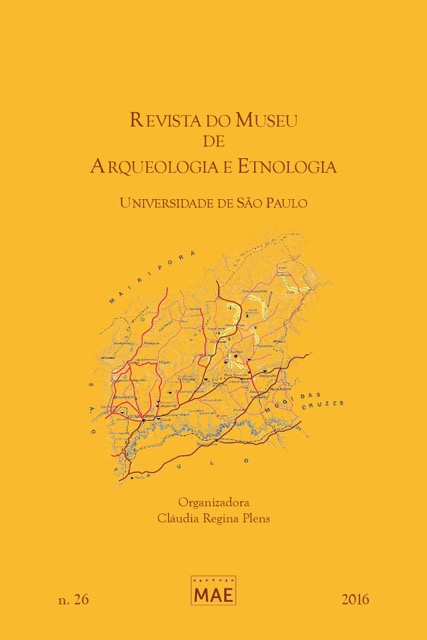
Guarulhos has many natural paths through hills, mountains, and a network of watersheds that allowed the Europeans to move around, enslave humans, and exploit local mineral resources. Besides the natural routes, Guarulhos (São Paulo, Brazil) gold mining archaeological remains (dated back to 1590 according to historical data) also show the great effort made by humans, especially indigenous people, for the construction of reservoirs and canals used for gold mining. Today’s region of Guarulhos is important for understanding the earliest forms of contact during the Portuguese colonization. The region sheds light on the interaction between Portuguese and indigenous groups, as well as the Portuguese strategies for territorial expansion. The purpose of this article is to point out how the mining process has been shaping the behavior of Guarulhos’s different segments of society since the beginning of this economic cycle to the present day.
Downloads
References
Downloads
Published
Issue
Section
License
Copyright (c) 2016 Claudia R. Plens, Vagner Carvalheiro Porto

This work is licensed under a Creative Commons Attribution-NonCommercial-NoDerivatives 4.0 International License.