
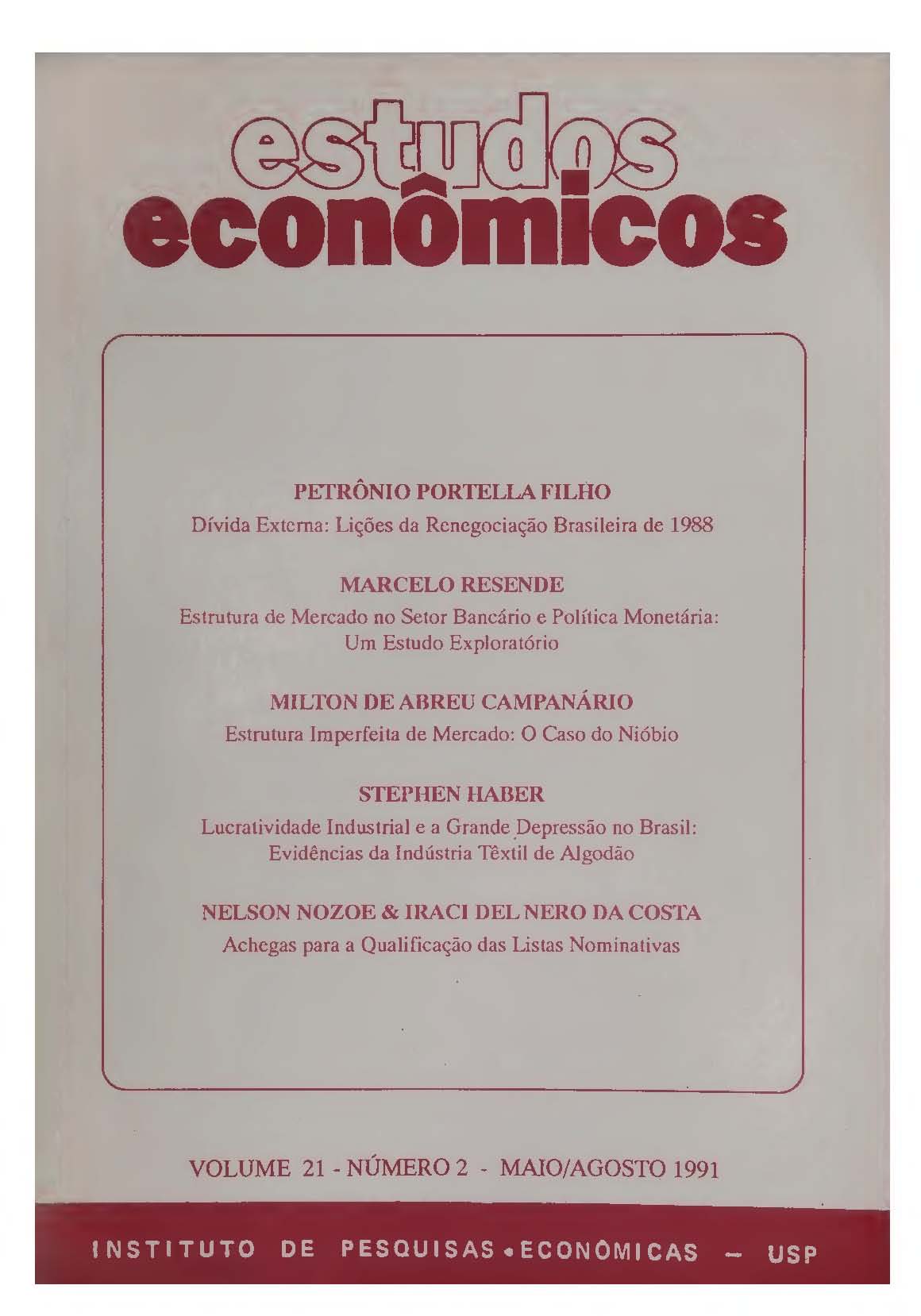
Lucratividade industrial e a grande depressão no Brasil: evidências da indústria têxtil de algodão
DOI:
https://doi.org/10.11606/1980-53572124shKeywords:
Industrialization, Industrial profitability, Cotton textile industry, Great DepressionAbstract
The purpose of this paper is to shed some light on at least part of the question about the effect of the depression on manufacturing enterprise in Latin America by going beyond the aggregate statistics to look at the experience of individual enterprises. This study concentrates on the case of Brazil, which, in the period after the First World War, had the largest and most industrialized economy of the region. Within the manufacturing sector this study is delimited to the most significant and best developed industry: cotton textiles.
Downloads
References
DAVIS, Lance E. Sources of industrial finance: the American textile industry, a case study. Explorations in Entrepreneurial History, 9 (4): 189-203, abr. 1957.
DAVIS, Lance E. Stock ownership in the early New England textile industry. Business History Review 32 (2): Summer 1958.
DAVIS, Lance E. The New England textile mills and the capital markets: a study of industrial borrowing, 1%40-IS60. The Journal ofEconomic History, 20 (I): 1-30, mar. 1960.
FISHLOW, Albert. Origins and consequences of import substitution in Brazil. In: DIMARCO, Luis Eugênio (ed). International economics and development: essays in honor of Raul Prebisch. New York, Academic Press, 1972.
GALLMAN, Robert E. The United States capital stock in the nineteenth century. In: ENGERMAN, Stanley L. & GALLMAN, R. E. (eds.). Long term factor in American economic growth, Chicago, 1968.
GALLMAN, Robert E. Investment flows and capital stocks: U. S. experience in the nineteenth century. In: KILBY, Peter (ed.), Quantity and quiddity: essays in U. S. economic history. Middletown Connecticut, Wesleyan University Press, 1987.
HABER, Stephen. Industry and underdevelopment: the industrialization of Mexico, 1890-1940. Stanford, Stanford University Press, 1989.
IBGE. Séries estatísticas retrospectivas, vol I. Repertório estatístico do Brasil, Quadros restropectivos. (Separata do Anuário Estatistico do Brasil, Ano V, 1939/1940). Edição fac-similada, Rio de Janeiro, 1986.
IBGE. Estatisticas históricas do Brasil: séries econômicas, demográficas e socials, 1550 a 1988. Rio de Janeiro, 1990.
LAYER, Robert B. Earnings of cotton mill operatives, 1825-1914. Cambridge, Committee on Research in Economic History, 1955.
MCGOULDRICK, Paul, New England textiles in the nineteenth century: profits and investment. Cambridge, Harvard University Press, 1968.
NOZOE, Nelson Hideiki. São Paulo: economia cafeeira e urbanização. São Paulo, IPE-USP, 1984.
STEIN, Stanley. The brazilian cotton manufacture: textile enterprise in an underdeveloped area, 1850-1950. Cambridge, Harvard University Press, 1957.
SUZIGAN, Wilson. Industria brasileira: origem e desenvolvimento. Sao Paulo, Brasiliense, 1986.
THORP, Rosemary (ed.). Latin America in the 1930s: the role ofthe periphery in world crisis. New York, St. Martin's Press, 1984.
TOPIK, Steven. Thepolitical economy ofthe brazilian state, 1889-1930. Austin, 1987.
VERSIANI, FUvio Rebelo. Índices de produção industrial para a década de 1920: um reexame. Estudos Econômicos, 14 (1): 43-55, jan/abr 1984a.
TOPIK, Steven. Before the depression; brazilian industry in the 1920s. In: THORP, R. (ed ), Latin America in the 1930s: the role of the periphery in world crisis. New York, St. Martin's Press, 1984b.
TOPIK, Steven. A década de 20 na industrialização brasileira. Rio de Janeiro, 1987.
TOPIK, Steven. & VERSIANI, Maria Teresa R. O. A indústria brasileira antes de 1930: uma contribuição. In: VERSIANI, F. R. & BARROS, J. R. M. de (eds.), Formação econômica do Brasil: a experiência da industrialização. São Paulo, Saraiva, 1977.
VILLELA, Annibal Villanova & SUZIGAN, Wilson. Político do governo e crescimento da economia brasileira, 1889-1945. Rio de Janeiro, IPEA/INPES, 1975.
Downloads
Published
Issue
Section
License
Copyright (c) 1991 Stephen Harber

This work is licensed under a Creative Commons Attribution-NonCommercial 4.0 International License.
By submitting an article, the author authorizes its publication and attests that it has not been submitted to any other journal. The original article is considered final. Articles selected for publication are proofread for grammatical and orthographic errors. The journal does not pay rights for published articles. The Institute of Economic Research from the School of Economics, Business and Accounting of the University of São Paulo (Instituto de Pesquisas Econômicas da Faculdade de Economia, Administração e Contabilidade da Universidade de São Paulo) owns the journal's copyright.


 Atualizado em 14/08/2025