
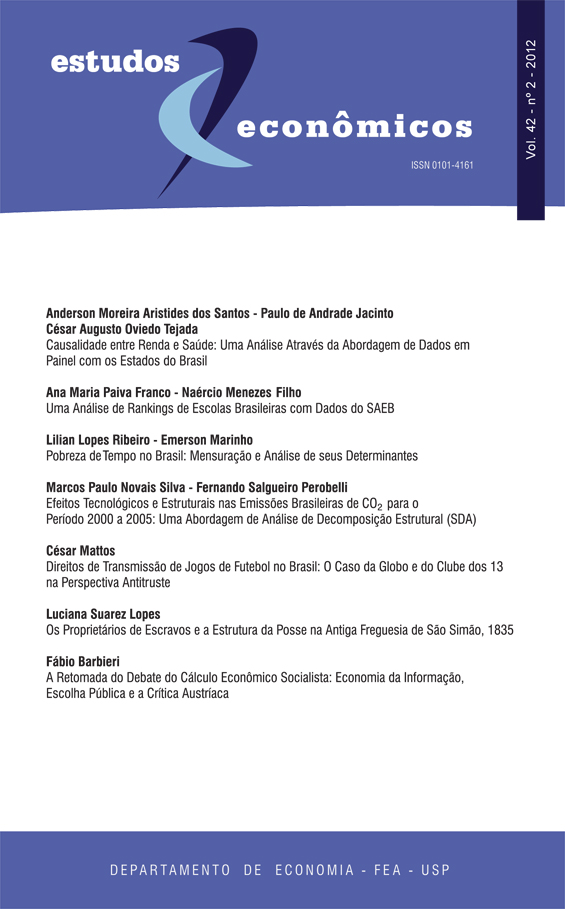
Time poverty in Brazil: measurement and analysis of its determinants
DOI:
https://doi.org/10.1590/S0101-41612012000200003Keywords:
Time poverty, Well-being, Time allocationAbstract
This article analyzes well-being on an individual level, through the allocation of work hours done by adults and children and thus it measures time poverty in Brazil. In order to achieve such measurement, poverty indicators such as Foster, Greer and Thorbecke (FGT) were adapted into a time poverty mode. Additionally, an analysis of its determinants was also conducted. Among other findings, the fact that women (either children and adult ones) are the time-poorest individuals in urban or rural areas. Another unfortunate finding is that the high rate of time poverty among children, numerically 16,1% is not far from the adult rate which is of 19,7%. The overall composite time poor individual profile is of an African-Brazilian adult woman of little education, not necessarily income poor and residing in an urban area of the northeast region, living in a household of few people, she is the mother of children who are younger than 14 years old.
Downloads
References
Downloads
Published
Issue
Section
License
Copyright (c) 2012 Lilian Lopes Ribeiro, Emerson Marinho

This work is licensed under a Creative Commons Attribution-NonCommercial 4.0 International License.
By submitting an article, the author authorizes its publication and attests that it has not been submitted to any other journal. The original article is considered final. Articles selected for publication are proofread for grammatical and orthographic errors. The journal does not pay rights for published articles. The Institute of Economic Research from the School of Economics, Business and Accounting of the University of São Paulo (Instituto de Pesquisas Econômicas da Faculdade de Economia, Administração e Contabilidade da Universidade de São Paulo) owns the journal's copyright.


 Atualizado em 14/08/2025