
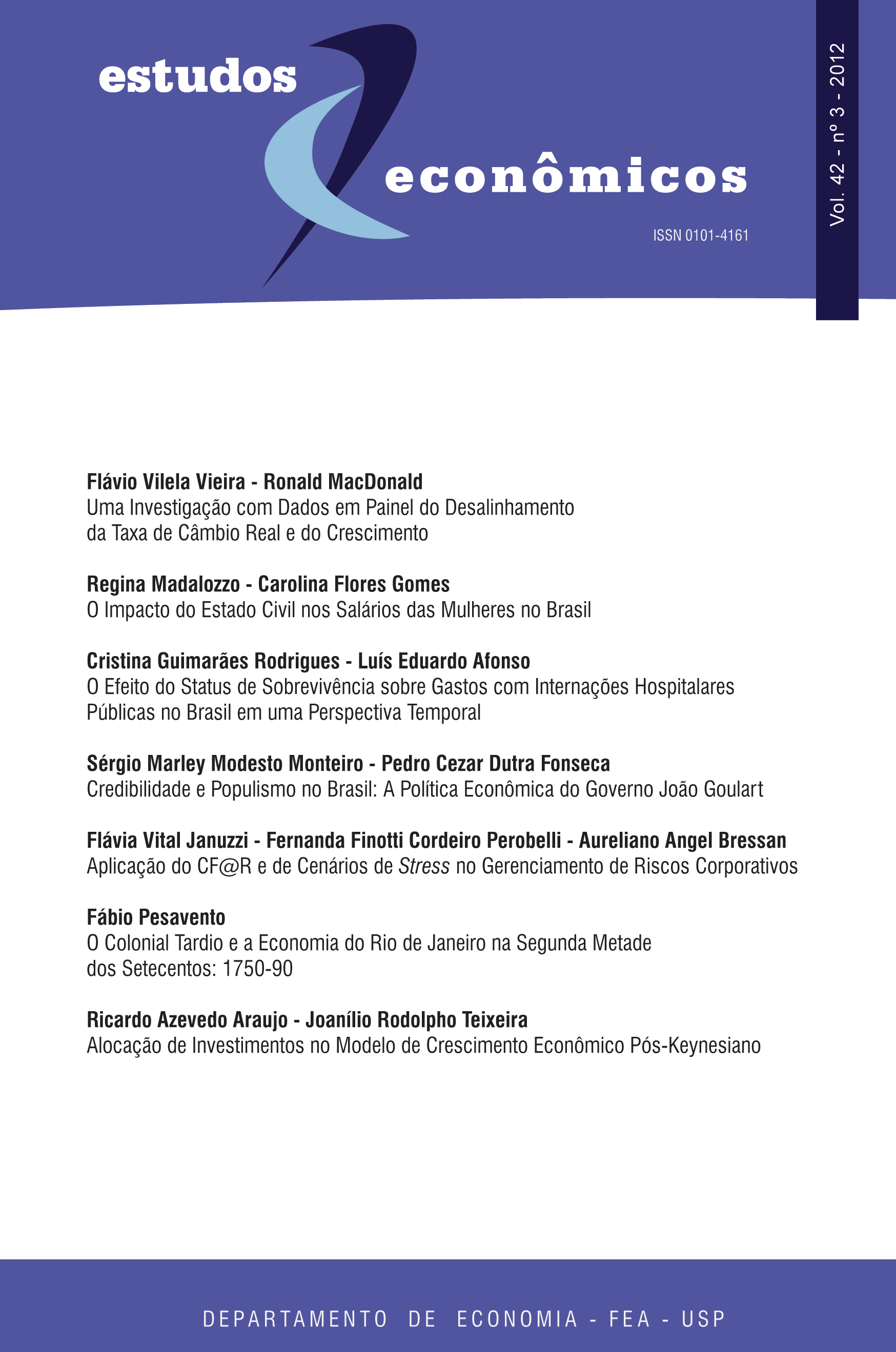
Decisions on investment allocation in the Post-Keynesian growth model
DOI:
https://doi.org/10.1590/S0101-41612012000300007Keywords:
Post-Keynesian growth model, structural change, multi-sector modelsAbstract
In this article the growth models of Feldman (1928) and Mahalanobis (1953) are extended to consider the analysis of decisions of investment allocation in the context of the Post-Keynesian Growth Model. By adopting this approach it is possible to introduce distributive features in the Feldman-Mahalanobis model that allows us to determine the rate of investment allocation according to the equilibrium decisions of investment and savings. Finally, an additional condition is added to the Post-Keynesian Growth Model in order to fully characterise the equilibrium path in an extended version of this framework, where capital goods are also needed to produce capital goods.
Downloads
References
ARAUJO, J. The government sector in Kaldor-Pasinetti Models. Journal of Post-Keynesian Economics 15(2), p. 211–228. 1992–93.
ARAUJO, R.; TEIXEIRA, J. A Multi-sector version of the Post-Keynesian Growth Model. Proceedings of the VIII International Colloquium on Growth, Structural Change and Institutions, p. 25–46.
Boyland, T.; Raghavendra, S. (Ed.). Galway, Ireland. 2011.
ARAUJO, R.; TEIXEIRA, J. Structural change and decisions on investment allocation. Structural Change and Economic Dynamics 13, p. 249–258. 2002.
BHADURI, A.; MARGLIN, S. Unemployment and the real wage: the economic basis for contesting political ideologies. Cambridge Journal of Economics 14 (4), p. 375–93. 1990.
BLECKER, R. International competition, income distribution and economic growth, Cambridge Journal of Economics 13, p. 395–412. 1989.
BLECKER, R. Distribution, demand and growth in neo-Kaleckian macro-models. In: SETTERFIELD, M. (Org.). The Economics of Demand-led Growth: Challenging the Supply-side Vision of the Long Run. Cheltenham, UK; Northampton, MA: Edward Elgar, p. 129–152. (2002)
BOSE, S. Optimal Growth and Investment Allocation. Review of Economic Studies, p. 456–480. 1968.
DUTT, A. Stagnation, income distribution and monopoly power. Cambridge Journal of Economics 8, p. 25 - 40. 1984.
DUTT, A, Alternative closures again: a comment on growth, distribution and inflation. Cambridge Journal of Economics 11, p. 75–82. 1987.
DUTT, A. Growth, distribution and uneven development. Malta: Cambridge University Press, 1990.
HALEVI, J. The significance of the theory of vertically integrated processes for the problem of economic development. Structural Change and Economic Dynamics 7, p. 163–171. 1996.
HARROD, R. International economics. Cambridge, UK: Cambridge University Press, 1933.
KALDOR, N. A model of economic growth. Economic Journal LXVII, p. 591-624. 1957.
KALECKI, M. Theory of Economic Dynamics: An Essay on Cyclical and Long-Run Changes in Capitalist Economy. London: Allen and Unwin, 1954.
KALECKI, M. The Marxian Equations of Reproduction and Modern Economics. Social Sciences
Information 7, p. 73–79. 1968.
LAVOIE, M. Pasinetti’s vertically hyper-integrated sectors and natural prices. Cambridge Journal of Economics 21, p. 453–467. 1997.
LAVOIE, M. Kaleckian Effective Demand and Sraffian Normal Prices: Towards a Reconciliation. Review of Political Economy 15(1), p. 53–74. 2003.
LAVOIE, M. 2006. Introduction to Post-Keynesian Economics. Palgrave: MacMillan.
NELL, E. The Rate of Profit in Kalecki’s Theory. In: Kalecki’s Relevance Today. SEBATIANI. M. (Ed.). London: Macmillan Press Ltd. 1989.
MOTT, T. Longer-run aspects of Kaleckian macroeconomics. In: SETTERFIELD, M. (Org.). The Economics of Demand-led Growth: Challenging the Supply-side Vision of the Long Run. Cheltenham, UK; Northampton, MA: Edward Elgar, p. 153–171. 2002.
PASINETTI, L. The notion of vertical integration in economic analysis. Metroeconomica 25, p. 1–29. 1973.
PASINETTI, L. Structural Change and Economic Growth – A Theoretical Essay on the Dynamics of the Wealth of the Nations. Cambridge: Cambridge University Press. 1981.
PASINETTI, L. Growing sub-systems, vertically hyper-integrated sectors and the labour theory of value. Cambridge Journal of Economics 12, p. 125–134. 1988.
PASINETTI, L. Sraffa’s circular process and the concept of vertical integration. In Essays on Pierro Sraffa. K. Bharadwaj; B. Schefold (Ed.). London: Unwin Hyman. 1990.
PASINETTI, L. Structural Economic Dynamics – A Theory of the Economic Consequences of Human Learning. Cambridge: Cambridge University Press. 1993.
PASINETTI, L. The Cambridge School of Keynesian Economics. Cambridge Journal of Economics 29, p. 837–848. 2005.
PASINETTI, L. Keynes and the Cambridge Keynesians: A ‘Revolution in Economics’ to be Accomplished. Cambridge: Cambridge University Press. 2007.
ROBINSON, J. The Accumulation of Capital. London: Macmillan. 1956.
ROBINSON, J. Essays in the Theory of Economics Growth, London: Macmillan. 1962.
ROWTHORN, R. Demand, Real Wages and Economic Growth. Studi Economici, no. 18. 1982.
SCAZZIERI, R. Vertical Integration in Economic Theory. Journal of Post Keynesian Economics 13(1), p. 20–46. 1990.
STEINDL, J. Maturity and Stagnation in American Capitalism. New York: Monthly Review Press. 1952.
STEEDMAN, I. Questions for Kaleckians. Review of Political Economy 4, p. 125–151. 1992.
STOCKHAMMER, E. Robinsonian and Kaleckian growth. An update on Post-Keynesian growth theories. Working paper no. 67, Vienna University of Economics, Department of Economics. 1999.
TAYLOR, L. A Stagnationist Model of Economic Growth. Cambridge Journal of Economics 9, p.
–403. 1985.
WEITZMAN, M. Shiftable Versus Non-shiftable Capital: A Synthesis. Econometrica, p. 511–529. 1971.
Downloads
Published
Issue
Section
License
Copyright (c) 2012 icardo Azevedo Araujo, Joanílio Rodolpho Teixeira

This work is licensed under a Creative Commons Attribution-NonCommercial 4.0 International License.
By submitting an article, the author authorizes its publication and attests that it has not been submitted to any other journal. The original article is considered final. Articles selected for publication are proofread for grammatical and orthographic errors. The journal does not pay rights for published articles. The Institute of Economic Research from the School of Economics, Business and Accounting of the University of São Paulo (Instituto de Pesquisas Econômicas da Faculdade de Economia, Administração e Contabilidade da Universidade de São Paulo) owns the journal's copyright.


 Atualizado em 14/08/2025