Body-Making as Storming the Bastille
Readings of Michel De Certeau Toward an Anthopology of Political Gestures
DOI:
https://doi.org/10.11606/2179-0892.ra.2018.148931Keywords:
Michel de Certeau, Practices, Body, Embodied Action, Social MovementsAbstract
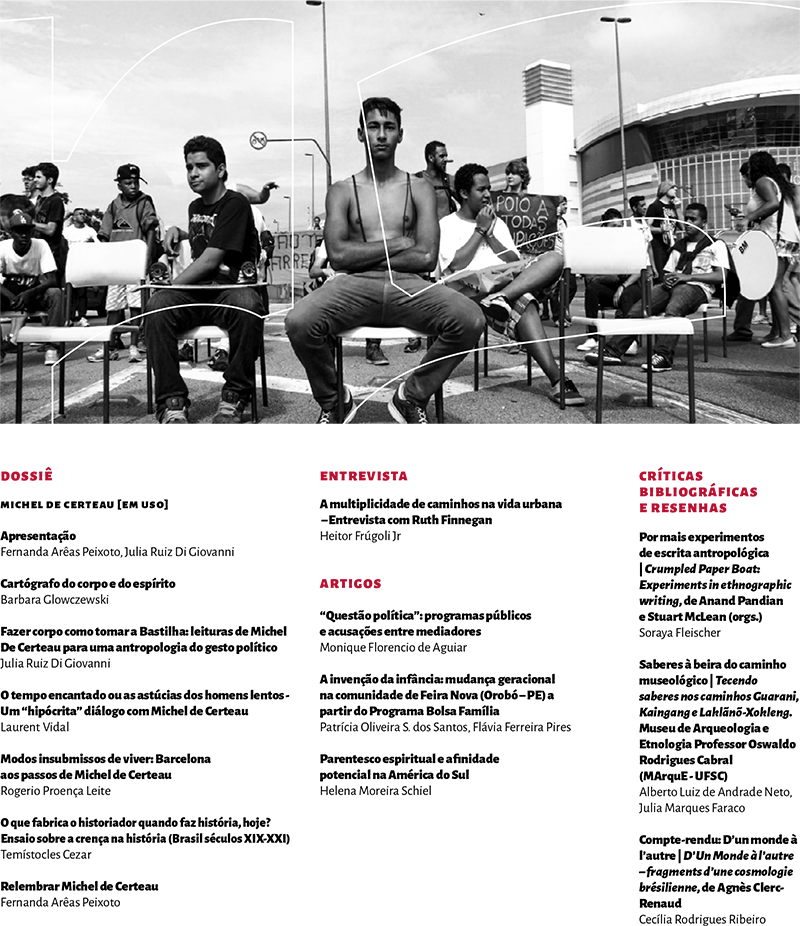
This article investigates Michel de Certeau’s understanding of the body as an instance of political action and social change, focusing on the persistence in his writings of references to embodiment – first as a fundamental dimension of the Christian mystic experience and later as a key to the politics of the streets in May 1968 in France – and on the author's ideas on how knowledge is produced and shared, embedded in the inventiveness of daily life. We highlight the relevance of an embodied dimension of experience in the author’s conceptualizations of practices, converging with the uses he makes of the linguistic notion of poetics in understanding social action. Pointing out the actuality and possible contemporary uses of his propositions, we reflect on practices of protest performed by student movements in São Paulo, Brazil, in 2015, addressing how the protesters seize the mobility of power structures, making use of everyday body practices supposedly normalized by school discipline in order to generate disruptive actions of civil disobedience.
Downloads
References
CAMPOS, Antonia; MEDEIROS, Jonas e RIBEIRO, Márcio. 2016. Escolas de luta. São Paulo, Veneta (Coleção Baderna).
CERTEAU, Michel de. [1964] 1987. “L’Homme em prière «cet arbre de gestes”. In La Faiblesse de Croire. Paris, Éditions du Seuil, pp. 267-305.
CERTEAU, Michel de. [1968] 1994. “La Prise de parole (mai 1968)”. In La Prise de parole et autres écrits politiques . Paris, Éditions du Seuil, pp. 27-129.
CERTEAU, Michel de. [1974] 2005. A cultura no plural. Campinas, Papirus Editora, 4a edição.
CERTEAU, Michel de. [1980] 2008. L’Invention du quotidien. I – Arts de faire. Paris, Gallimard.
CERTEAU, Michel de. [1982] 2015. A fábula mística: séculos XVI e XVII– Volume I. Rio de Janeiro, Forense Universitária.
CERTEAU, Michel de. [1982] 1997. “Historias de cuerpos: entrevista con Michel de Certeau”. Entrevista concedida a G. Vigarello. Historia y Grafía, Julio-Diciembre. Tradução de Alejandro Pescador. Disponível em: http://www.hemerodigital.unam.mx/ANUIES/hemeroteca/framesacer.html.
CERTEAU, Michel de. [1970] 2005. La Possesion de Loudun. Paris, Gallimard/Julliard.
CERTEAU, Michel de; GIARD, Luce e MAYOL, Pierre. [1980] 1994
L’Invention du quotidien. II – Habiter, cuisiner. Paris, Gallimard.
DI GIOVANNI, Julia Ruiz. 2012. Artes do Impossível: ação de rua no movimento antiglobalização. São Paulo, Fapesp/Annablume.
DI GIOVANNI, Julia Ruiz. 2015a. Cadernos do Outro Mundo: o Fórum Social Mundial em Porto Alegre. São Paulo, Editora Humanitas/Fapesp.
DI GIOVANNI, Julia Ruiz. 2015b. “Artes de abrir espaço. Apontamentos para a análise de práticas em trânsito entre arte e ativismo”. Cadernos de Arte e Antropologia, vol. 4, n. 2-1: 13-27.
DI GIOVANNI, Julia Ruiz; MEIHY, Murilo S. Bom. 2016. “O jardim das flores secas: o que esperar da chamada Primavera Árabe?”. In ALMEIDA, J. R. de; SCHITTINO, R. e POGGI, T. (org.). Política e violência: desafios contemporâneos. Curitiba, Editora Prismas, pp. 253-281.
FOUCAULT, Michel. [1966] 2013. “O corpo utópico”. In O corpo utópico, As heterotopias/Le Corps utopique, Les Hétérotopies. Tradução de Salma Tannus Muchail. Rio de Janeiro, Editora N-1, pp. 7-16.
FREIJOMIL, Andrés G. 2015. “Michel de Certeau, une reconversion des savoirs”. In La Vie des idées. Disponível em: http://www.laviedesidees.fr/Michel-de-Certeau-une-reconversion-des-savoirs.html. Aceso em julho de 2017.
GIARD, Luce. [1980] 1994. “Faire la cuisine”. In CERTEAU, Michel de; GIARD, Luce e MAYOL, Pierre. L’Invention du Quotidien II: Habiter, cuisiner. Pari, Gallimard, pp. 213 -350.
GIARD, Luce. [1968] 1994. “Par quoi demain déjà se donne à naître”. In La Prise de parole et autres écrits politiques. Paris, Éditions du Seuil, pp. 7- 26.
GRUPO CONTRAFILÉ (org.). 2016. “A cadeira andante”. In A batalha do vivo – Grupo Contrafilé, secundaristas e amigos. MASP/ Sesc Interlagos.
HOLMES, Brian. 2009. “Toward the New Body: Marcelo Exposito’s ‘Entre Sueños’”. In Escape the Overcode: Activist Art in the Control
Society. Eindhoven, Van Abbemuseum, pp. 15-23.
INGOLD, Tim. 2013. Making: Anthropology, Archeology, Art and Architecture. Londres/Nova York: Routledge.
LEROI-GOURHAN, André. [1965] 2012. Le Geste et la parole II: La Mémoire et les rythmes. Paris, Éditions Albin Michel.
MAISONNEUVE, Jean. 1976. “Le Corps et le corporeism aujourd’hui”.
Revue Française de Sociologie, n. 17-4: 551-571.
MAUSS, Marcel. [1934] 2003. “As técnicas do corpo. Parte I – Noção de técnica do corpo”. In Sociologia e antropologia. São Paulo, Cosac & Naify, pp. 401-408.
MOL, Annemarie e LAW, John. 2004. “Embodied Action, Enacted Bodies. The Example of Hypoglycoemia”. Body and Society, vol.10 (2-3): 43-62.
TURNER, Victor. 1982. From Ritual to Theatre, The Human Seriousness of Play. Nova York, PAJ Publications.
WRIGHT, Stephen. 2016. Para um léxico dos usos/Toward a Lexicon of Usership. São Paulo, Edições Aurora.
Downloads
Published
Issue
Section
License
Copyright (c) 2020 Revista de Antropologia

This work is licensed under a Creative Commons Attribution 4.0 International License.
Authors who intend to publish in this journal must agree with the following terms:
- a) Authors retain copyright and grant the journal the right of first publication. The work is simultaneously licensed under the Creative Commons Attribution License, which allows the work to be shared as long as the author and the initial publication in this journal are appropriately credited.
- b) Authors are authorized to sign additional contracts for non-exclusive distribution of the version of the work published in this journal (e.g., to publish it as a book chapter), as long as the author and the initial publication in this journal are appropriately credited.
- c) Authors are allowed and encouraged to publish and distribute their work online (e.g. on their personal webpage) after the editorial process, for this can generate productive changes as well as increase the impact and citation of the work. See The Effect of Open Access Publications.