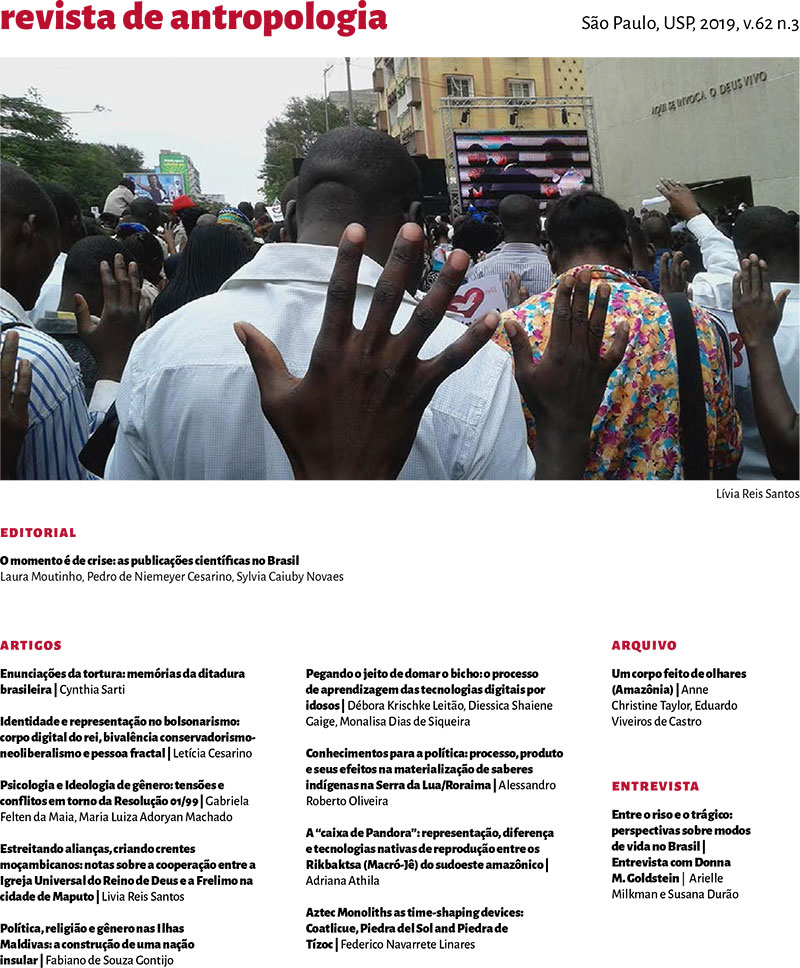
Política, religião e gênero nas Ilhas Maldivas. A construção de uma nação insular
DOI:
https://doi.org/10.11606/2179-0892.ra.2019.165234Palavras-chave:
Política, nação, turismo, islamismo, gêneroResumo
Nas Ilhas Maldivas, há um nítido contraste entre, por um lado, o turismo organizado geralmente por agências internacionais de viagem voltado para ilhas ocupadas por hotéis luxuosos ou resorts, até pouco tempo a única forma de turismo permitida no país, e por outro, o turismo independente, recentemente permitido para a visitação de ilhas habitadas basicamente por pescadores. Uma legislação específica regulamenta as atividades nas ilhas-resorts, de cunho liberal, diferente daquela mais conservadora e baseada em preceitos islâmicos que regulamenta as relações sociais no restante do país. Essa dualidade – um país, duas legislações – pode ajudar a compreender a configuração histórica particular das relações de poder, assim como as interpretações das formas da experiência da religiosidade e as expressões de gênero, que estão na base da legitimação de ideologias conflituosas de elaboração da identidade nacional maldívia.
Downloads
Referências
ABDUL-RAHMAN, Muhammad Saed. 2007. Islam, Questions and Answers: Jurisprudence and Islamic Rulings – Transactions, Part 5. Londres, MSA Publications Ltd.
ADAM, Shiham, SINAN, Hussain J. R., ALI, Khadeeja, ZIYAD, Adam, SHIFAZ, Ahmed e AHUSAN, Mohamed. 2014. Maldives National Report Submitted to the Indian Ocean Tuna Commission Scientific Committee – 2014. Male’, Ministry of Fisheries and Agriculture.
AMIR, Hassan. 2011. Islamism and Radicalism in the Maldives. Monterrey, Dissertação de Mestrado, Naval Postgraduate School.
ANTROSIO, Jason e HAN, Sallie. 2015. “Hello Anthropocene: Climate Change and Anthropology”. Open Anthropology – A Public Journal of the American Anthropological Association, v. 3, n. 1: 1-11.
AQUINO, Jania Perla Diógenes de. 2015. “Turistas Estrangeiros e Mulheres Locais: ‘mercado do sexo’ e romance nas noites da Praia de Iracema em Fortaleza”. Revista de Antropologia, v. 58, n. 2: 208-234.
ASAD, Talal. 2009. “The Idea of an Anthropology of Islam”. Qui Parle, v. 17, n. 2:1-30.
BAER, Hans. 2012. Global Capitalism and Climate Change: The Need for an Alternative World System. Lanham / Nova York, Altamira Press.
BAER, Hans e SINGER, Merrill. 2014. The Anthropology of Climate Change: an Integrated Critical Perspective. Abingdon / Nova York, Routledge.
BARNETT, Jon e ADGER, Neil W. 2003. “Climate Dangers and Atoll Countries”. Climatic Change, v. 61, n. 3: 321-337.
BARTH, Fredrik.2000. “A Análise da Cultura das Sociedades Complexas”. In: O Guru, O Iniciador e Outras Variações Antropológicas. Rio de Janeiro, Contra Capa, pp. 108-138.
BELL, Harry C. P. 1940. The Maldive Islands: Monograph on the History, Archaeology and Epigraphy. Colombo, Ceylon Government Press.
BELL, Heather M. 1992. “H. C. P. Bell in Sri Lanka and the Maldives”. South Asian Studies, v. 8: 105-108.
BLÁZQUEZ, Gustavo. 2012. “Celebraciones escolares y poéticas patrióticas: la dimensión performativa del Estado-Nación”. Revista de Antropologia, v. 55, n. 2:703-746.
BOURDIEU, Pierre. 1980. “L’Identité et la Représentation: éléments pour une réflexion critique sur l’idée de région”. Actes de la Recherche en Sciences Sociales, v. 35, n. 1: 63-72.
BOWEN, John R. 2012. A New Anthropology of Islam. Cambridge, Cambridge University Press. BURESI, Pascal2007 “Histoire de l’Islam”. La Documentation Française, Dossiê nº 8058, julho-agosto:2-66.
CARLSEN, Jack C. e HUGHES, Michael. 2008. “Tourism Market Recovery in the Maldives after the 2004 Indian Ocean Tsunami”. Journal of Travel & Tourism Marketing, v. 23, n. 2-4:139-149.
CARNEIRO DA CUNHA, Manuela 2009. Cultura com Aspas. São Paulo, Cosac Naify.
COLTON, Elizabeth O. 1995. The Elite of the Maldives: Sociopolitical Organisation and Change. Londres, Dissertação de Mestrado, London School of Economics and Political Science.
DE LAURETIS, Teresa. 1994. “A Tecnologia de Gênero”. In: HOLLANDA, Heloísa Buarque de (org.). Tendências e impasses: o feminismo como crítica da cultura, Rio de Janeiro, Rocco, pp. 206-241.
DOMROES, Manfred. 2001. “Conceptualising State-Controlled Resort Islands for an Environment-Friendly Development of Tourism: the Maldivian experience”. Singapore Journal of Tropical Geography, v. 22, n. 2: 122-137.
DOVE, Michael R. (org.) 2014. The Anthropology of Climate Change: an Historical Reader. Malden / Oxford, Wiley Blackwell.
FERREIRA, Francirosy Campos Barbosa. 2007. “O Sacrifício do Carneiro Islâmico como Objeto Transicional – Notas Antropológicas”. Revista de Antropologia, v. 50, n. 2: 747-783.
FORBES, Andrew D. W. 1987. “The Pre-Islamic Archaeology of the Maldive Islands”. Persée, v. 76: 281-288.
FRITZ, Sonja. 2002. The Divehi Language: a Descriptive and Historical Grammar of Maldivian and its Dialects. Würzburg / Heidelberg, Ergon Verlag / Südasien-Institut.
FULU, Emma M. 2009. Intimate Partner Violence in the Maldives: Globalisation and the Negotiation of Gender and Islam. Melbourne, Tese de Doutorado, School of Philosophy, Anthropology and Social Inquiry, University of Melbourne.
GEERTZ, Clifford. 1973. “Person, Time, and Conduct in Bali”. In: The Interpretation of Cultures. Nova York, Basic Books, pp. 360-411.
GEERTZ, Clifford. 2004. Observando o Islã: o desenvolvimento religioso no Marrocos e na Indonésia. Rio de Janeiro: Zahar.
GHINA, Fathimath. 2003. “Sustainable Development in Small Island Developing States: the Case of the Maldives”. Environment, Development and Sustainability, v. 5, n. 1-2: 139-165.
GNANADESIKAN, Amalia E. 2014. Dhivehi: the Language of the Maldives. Berlim, De Gruyter Mouton.
GRÜNEWALD, Rodrigo de A. 2001. Os índios do descobrimento: tradição e turismo. Rio de Janeiro, Contra Capa.
HELMREICH, Stefan. 2011. “Nature/Culture/Seawater”. American Anthropologist, v. 113, n. 1: 132-144.
HEYERDAHL, Thor. 1986. The Maldive Mystery. Chevy Chase, Adler & Adler.
HOFMEISTER, Wilhelm (org.) 2015. Panorama: Insights into Asian and European Affairs – From the Desert to World Cities, the New Terrorism. Cingapura, Konrad-Adenauer-Stiftung.
HUSSAIN, Dheena. 2008. Functional Translation of the Constitution of the Republic of Maldives. A pedido do Ministry of Legal Reform, Information and Arts, 2008. Disponível em <http://www.majlis.gov.mv/en/wp-content/uploads/Constitution-english.pdf>. Acesso em: 08/07/2018.
KING, Brian E. M. 1997. Creating Island Resorts. Londres / Nova York, Routledge.
KOECHLIN Bernard.1979. “Notes sur l’Histoire et le Navire Long-Courier, Odi, Aujourd’hui Disparu des Maldives”. Persée, v. 18: 283-300.
KUNDUR, Suresh K. 2012. Development of Tourism in Maldives. International Journal of Scientific and Research Publications, v. 2, n. 4: 1-5.
LATOUR, Bruno. 2014. “Para distinguir amigos e inimigos no tempo do antropoceno”. Revista de Antropologia, v. 57, n. 1: 11-31.
MacCANNELL, Dean. 1992. Empty Meeting Grounds. Londres, Routledge, 1992.
MACHADO, Igor José de Renó. 2004. “Estado-Nação, Identidade-Para-o-Mercado e Representações de Nação”. Revista de Antropologia, v. 47, n. 1: 207-234.
MALONEY, Clarence. 1976. “The Maldives: New Stresses in an Old Nation”. Asian Survey, v. 16, n. 7: 654-671.
MALONEY, Clarence. 1980. People of the Maldive Islands. Madras, Orient Longman.
MALONEY, Clarence e MUNCH-PETERSEN, Nils Finn. 1991. “Divehi”. In: HOCKINGS, Paul (org.). Encyclopedia of World Cultures – Volume III. South Asia. Nova York, G. K. Hall & Company, pp. 75-79.
MARCUS, Anthony. 2012. “Reconsidering Talaq: Marriage, Divorce and Sharia Reform in the Republic of Maldives”. In: RAGHAVAN, Chitra e LEVINE, James P. (orgs.). Self-Determination and Women’s Rights in Muslim Countries. Waltham, Brandeis University Press, pp. 95-123.
MARRANCI, Gabriele. 2008. The Anthropology of Islam. Oxford / Nova York, Berg.
MASTERS, Tom. 2015. Maldives – Lonely Planet. Londres, Lonely Planet Publications Pty Ltd.
MAUSOOM, Abdulla. 2004. The Interdependency and the Relationship Between the Government and the Private Sector and the Development of Enclave Micro Island Tourism in the Maldives. Birmingham, Tese de Doutorado, University of Birmingham.
MELOTTI, Marxiano. 2013. “Cultural Heritage and Tourism. Maldives and the Challenge of Future”. In: Anais do Encontro do Ironbridge International Institute for Cultural Heritage,Tourism and the Shifting Values of Cultural Heritage.Taipé, National Taiwan University, National Taipei University of Education, National Central University. Disponível em <https://www.academia.edu/7240788/Cultural_Heritage_and_Tourism._Maldives_and_the_Challenge_of_Future> Acesso em: 03/07/2018.
MIHDHA, A. 2008. The Political Economy of Development: the case of the tourism industry in the Maldives. Londres, Dissertação de Mestrado, Department of Economics, Faculty of Law and Social Sciences, School of Oriental and African Studies.
MOHAMED, Naseema. 2005. “Notes on Early History of the Maldives”. Persée, n. 70: 7-14.
MOHAMED, Mizna2012 “Changing Reef Values: an Inquiry into the Use, Management of Governances of Reef Resources in Island Communities of the Maldives”. Christchurch, Tese de Doutorado, University of Canterbury.
MOHAMED, Mizna. 2015. “Historical Changes in Human-Nature Interactions in Island Communities of the Maldives”. Rural South Asian Studies, v. 1, n. 1: 22-36. MOLINA, Sérgio 2003 O pós-turismo. São Paulo, Aleph.
MOOSA, Zakiyya. 2016. Authenticity and Commodification of Cultural Events for the Maldivian Tourism Industry. International Journal of Asian Business and Information Management, v. 7, n. 2: 15-24.
MUNCH-PETERSEN, Nils Finn. 1982. “Maldives: history, daily life, and art handicraft”. Bulletin du C.E.M.O.I., v. 1: 74-103.
NASEEM, Azra. 2012. On Evildoers: a Foucaultian Analysis of the Discursive Structuring of Contemporary Terrorism. Dublin, Tese de Doutorado, Faculty of Humanities and Social Science, School of Law and Government, Dublin City University.
NATIONAL BUREAU OF STATISTICS. 2014. Maldives – Population and Housing Census 2014. Male’, National Bureau of Statistics. NIAS2014 “The Banning of a Book in the Maldives”.
NIAS Press – Nourishing Knowledge, 22/09/2014. Disponível em <http://www.niaspress.dk/blogs/karoline/blog/2014-september/banning-book-maldives>. Acesso em: 22/08/2018.
ORŁOWSKA, Justyna. 2015. Living on the Sinking Island: Social Aspects of Climate Change on Example of Maldives. Varsóvia, Tese de Doutorado, Institute of Philosophy and Sociology, Polish Academy of Sciences.
OSELLA, Filippo e SOARES, Benjamin (orgs.) 2010. Islam, Politics, Anthropology. Malden / Oxford, Willey-Blackwell.
PEIRANO, Mariza. 1992. Uma Antropologia no plural. Brasília, Editora da UnB.
PIJPE, Jeroen, De VOOGT, Alex, VAN OVEN, Mannis, HANNEMAN, Peter, VAN DER GAAG, Kristiaan J., KAYSER, Manfred e De KNIJFF, Peter. 2013. “Indian Ocean Crossroads: Human Genetic Origin and Population Structures in the Maldives”. American Journal of Physical Anthropology, v. 151: 58-67.
PISCITELLI, Adriana. 2010. “‘Gringas Ricas’: Viagens sexuais de mulheres europeias no Nordeste do Brasil”. Revista de Antropologia, v. 53, n. 1: 79-115.
RAMACHANDRAN, Sudha. 2016. “The Maldives: Losing a Tourist Paradise to Terrorism”. Terrorism Monitor, v. XIV, n. 2: 3-6.
RASHEED, Athaulla A. 2013. Tourism, Economic Development and Governance in the Maldives: a Historical Institutional Evaluation. Brisbane, Tese de Doutorado, School of Political Science & International Studies, The University of Queensland.
ROMERO-FRÍAS, Xavier. 1999. The Maldive Islanders: a Study of the Popular Culture of an Ancient Ocean Kingdom. Barcelona, Nova Ethnographia Indica.
ROMERO-FRÍAS, Xavier. 2011. “The Riba in Fua Mulaku Island. Destruction of an Oceanic Shoreline Funerary Building”. Academia.edu. Disponível em <https://www.academia.edu/7859002/The_Riba_in_Fua_Mulaku_Island._Destruction_of_an_Oceanic_Shoreline_Funerary_Building>. Acesso em 15/10/2018.
ROMERO-FRÍAS, Xavier. 2015a. “The Maldives Were Such an Unknown Place Back Then: Nils Finn Munch-Petersen, a True Pioneer”. Academia.edu. Disponível em <https://www.academia.edu/12694851/The_Maldives_were_such_an_unknown_place_back_then_Nils_Finn_Munch-Petersen_a_true_pioneer>. Acesso em 15/10/2018.
ROMERO-FRÍAS, Xavier2015b “A Passion to Preserve the “Divehi Civilization of the Maldives”; the Work of Bernard Koechlin”. Academi.edu. Disponível em <https://www.academia.edu/12304027/A_passion_to_preserve_the_Divehi_civilization_of_the_Maldives_the_work_of_Bernard_Koechlin>. Acesso em 15/10/2018.
ROMERO-FRÍAS, Xavier2015c “Clarence Maloney, his Vision, his Work and the Ancient Underlying Cultural Influences in the Maldives”. Academia.edu. Disponível em <https://www.academia.edu/12410116/Clarence_Maloney_his_vision_his_work_and_the_ancient_underlying_cultural_influences_in_the_Maldives>. Acesso em 15/10/2018.
SALIH, Ahmed. 2003. Tourism Generates Employment. But For Whom? Maldivian Tourist Resort Labour Market. Dunedin, Dissertação de Mestrado, University of Otago.
SHAKEELA, Aishath. 2009. Tourism Education and Local Employment as Factors Contributing to the Sustainable Development in Small Island Developing States (SIDS): the Case of the Maldives. Brisbane, Tese de Doutorado, School of Tourism, University of Queensland.
SCHEYVENS, Regina. 2011. “The Challenge of Sustainable Tourism Development in the Maldives: understanding the social and political development dimensions of sustainability”. Asia Pacific Viewpoint, v. 52, n. 2: 148-164.
SCOTT, James C. 1990. Domination and the Arts of Resistance: Hidden Transcripts.New Haven, Yale University Press.
SCOTT, Joan W. 1992. “Experience”. In: BUTLER, Judith e SCOTT, Joan W. (orgs.). Feminists Theorize the Political.Nova York/Londres, Routledge, pp. 22-40.SIMMEL, Georg1996 [1909] “A Ponte e a Porta”. Revista Política & Trabalho, n. 12: 5-9.
SIMMEL, Georg. 1996 [1909]. “A Ponte e a Porta”. Revista Política & Trabalho, n. 12: 5-9.
SINAN, Hussain. 2011. Background Report of Fishery Products: the Maldives. Male’, Ministry of Fisheries and Agriculture.
SLEEPER, Bbuck. 2011. Last Resorts: a Tour Guide to Territorial Protection for the Republic of the Maldives. Cambridge,Dissertação de Mestrado, Department of Architecture, Massachusetts Institute of Technology.
SONN, Tamara. 2010. Islam: a Brief History. Malden / Oxford, Willey-Blackwell.
WOLF, Eric. 2003. Antropologia e Poder. Brasília, EdUnB.
WORLD TRAVEL AND TOURISM COUNCIL. 2018. Travel and Tourism: Economic Impact 2018 – Maldives. Londres, WTTC, 2018. Disponível em <https://www.wttc.org/-/media/files/reports/economic-impact-research/countries-2018/maldives2018.pdf>. Acesso em: 20/10/2018).
YAHYA, Faizal, PARAMESWARAM, Ashvin e SEBASTIAN, Rodney2005 “Tourism and the South Asia Litoral: Voices from the Maldives”. South Asia: Journal of South Asian Studies, v. XXVIII, n. 3: 457-480.
Downloads
Publicado
Edição
Seção
Licença
Copyright (c) 2020 Revista de Antropologia

Este trabalho está licenciado sob uma licença Creative Commons Attribution 4.0 International License.
Autores que publicam na Revista de Antropologia concordam com os seguintes termos:
a) Autores mantém os direitos autorais e concedem à revista o direito de primeira publicação, com o trabalho simultaneamente licenciado sob a Licença Creative Commons Attribution que permite o compartilhamento do trabalho com reconhecimento da autoria e publicação inicial nesta revista.
b) Autores têm autorização para assumir contratos adicionais separadamente, para distribuição não-exclusiva da versão do trabalho publicada nesta revista (ex.: publicar em repositório institucional ou como capítulo de livro), com reconhecimento de autoria e publicação inicial nesta revista.
c) Autores têm permissão e são estimulados a publicar e distribuir seu trabalho online (ex.: em repositórios institucionais ou na sua página pessoal) após o processo editorial, já que isso pode gerar alterações produtivas, bem como aumentar o impacto e a citação do trabalho publicado (Veja O Efeito do Acesso Livre).