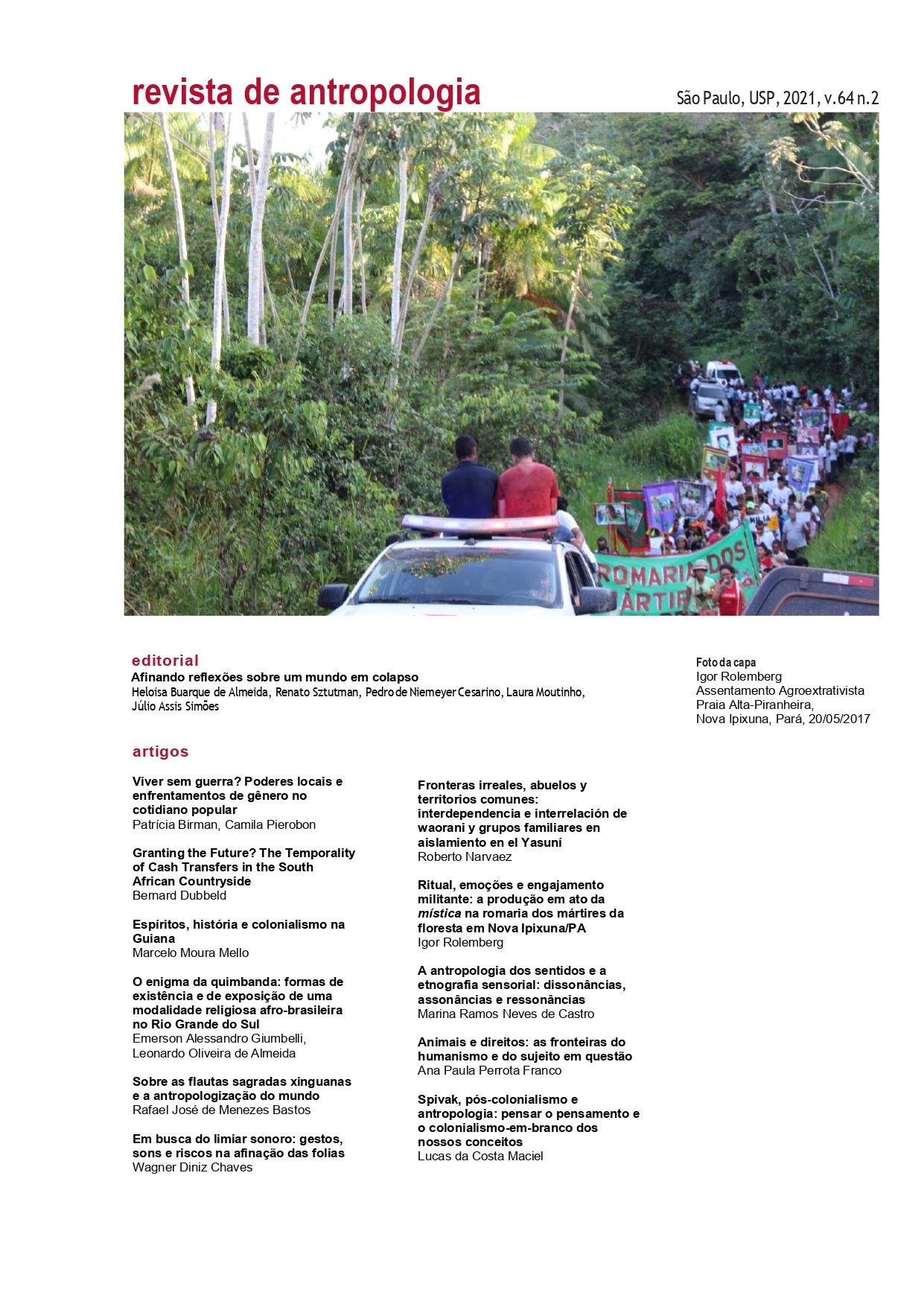
O enigma da quimbanda: formas de existência e de exposição de uma modalidade religiosa afro-brasileira no Rio Grande do Sul
DOI:
https://doi.org/10.11606/1678-9857.ra.2021.186652Palavras-chave:
Religiões afro-brasileiras, umbanda, batuque, exuResumo
Quimbanda, no Rio Grande do Sul, é uma modalidade ritual que assumiu um estatuto sem par no restante do Brasil. Designando o culto de exus e pombagiras, a quimbanda alcançou um lugar proeminente em relação a outras expressões afrorreligiosas, como são o batuque e a umbanda. O objetivo deste texto é apontar as condições de possibilidade da quimbanda, mostrando como ela corresponde a um deslocamento em relação a princípios caros uns ao batuque, outros à umbanda. Também as formas de exposição de exus e pombagiras, que encadeiam manifestações espirituais, registros fotográficos e divulgação na internet, são abordadas como parte constitutiva do desenvolvimento da quimbanda. As análises baseiam-se na discussão de bibliografia sobre a quimbanda, na etnografia de rituais e em entrevistas com religiosos, buscando contribuir para o debate acerca das modalidades religiosas geradas pelo culto aos orixás no Brasil.
Downloads
Referências
ALMEIDA, Leonardo Oliveira de. 2019. Tambores de todas as cores: práticas de mediação religiosa afro-gaúchas. Porto Alegre, Tese de Doutorado, Universidade Federal do Rio Grande do Sul.
ANJOS, José Carlos Gomes dos. 2006. No território da linha cruzada: a cosmopolítica afro-brasileira. Porto Alegre, Editora da UFRGS/Fundação Cultural Palmares.
ASSUNÇÃO, Luiz. 2004. “Os Mestres da Jurema”. In. PRANDI, Reginaldo (Org.). Encantaria brasileira: o livro dos mestres, caboclos e encantados. Rio de Janeiro–RJ, Pallas, pp. 183-215.
BARBOSA NETO, Edgar Rodrigues. 2012. A máquina do mundo: variações sobre o politeísmo em coletivos afro-brasileiros. Rio de Janeiro, Tese de Doutorado, Universidade Federal do Rio de Janeiro.
BASTIDE, Roger. 1959. A Sociologia do Folclore Brasileiro. São Paulo, Editora Anhembi.
BEM, Daniel Francisco de. 2012.Tecendo o axé: uma abordagem antropológica da atual transnacionalização afro-religiosa nos países do Cone Sul. Porto Alegre, Universidade Federal do Rio Grande do Sul.
BIRMAN, Patricia. 1997. “O campo da nostalgia e a recusa da saudade: temas e dilemas dos estudos afro-brasileiros”. Religião e Sociedade, v. 18, n. 2: 75-92.
BRASIL. 2011. Alimento: Direito Sagrado – Pesquisa Socioeconômica e Cultural de Povos e Comunidades Tradicionais de Terreiros. Brasília: Ministério do Desenvolvimento Social e Combate à Fome; Secretaria de Avaliação e Gestão da Informação.
BRUMANA, Fernando; MARTINEZ, Elda. 1991. Marginália Sagrada. Campinas, Editora Unicamp.
CAPONE, Stefania. 2004. A busca da África no candomblé: tradição e poder no Brasil. Rio de Janeiro, Pallas Editora.
CARNEIRO, Edison. 2005."Um orixá caluniado". In: CARNDEIRO, Edison (org.) Antologia do negro brasileiro. Rio de Janeiro, Agir, pp. 397-400.
CARVALHO, José Jorge. 1995. “A experiência histórica dos quilombos nas Américas e no Brasil.” In: CARVALHO, José Jorge; DORIA, Siglia Zambrotti e OLIVEIRA JÚNIOR, Adolfo Neves de. (orgs.). O Quilombo do Rio das Rãs. História, tradições, lutas. Salvador, EDUFBA, pp.13-73.
CHIESA, Gustavo. 2012. “Criando mundos, produzindo sínteses: experiência e tradição na Umbanda”. Debates do Ner, v. 21: 205-238. https://doi.org/10.22456/1982-8136.26495
CORRÊA, Norton. 2006. O Batuque no Rio Grande do Sul: Antropologia de uma religião afro-rio-grandense. São Luiz, Cultura&arte.
ENGELKE, Matthew. 2010. “Religion and the media turn: a review essay”. American Ethnologist, v. 37, n. 2: 371-379. https://doi.org/10.1111/j.1548-1425.2010.01261.x
GIUMBELLI, Emerson. 1997. O Cuidado dos mortos: uma história da condenação e legitimação do espiritismo. Rio de Janeiro, Arquivo Nacional.
GIUMBELLI, Emerson; RICKLI, João; TONIOL, Rodrigo (Orgs.). 2019. Como as coisas importam: uma abordagem material da religião – textos de Birgit Meyer. Porto Alegre, Editora da UFRGS.
LEISTNER, Rodrigo Marques. 2014. Os outsiders do além: um estudo sobre a quimbanda e outras ‘feitiçarias’ afro-gaúchas. São Leopoldo, Tese de doutorado, Universidade do Vale do Rio dos Sinos.
MAGGIE, Yvonne. 1992. Medo do feitiço: relações entre magia e poder no Brasil. Rio de Janeiro, Arquivo Nacional.
MEYER, Birgit; VERRIPS, Jooda. 2008. “Aesthetics”. In: MORGAN, David. (org.). Key Words in Religion, Media, Culture. Londres/Nova York, Routledge, pp. 20-30.
MEYER, Birgit. 2020. “Religion as Mediation”. Entangled Religions, v. 11, n. 3. https://doi.org/10.13154/er.11.2020.8444
MORGAN, David. 2012. The Embodied Eye. Religious visual culture and the social life of feeling. Berkeley, University of California Press.
ORTIZ, Renato. 1978. A morte branca do feiticeiro negro. Petrópolis, Vozes.
RABELO, Miriam. 2015. “Aprender a ver no candomblé”. Horizontes Antropológicos, n. 44: 229-251. http://dx.doi.org/10.1590/S0104-71832015000200010
RUFINO, Luiz. 2018. “Pedagogia das encruzilhadas”. Periferia, v. 10, n. 1, p. 71-88. https://doi.org/10.12957/periferia.2018.31504
SERRA, Ordep Trindade. 1995. Águas do Rei. Petrópolis, Vozes.
SILVA, Suziene David da. 2003. A quimbanda de mãe Ieda: religião afro-gaúcha de exus e pombas-giras. Recife, Dissertação de Mestrado, Universidade Federal de Pernambuco.
SILVA, Vagner Gonçalves da. 1995. Orixás da metrópole. Petrópolis, Vozes.
SILVA, Vagner Gonçalves da. 2019. Exu: o guardião da casa do futuro. Rio de Janeiro, Pallas.
STOLOW, Jeremy. 2005. “Religion and/as Media”. Theory, Culture & Society, v. 22, n. 4: 119-145. https://doi.org/10.1177/0263276405054993
TEIXEIRA, Talita Bender. 2005. Trapo Formoso: o vestuário na Quimbanda. Porto Alegre, Dissertação de Mestrado, Universidade Federal do Rio Grande do Sul.
VAN DE PORT, Mattijs. 2016. “Expondo exu: algumas notas sobre práticas de exposição em religião, artes e ciências”. In: FONSECA, Claudia; ROHDEN, Fabíola; MACHADO, Paula Sandrine e PAIM, Heloísa Salvatti. (orgs.) Antropologia da Ciência e da Tecnologia, dobras reflexivas. Porto Alegre: Sulina, pp. 99-116.
Downloads
Publicado
Edição
Seção
Licença
Copyright (c) 2021 Revista de Antropologia

Este trabalho está licenciado sob uma licença Creative Commons Attribution 4.0 International License.
Autores que publicam na Revista de Antropologia concordam com os seguintes termos:
a) Autores mantém os direitos autorais e concedem à revista o direito de primeira publicação, com o trabalho simultaneamente licenciado sob a Licença Creative Commons Attribution que permite o compartilhamento do trabalho com reconhecimento da autoria e publicação inicial nesta revista.
b) Autores têm autorização para assumir contratos adicionais separadamente, para distribuição não-exclusiva da versão do trabalho publicada nesta revista (ex.: publicar em repositório institucional ou como capítulo de livro), com reconhecimento de autoria e publicação inicial nesta revista.
c) Autores têm permissão e são estimulados a publicar e distribuir seu trabalho online (ex.: em repositórios institucionais ou na sua página pessoal) após o processo editorial, já que isso pode gerar alterações produtivas, bem como aumentar o impacto e a citação do trabalho publicado (Veja O Efeito do Acesso Livre).