Política Editorial
Preprints
|
RLAE publishes articles that have been posted on national and international preprint servers recognized by the academic community, such as SciELO Preprints, bioRxiv, medRxiv, OSF Preprints (SocArXiv, PsyArXiv), and Research Square. To explore other repositories, click here. Information indicating that the manuscript is a preprint must be included in the Open Science Compliance Form, which is mandatory to complete and submit. Authors must disclose details of the preprint posting, including the DOI and licensing terms, at the time of manuscript submission - if the deposit has already occurred - or at any stage of the review process if the deposit occurs after submission. |
Peer review process
|
All manuscripts submitted to RLAE undergo peer review. RLAE employs three peer review models: 1) Double-anonymous review: both authors and reviewers remain anonymous to each other; 2) Single-anonymous review: authors disclose their identity, but reviewers remain anonymous; 3) Open review: both authors and reviewers are aware of each other’s identities. The standard peer review model adopted by RLAE is the double-anonymous review. In cases of preprints, where author anonymity cannot be guaranteed, the review may be conducted as single-anonymous or open. The decision to adopt an open peer review process depends on the agreement of authors, editors, and reviewers. The review process consists of two stages: the submission process and the evaluation process. Submission process Manuscripts submitted to the journal undergo a preliminary assessment by the Editor-in-Chief, who will decide on approval or rejection based on the journal’s publication priorities (see “Focus and scope” section). Once approved in the preliminary assessment, the manuscript and other submission documents are reviewed by the journal’s editorial office for compliance with the guidelines outlined in these instructions to authors. At this stage, the editorial office may request adjustments to the manuscript or required documentation up to a maximum of two times. If this limit is exceeded, the submission process will be terminated. Figure 1 below illustrates the complete workflow of this stage.
Figure 1 - Workflow of the RLAE submission process. To view the figure in higher resolution, click here.
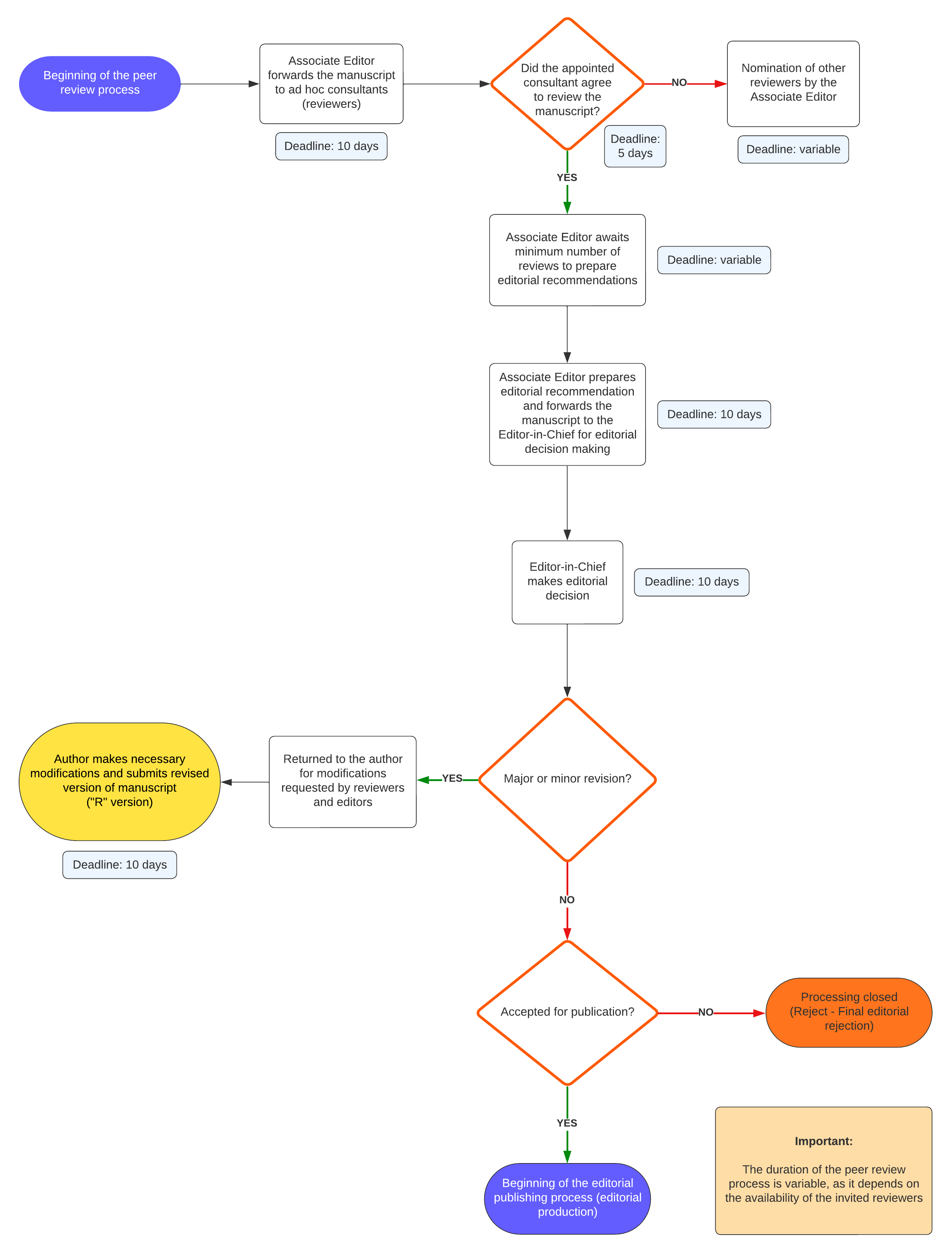
Evaluation process Once approved in the preliminary assessment and in compliance with the journal’s guidelines, manuscripts are forwarded to the Editor-in-Chief, who assigns an Associate Editor to manage the manuscript’s review process. The Associate Editor selects the reviewers and, after receiving the required number of reviews (three as standard), provides an editorial recommendation to the Editor-in-Chief. The Editor-in-Chief then decides on the approval, revision, or rejection of the manuscript based on the reviews and the recommendation from the Associate Editor, as shown in Figure 2.
Figure 2 - Workflow of the peer review process and editorial decision-making. To view the figure in higher resolution, click here.
In addition, aligned with the international Open Science movement - which promotes a more collaborative and transparent approach to science by sharing and opening the entire cycle of knowledge production and communication - RLAE, after adopting the disclosure of the Associate Editor’s name to authors, further advances this practice by making all reviewer reports available to reviewers of the same manuscript. Accordingly, reviewers will receive, via e-mail, a copy of the editorial decision letter containing all peer review reports for that manuscript, fostering greater transparency in the peer review process. Important: After the initial round of peer review and issuance of the first editorial decision, there will be a maximum of two additional rounds of review. If the revised manuscript does not meet the required revisions within this limit, it will be rejected. Notice regarding the deadline for submitting revised versions: The ScholarOne Manuscripts system operates on Eastern Standard Time (EST), not on Brazilian time zones. Therefore, we recommend that authors submit revised versions at least one day before the deadline established by the system. |


Open data
|
In line with the international movement toward a more collaborative and transparent science - promoting the sharing and openness of the entire cycle of knowledge production and communication - RLAE, as a medium for scientific dissemination and communication aimed at strengthening health practices and advancing nursing knowledge, aligns itself with Open Science. Thus, the journal embraces open data, as it enhances rigor, maximizes reach and impact, and enriches the scientific record. The journal encourages authors to publish their analytical datasets, instruments, statistical analysis scripts, protocols, and supplementary materials in open online repositories, such as SciELO Data, Zenodo, Figshare, OSF, and Mendeley Data. Information regarding the deposition of content in a repository must be included in the Open Science Compliance Form. RLAE requires the mandatory availability of data for all articles accepted for publication, except those covered by exception criteria, as outlined in the document RLAE Data Sharing Terms (aka Terms for Open Data RLAE). For further information, please refer to:
|
Fees
|
There is no cost to authors for submitting manuscripts to RLAE. However, if the manuscript is approved in the preliminary assessment phase, authors must pay a processing fee for the manuscript to proceed to the peer review process. The costs associated with submission and publication in RLAE consist of two separate fees - the processing fee and the publication fee - which are charged at different stages of the editorial workflow. In addition, authors are responsible for covering expenses related to language editing and translation services for approved manuscripts. The amounts for the processing and publication fees, as well as other related costs, are listed below and can also be consulted here.
|
|||||||||||||||||||||||||||
Ethics and misconduct, correction and retraction policy
|
For cases requiring corrections, retractions, or expressions of concern, RLAE follows the recommendations of the following guides developed by SciELO: In situations that warrant corrections, retractions, or expressions of concern, the Editorial Board will be convened to analyze the case and determine the appropriate course of action, which may include embargoing the article and/or suspending the authors from publishing in the journal for a specified period. The Board may also decide to publish statements of concern or retractions of articles, depending on the severity of the occurrence. |
Conflict of interest policy
|
Conflicts of interest may be personal, commercial, political, academic, or financial in nature. Conflicts of interest can arise when authors, reviewers, or editors have interests that may influence the preparation or evaluation of manuscripts. Authors are responsible for identifying and disclosing any conflicts that may have influenced the research, by reporting any potential conflicts of interest at the time of submission, directly in the ScholarOne Manuscripts system, in the designated field, and in a specific statement included in the Cover Letter. Editors must disclose any conflicts of interest that may influence their assessment of a manuscript. They should declare themselves unqualified to make decisions on manuscripts that conflict with their own interests, such as manuscripts submitted by authors from their own department, research collaborators, or relatives. For more information, please refer to the section “Disclosure of Financial and Non-Financial Relationships and Activities, and Conflicts of Interest” in the Recommendations for the Conduct, Reporting, Editing, and Publication of Scholarly Work in Medical Journals, by the ICMJE. |
Adoption of similarity checking software
|
RLAE uses similarity tracking tools (CrossRef Similarity Check – iThenticate). Similarity checks are routinely performed at two stages: initially, right after submission during the preliminary assessment, and at the end of the review process, before acceptance for publication. Additional similarity checks may also be conducted when necessary. In cases of doubt or concern, the Editor-in-Chief will contact the corresponding author and, if necessary, the other authors. Authors must comply with the provisions of the Brazilian Copyright Law (Law No. 9.610/1998 - Portuguese only) and its legal implications. |
Use of artificial intelligence resources
|
RLAE supports the recommendations of the World Association of Medical Editors (WAME) regarding the ethical considerations related to the use of generative artificial intelligence (AI) or AI-assisted technologies. At submission, authors are required to declare whether they used generative AI or AI-assisted technologies (such as Large Language Models - LLMs, chatbots, or image generators) in the production of the submitted manuscript. Authors who used such technologies must describe, both in the Cover Letter and within the manuscript, how these technologies were used. Contributions from artificial intelligence technologies must be clearly and explicitly reported in a specific section under the Methods section. This section must include the name(s) of any technology used, a description of how the authors employed it and assessed the validity of the results produced, and a clear statement identifying which aspects of the manuscript’s content, data, or supporting files were generated or affected by the use of AI. The description must contain sufficient detail to allow replication of the approach, including the tool used, its version, and the prompts or instructions given to the tools, where applicable. Chatbots (such as ChatGPT) must not be listed as authors or co-authors because they cannot take responsibility for the accuracy, integrity, and originality of the work - responsibilities that are required for authorship (see “Author contributions and authorship” section). Authors remain responsible for all submitted material that includes the use of AI-assisted technologies, and they must be able to affirm that:
The use of AI technologies to fabricate primary research data is unacceptable. Any breach of this policy will be considered a violation of best practices regarding methods, contributions, and/or results. In such cases, RLAE may notify the authors’ institutions, reject the manuscript (pre-publication), or retract the article (post-publication). |
Sex and gender issues
|
The RLAE editorial team, as well as the authors who publish in the journal, must always adhere to the Sex and Gender Equity in Research (SAGER) guidelines. The SAGER guidelines provide recommendations for reporting sex and gender information in study design, data analysis, and the results and interpretation of findings. In addition, RLAE observes gender equity policies in the composition of its editorial board, aligning itself with the Open Science modus operandi, guided by IDEA - Impact, Diversity, Equity, Inclusion, and Accessibility. |
Ethics Committee
|
For research involving human subjects, the resolutions of the Brazilian National Health Council (CNS - Ministry of Health - Portuguese only) regulating ethical issues in research involving humans, either directly or indirectly, must be followed, particularly CNS Resolutions No. 466/2012 and No. 510/2016. Authors must indicate in the manuscript the approval of the project by a Research Ethics Committee (CEP) recognized by the National Research Ethics Commission (CONEP) of the CNS, or by an equivalent body when the research was conducted in another country. For research involving animals, the Brazilian Guide for the Care and Use of Animals in Teaching or Scientific Research Activities (DBCA – CONCEA Normative Resolution No. 55) must be observed, as well as the Guide for the Care and Use of Laboratory Animals (Institute of Laboratory Animal Resources, National Academy of Sciences, Washington, D.C., USA), and the Ethical Principles in Animal Experimentation of the Brazilian College of Animal Experimentation (COBEA). These details must be reported in the Methods section, in accordance with the ARRIVE 2.0 Guidelines (Animal Research: Reporting of In Vivo Experiments). Research involving animals conducted in other countries must present documentation of local ethical approval. |
Copyright
|
Authors of articles published in the Revista Latino-Americana de Enfermagem retain copyright of their works, licensing them under a Creative Commons license, which allows articles to be reused and distributed without restriction, provided the original work is properly cited. In return, authors grant RLAE the right of first publication under the Creative Commons Attribution (CC-BY) license. For open access publication, RLAE adopts the Creative Commons CC-BY license. This license allows for distribution, remixing, adaptation, and creation from the article, including for commercial purposes, provided proper credit is given to the original author for the creation and to RLAE for the publication. RLAE is not responsible for any violations of Brazilian Copyright Law (Law No. 9.610/1998 - Portuguese only). The published work is the sole responsibility of the author(s), and RLAE’s role is limited to evaluating the work as a vehicle for scientific publication. RLAE allows authors to retain copyright of the accepted articles without restrictions. Authors must transfer the copyright of the submitted text to RLAE by signing the Statement of responsibility, copyright, and authorship, signed by all authors. |
Intellectual property and terms of use
|
Website responsibility The copyright terms applicable to the published content are stated and distinguished from the copyright terms applicable to the website itself, ensuring transparency and clarity regarding the rights and responsibilities associated with the journal’s content and website. Author responsibility All content of the journal and articles published by the Revista Latino-Americana de Enfermagem, unless otherwise specified, are licensed under the Creative Commons Attribution CC-BY license. Authors of articles published by RLAE retain copyright of their works, licensing them under the Creative Commons Attribution license, which allows articles to be reused and distributed without restriction, provided the original work is properly cited. RLAE encourages authors to self-archive their articles, posting them on personal blogs, institutional repositories, academic social media platforms, as well as sharing them on personal social media accounts, provided the full citation of the version on the journal’s website is included. |
Sponsors and Promotion Agencies
|
Conselho Nacional de Desenvolvimento Científico e Tecnológico (Brazilian National Council for Scientific and Technological Development - CNPq) Agência de Bibliotecas e Coleções Digitais da Universidade de São Paulo (Library and Digital Collections Agency of the University of São Paulo - ABCD-USP) |