
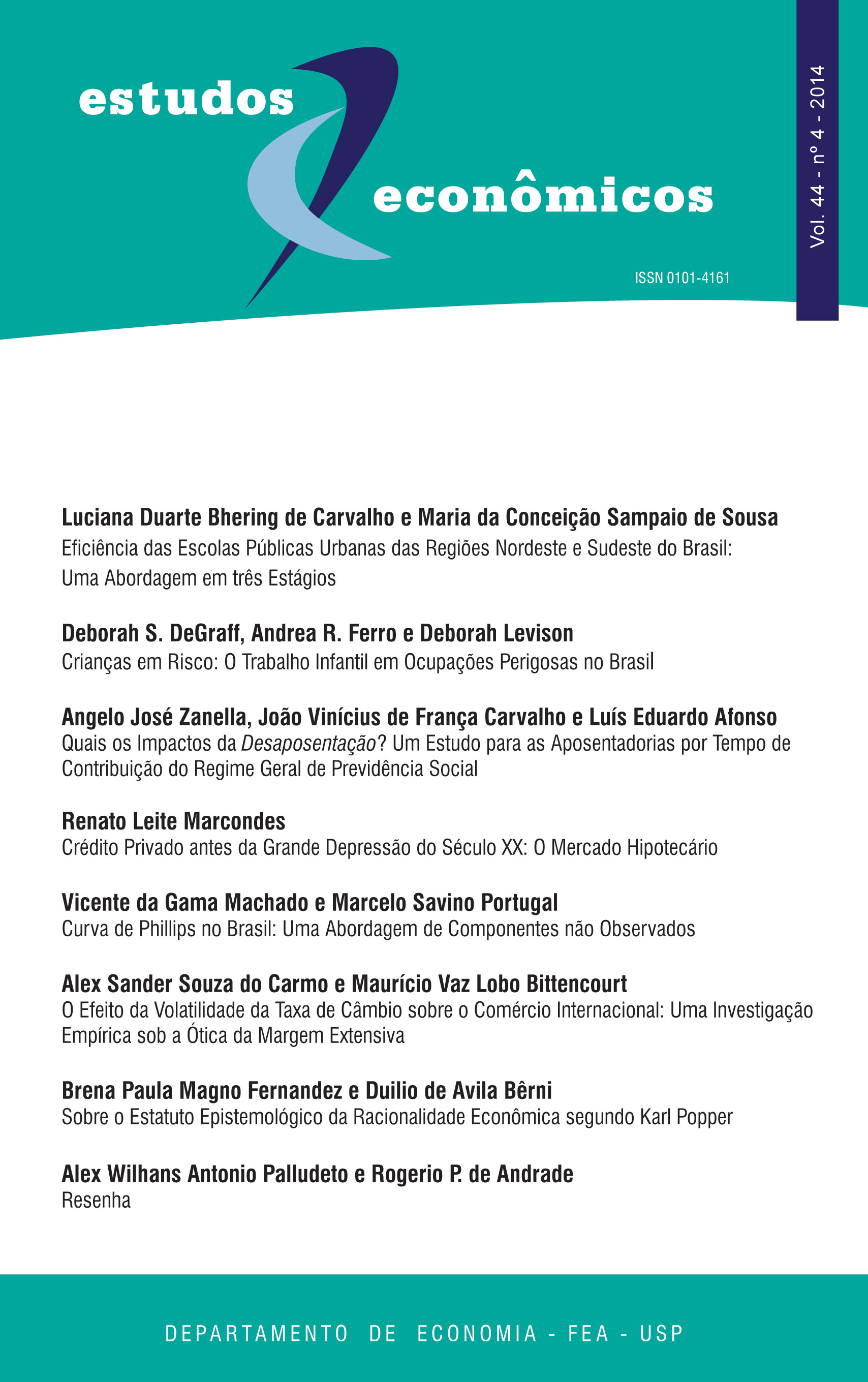
Kids at risk: children’s employment in Hazardous occupations in Brazil
DOI:
https://doi.org/10.1590/S0101-41612014000400002Keywords:
child labor, risky work, multivariate models, BrazilAbstract
While the literature on child labor in Brazil is large, it is not comprehensive: in particular, there are few studies on children’s work in risky occupations, and those that exist tend to be qualitative and based on limited samples. In this paper, we aim to paint a broader picture of children’s engagement in risky labor force work, based on quantitative evidence from PNAD data. We document associations between parental characteristics and children’s work, using both descriptive statistics and multivariate modeling to understand the determinants of child participation in risky labor force work. Brazilian children engaged in risky occupations are less likely than even other employed children to be enrolled in school, and more likely to work long hours and experience a variety of working conditions that may be unsafe. We also see that there are likely to be vast differences between girls and boys in their experience working in hazardous occupations, and that girls are over-represented in risky jobs in Brazil.
Downloads
References
ALBERTO, M.F.P, NUNES, T.S., CAVALCANTE, C.P.S., SANTOS, D.P. O Trabalho Infantil Doméstico
em João Pessoa - PB: um Diagnóstico Rápido à Luz Das Piores Formas de Trabalho
Infantil. Brasília: OIT, 2006.
ASSAAD, R., LEVISON, D. and ZIBANI, N. “The Effect of Domestic Work on Girls’ Schooling:
Evidence from Egypt,” Feminist Economics 16(1): 79-128, 2010.
BARROS, R.P., MENDONÇA, R.S.P. and VELAZCO, T. A Pobreza é a Principal Causa do Trabalho
Infantil no Brasil Urbano? Rio de Janeiro: IPEA, 1994.
BASU, K. “Child Labor: Cause, Consequence, and Cure, with Remarks on International Labor Standards,” Journal of Economic Literature 37(3): 1083–1119, 1999.
BASU, K. and, TZANNATOS, Z. “The Global Child Labor Problem: What Do We Know and What
Can We Do?” World Bank Economic Review 17(2): 147–173, 2003.
BOURDILLON, M., MYERS, W., LEVISON, D. and WHITE, B. Rights and Wrongs of Children’s
Work. New Brunswick NJ: Rutgers University Press, 2010.
Brasil - Presidência da República. Decreto n. 6481 de 12 de junho de 2008.
Brazil - Ministério do Trabalho e Emprego (Ministry of Labor and Employment), at http://siti.mte.gov.br/risks/list (accessed September 12, 2008).
CARDOSO, E. and SOUZA, A.P. “The Impact of Income Transfers on Child Labor and School Attendance in Brazil,” São Paulo: USP, at http://www.econ.fea.usp.br/elianacardoso/ECONBRAS/cardoso-souza.pdf. (accessed August 22, 2003), 2003.
CASTRO, C. L., GORMLY, S. and RITUALO, A. R. “The SIMPOC Philippine Survey of Children 2001: A Data Source for Analyzing Occupational Injuries to Children,” Public Health Reports 120, 2005.
CRUZ, M.N.A. and ASSUNÇAO, A.A. “Estrutura e Organização do Trabalho Infantil de Rua em Belo Horizonte, MG, Brasil,” Saúde Soc. São Paulo 17(1): 131-142, 2008.
DEGRAFF, D. S., FERRO, A. R. and LEVISON, D. “In Harm’s Way: Children’s Work in Risky Occupations in Brazil,” unpublished manuscript, 2014.
DEGRAFF, D. S., LEVISON, D. and ROBISON, M. “Child Labor and Mothers’ Work in Brazil,”
International Journal of Sociology and Social Policy 29(3/4): 152-163, 2009.
DEGRAFF, D. S., and LEVISON, D. “Children’s Work and Mothers’ Work – What is the Connection?” World Development 37(9): 1569-1587, 2009.
DI GIOVANNI, G. Aspectos qualitativos do trabalho infantil no Brasil. Brasília: OIT, 2004
DORMAN, P. “Child Labor, Education and Health: A Review of the Literature,” ILO/IPEC Working Paper. Geneva, Switzerland: International Labour Office, 2008.
EDMONDS, E. V. “Child Labor,” in Schultz, T.P. and Strauss, J. eds., Handbook of Development Economics 4. North-Holland (Elsevier), Amsterdam, 2008.
EDMONDS, E. and PAVCNIK, N. “Child Labor in the Global Economy,” Journal of Economic
Perspectives 19(1): 199–220, 2005.
FEITOSA, I.C.N. and DIMENSTEIN, M. “Trabalho Infantil e Ideologia na Fala de Mães Trabalhadoras,” Estudos e Pesquisas em Psicologia, UERJ, RJ 4(2), 2004.
FERRO, A.R. and KASSOUF, A.L. “Avaliação do Impacto dos Programas Bolsa Escola sobre o Trabalho Infantil no Brasil,” Pesquisa e Planejamento Econômico, Rio de Janeiro 35(December): p. 417, 2005.
FERRO, A.R., KASSOUF, A.L. and LEVISON, D. “The Impact of Conditional Cash Transfer Programs on Household Work Decisions in Brazil,” Research in Labor Economics 31: 161-218, 2010.
FILMER, D. and PRITCHETT, L. “Estimating Wealth Effects without Income or Expenditure Data – or Tears: Education Enrollment in India,” Demography 38 (1): 115-132, 2001.
GORMLY, S. and RITUALO, A. R. “When Is Child Work Hazardous? Evidence from the SIMPOC
Surveys,” unpublished manuscript, 2005.
GRANOVETTER, M. S. “The Strength of Weak Ties,” American Journal of Sociology 78(6): 1360-
, 1973.
IBGE Demographic Census, 2010.
IBGE Pesquisa Nacional por Amostra de Domicílios – PNAD, 2011.
ILO – International Labour Organization. O Trabalho Infantil Doméstico Nas Cidades de Belém, Belo
Horizonte e Recife: um Diagnóstico Rápido. Brasília: OIT, 2003.
ILO – International Labour Organization. Current International Recommendations on Labour Statistics, International Labour Office, Geneva, 2002.
ILO – International Labour Organization. Resolution Concerning Statistics of the Economically Active Population, Employment, Unemployment and Underemployment, Adopted by the Thirteenth International Conference of Labour Statisticians (October), at http://www.ilo.org/public/english/bureau/stat/download/res/ecacpop.pdf (accessed March 2010), 1982.
KASSOUF, A.L. Aspectos Socioeconômicos do Trabalho Infantil no Brasil. Brasília: Ministério da
Justiça, 2002.
LAMARÃO, M.L.N. O Trabalho Doméstico de Meninas em Belém. Belém: Cedeca-Emaús, UNICEF, Save the Children, 2000.
LEVISON, D. and LANGER, A. “Counting Child Domestic Servants in Latin America,” Population
and Development Review 36(1): 125-149, 2010.
LEVISON, D., HOEK, J., LAM, D. and DURYEA, S. “Intermittent Child Employment and Its Implications for Estimates of Child Labour,” International Labour Review 146(3-4): 217-251, 2007.
MADSIAN, C. “Not for Bread Alone: Peanut Vendors in Brazil,” in G.K. Lieten, ed. Working Children around the World: Child Rights and Child Reality, New Delhi: Institute for Human Development, pp. 128-139, 2004.
MINNESOTA POPULATION CENTER. Integrated Public Use Microdata Series — International:
Version 4.0, Minneapolis: University of Minnesota, at www.ipums.org, 2008.
NICOLELLA, A.C., KASSOUF, A.L. and BARROS, A.L.M. “O Impacto do Trabalho Infantil no Setor
Agrícola Sobre a Saúde,” Revista Brasileira de Economia e Sociologia Rural 46(3): 673-701, 2008.
PESQUISA NACIONAL POR AMOSTRA DE DOMICÍLIOS. Fundação Instituto Brasileiro de Geografia e Estatística, 2001.
PESQUISA NACIONAL POR AMOSTRA DE DOMICÍLIOS. Fundação Instituto Brasileiro de
Geografia e Estatística, 2008.
PORTELA, A. and EMERSON, P.M.S. “Is There a Child Labor Trap?” Intergenerational Persistence of Child Labor in Brazil,” Economic Development and Cultural Change 51(2): 375-398, 2000.
SABOIA, A.L. As Meninas Empregadas Domésticas: Uma Caracterização Sócio-econômica. Rio de Janeiro: OIT, 2000.
YAP, Y., SEDLACEK, G. and ORAZEM, P.F. “Limiting Child Labor through Behavior-based Income
Transfers: An Experimental Evaluation of the PETI Program in Rural Brazil,” at http://
poverty.worldbank.org/files/11375_orazem-peti-brazil.pdf (accessed March 17, 2003), 2003.
Downloads
Published
Issue
Section
License
Copyright (c) 2014 Deborah S. DeGraff, Andrea Rodrigues Ferro, Deborah Levison

This work is licensed under a Creative Commons Attribution-NonCommercial 4.0 International License.
By submitting an article, the author authorizes its publication and attests that it has not been submitted to any other journal. The original article is considered final. Articles selected for publication are proofread for grammatical and orthographic errors. The journal does not pay rights for published articles. The Institute of Economic Research from the School of Economics, Business and Accounting of the University of São Paulo (Instituto de Pesquisas Econômicas da Faculdade de Economia, Administração e Contabilidade da Universidade de São Paulo) owns the journal's copyright.


 Atualizado em 14/08/2025