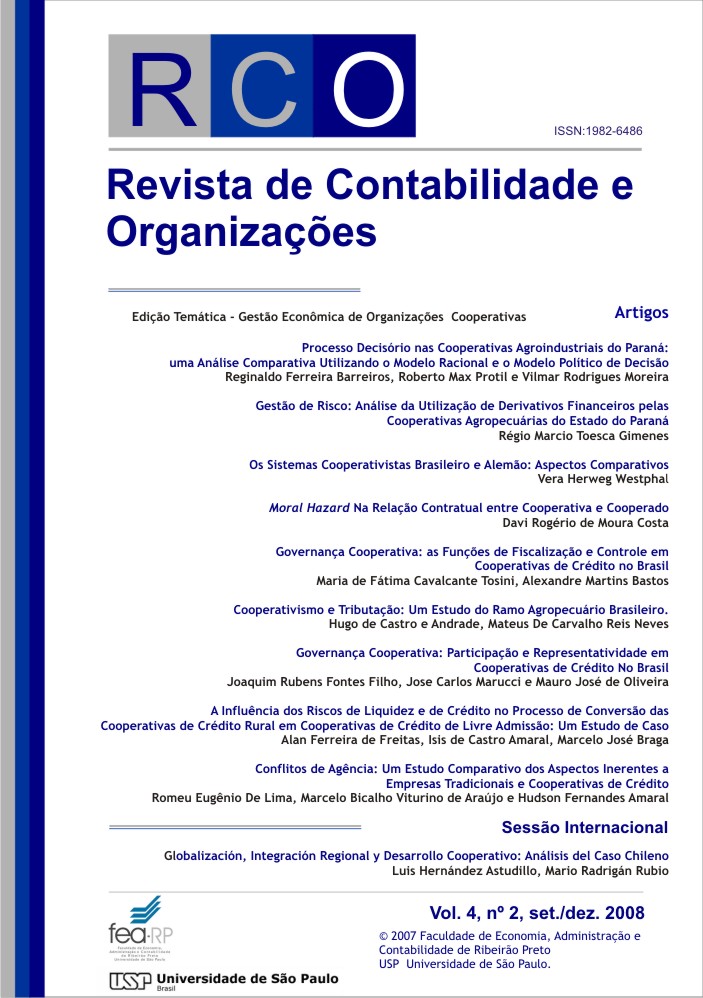
Cooperative governance: the role of supervision and control in credit cooperative in Brazil
DOI:
https://doi.org/10.11606/rco.v2i4.34722Keywords:
Financial cooperative, governance, supervision, controlAbstract
The article analyzes supervision and control functions in financial cooperatives as necessary elements to good governance practices in such organizations, suggesting instruments and conditions in a way to enable, with no significant cost impacts and respected the individual characteristics of each financial cooperative, a development in the controlling and monitoring ability of agents involved in this process. Supervision and control have a fundamental role in governance of such institutions, allowing their members and officials to assess the reach of corporate goals and refine strategic goals assuming, in consequence, a relevant role in the continuity of financial cooperatives. The article discloses the result of an institutional survey, conducted by the Central Bank of Brazil, in both the universe of single financial cooperatives and a sample of their members, with the purpose of compiling and understanding their main governance practices. Answers provided by 1199 financial cooperatives and 420 members were compared and analyzed vis-à-vis the functions of supervision and control in financial cooperatives. Based on such analyses, reflections and directions are suggested to improve financial cooperative governance.Downloads
Downloads
Published
Issue
Section
License
The RCO adopts the Free Open Access policy, under the standard Creative Commons agreement (CC BY-NC-ND 4.0). The agreement provides that:
- Submission of text authorizes its publication and implies commitment that the same material is not being submitted to another journal. The original is considered definitive.
- Authors retain the copyright and grant the journal the right of first publication, with the work simultaneously licensed under the Creative Commons Attribution License which allows the sharing of the work with acknowledgment of authorship and initial publication in this journal.
- Authors are authorized to take additional contracts separately, for non-exclusive distribution of the version of the work published in this journal (e.g. publish in an institutional repository or as a book chapter), with necessary recognition of authorship and initial publication in this journal.
- Authors are allowed and encouraged to publish and distribute their work online (e.g. in institutional repositories or on their personal page) before or during the editorial process, as this can generate productive changes as well as increase the impact and citation of published work (See The Effect of Free Access).
- The journal does not pay copyright to the authors of the published texts.
- The journal's copyright holder, except those already agreed in the Free Open Access Agreement (CC BY-NC-ND 4.0), is the Accounting Department of the Faculty of Economics, Administration and Accounting of Ribeirão Preto of the University of São Paulo.
No submission or publication fees are charged.
Up to 4 authors per article are accepted. Exceptionally duly justified cases may be reviewed by the Executive Committee of the RCO. Exceptional cases are considered as: multi-institutional projects; manuscripts resulting from the collaboration of research groups; or involving large teams for evidence collection, construction of primary data, and comparative experiments.
It is recommended that the authorship be ordered by contribution of each of the individuals listed as authors, especially in the design and planning of the research project, in obtaining or analyzing and interpreting data, and writing. Authors must declare the actual contributions of each author, filling the letter to the editor, at the beginning of the submission, taking responsibility for the information given.
Authors are allowed to change throughout the evaluation process and prior to the publication of the manuscript. The Authors should indicate the composition and final order of authorship in the document signed by all those involved when accepted for publication. If the composition and authoring order is different than previously reported in the system, all previously listed authors should be in agreement.
In the case of identification of authorship without merit or contribution (ghost, guest or gift authorship), the RCO follows the procedure recommended by COPE.