Archives
-

Primer Semestre 2024
Vol. 11 No. 23 (2024)Issue 23 of the Revista de Estudios Brasileños presents a wide range of articles, interviews, and reviews that reflect the thematic and methodological diversity of Brazilian studies. Without a specific thematic dossier, this volume brings together original research spanning history, social sciences, literature, education, health, environment, and science and technology, offering readers a comprehensive overview of recent academic production.
The articles cover topics ranging from the role of social and human capital in local development in the Amazon to the emergence of biobanks as a scientific infrastructure in Brazil. Other contributions discuss scientists’ personal archives as sources for the history of science, medical practices in the 19th-century Paraíba Valley, and the television adaptation of Morte e Vida Severina as an educational resource. The issue also includes analyses of environmental science and Actor-Network Theory, the financial dependence of small municipalities, and the use of science and technology in the Amazon during the military dictatorship.
Further reflections address Indigenous health policies and intermedicality among the Xukuru do Ororubá people, the importance of Antônio Coruja’s Compêndio da gramática da língua nacional for understanding the relationship between language and nation, and a study of state-level containment measures against COVID-19. Another article on urban memory revisits the narratives of João do Rio and Vincenzo Pastore to reflect on incipient citizenship in Brazil’s First Republic.
In addition to the articles, this issue features an interview with photographer Tony Genérico about his work Threatened Beauty, situated at the intersection of art and science, and a review of the collective book Movimento #FicaEspanhol. Lutas e Resistências.
With this edition, the REB reaffirms its commitment to disseminating innovative and interdisciplinary research on Brazil, inviting readers to engage with key debates that help illuminate the country’s history and contemporary challenges.
-

Second Semester 2023
Vol. 10 No. 22 (2023)The complexity of Brazilian reality serves as an invitation to reflect upon it, deepening the understanding of its past, present, and the multiple challenges that must be faced in the future. Within this framework, the thematic diversity and the relevance of the issues addressed stand out as the defining features of the studies compiled in this issue. The articles gathered here address issues related to the environment and the urgent need for its preservation. Likewise, other works, from a historical perspective, analyze aspects of Brazilian society in the nineteenth century, the relationship between literature and its production context, as well as comparative studies. Education and culture within Brazilian society also hold a prominent place, with research focusing on higher education, foreign language teaching, media discourse, and identity constructions. This issue also features a particularly revealing interview with Ricardo Rezende Figueira, Professor of Human Rights at the Federal University of Rio de Janeiro (UFRJ, Brazil), in which it is discussed how the State’s omission in certain areas and regions jeopardizes the fundamental rights guaranteed by the Brazilian Constitution. We express our sincere gratitude to the authors for their valuable contributions, as well as to the external reviewers and editorial team, whose efforts make the publication of this journal possible. We wish all our readers an enriching reading experience.
-
First Semester 2023
Vol. 10 No. 21 (2023)The Revista de Estudios Brasileños addresses in the dossier of this issue a classic and central theme of current scientific thought: the relationship between Social Sciences studies and Science and Technology studies. In the following pages, a specific but plural aspect is analyzed: the study, from the social sciences, of the performance and content of Science and Technology studies. It is plural because, as highlighted in the introduction to the dossier and reflected in the diversity of the works collected here, the content of the different Social Sciences and the content of what are known as 'pure sciences' is very different.
The History of Science is also that of the incorporation into it of the Social Sciences, which always involve a projection of values of a very different nature onto the reality to be analyzed, which is often the result of research inherent to the experimental sciences. This undoubtedly brings the relationship between experimental sciences and Social Sciences to the forefront, making the subjects of reflection very plural and making it especially interesting to analyze, from the Social Sciences, not only the results of the research of the experimental sciences, but also the reasons that lead them to choose certain research topics and the evaluation of the method employed.
Therefore, the studies in the dossier invite the reader of a Social Sciences journal, such as the Revista de Estudios Brasileños, to reflect on the other sciences, not to consider them as something distant, but on the contrary, as a knowledge connected to their research and their own decisions.
-

Second Semester 2022
Vol. 9 No. 20 (2022)The Revista de Estudios Brasileños reaches its 20th issue and does so in an important year, the Bicentennial of Brazilian Independence. This special anniversary could not be ignored by the journal and the content of the Dossier is dedicated to it. The dossier is coordinated by the current director of the Centro de Estudios Brasileños, professor at the University of Salamanca, and specialist in Brazilian History, José Manuel Santos. In the section were published six articles from authors from different universities and different countries, who analyze some aspects of the roots of current Brazil, Independence itself, and the first problems to be addressed by the new State.
This issue is completed with three attractive interviews. The first one is with Stuart B. Schwartz. This Yale’s professor is probably one of the most recognized and influential specialists among historians of colonial Brazil. The second interview is with the professor and researcher at USP, Prof. Amancio Jorge de Oliveira, vice director of the Ipiranga Museum, in the occasion of the reopening of the institution, one of the most significant events of the Bicentennial, which can be valued as a success, as it makes it possible to relive this significant moment of Brazil's Independence. In the last interview, Prof. Pedro Dallari (USP) interviews Rubens Ricupero, responsible, in 2022, for the José Bonifácio Chair, of the Institute of International Relations (IRI, USP), whose research topic was the Bicentennial of Independence from Brazil.
All that makes this news issue of the Revista de Estudios Brasilñeos particularly interesting for those who wants to know more about the past or present of Brazil.
-

Special Issue Pandemic in Brazil
Vol. 9 No. 19 (2022)The theme of this special issue of Revista de Estudios Brasileños, from the Center for Brazilian Studies at the Universidad de Salamanca, deals with the impacts and management of the COVID-19 pandemic in Brazil.
-

First Semester 2022
Vol. 9 No. 18 (2022)This issue we present now corresponds to the first volume of the year 2022. The journal brings together a total of nine articles in the General Section that, as always, analyze different aspects of the Brazilian reality. Education and indigenous culture, as well as public policies for the Brazilian Amazon region once again occupy several pages of this publication, highlighting the relevance of the topic for Brazilian present moment. The Dossier is dedicated to a subject very dear to the USAL: the teaching and learning of Spanish, in this case, focused on the Brazilian reality. The section was coordinated by professors Andréia Roder Carmona-Ramires (Universidade Estadual do Paraná, UEPR, Brazil) and Odair Luiz Nadin (Universidade Estadual Paulista, Unesp, Brazil), responsible for selecting the material that we now offer to our readers. In addition to the section presentation article (signed by the coordinators), the Dossier includes the articles of Marcella Nascimento Fernandes and Letícia Coroa do Couto, about the experience of carrying out an extension course dedicated to Spanish for Specific Purposes. Next, we have the article by Graziellen Gelli Pinheiro Lima, which presents an analysis of the Spanish course programs in the federal universities of the Brazilian Northeast; and, closing the section, the work of Glória de Fátima Pinotti de Assumpção, who contributes with a discussion technique about the teaching of Terminology in Technical Vocational Education of Secondary Level. To finish, we would like to greatly appreciate the contribution of all the authors, collaborators and all the professionals who have directly or indirectly contributed to the preparation of this issue that we finally publish.
We wish all readers enjoy reading.
-

Second Semester 2021
Vol. 8 No. 17 (2021)In 2001, the Universidad de Salamanca created the Centro de Estudios Brasileños, with the aim of promoting academic and exchange relations between the University and Brazilian Higher Education institutions. Since then, the CEB has had the collaboration of the Embassy of Brazil in Madrid, the Junta de Castilla y León and the Fundación Cultural Hispano-Brasileña, among many other national and international academic and cultural institutions.
The Revista de Estudios Brasileños, created in 2014, is one of the initiatives promoted by the CEB, as part of its commitment to academic cooperation and scientific dissemination about Brazil. And for this, the collaboration with the University of São Paulo is decisive, in the sense of strengthening the dialogue for the dissemination of knowledge about Brazil and the internationalization of the University and this Center.
In this sense, the reader of this issue will find, in the "Varia" section, the article entitled "Twenty years later", which tells the history of the institution, illustrated by a set of photographs that collect some important moments of the history of CEB. As in all issues, the REB publishes in the "General Section" articles that address different topics on Brazil, maintaining the plurality of content and analytical approaches. The "Dossier" brings together seven articles that, from different perspectives, address the issue of sustainable development in Brazil. The studies gathered in the section analyze some consequences of the pandemic in Brazil, the possibilities of tourism as a practice for regional development, photovoltaic energy, solid waste treatment, the importance of a sustainable urbanization process and the Brazilian environmental policy in comparative perspective.
This issue also includes an interview conducted by Prof. Ascensión Rivas Hernández to the Brazilian writer, academic and member of our Advisory Council, Ana Maria Machado. The writer was honored at the second edition of the International Congress of Brazilian Literature, which the CEB organizes every two years, in collaboration with the Brazilian Academy of Letters. In the interview, Ana Maria Machado talks about her work as a writer and her doctorate under the supervision of Roland Barthes.
Finally, in this issue, Ignacio Berdugo (co-director of the REB since 2022), signs an article on the challenges of international criminal law in the Brazilian Amazon. We cannot finish this presentation without thanking enormously the contribution of all the authors, collaborators, reviewers and all the professionals who have worked so that this number has finally seen the light.
We wish you all a happy reading.
-

Vol. 8 No. 16 (2021)
En la segunda parte del año 2020 y a inicios del presente 2021, la pandemia de COVID-19 causada por el virus Sars-Cov-2 ha seguido creciendo a un ritmo alarmante, alcanzando a todos los lugares del planeta y causando estragos en todos los continentes. Dos de los países más afectados, si bien con diferentes respuestas ante el problema, han sido España y Brasil, en los que se edita esta Revista. La variada reacción de las autoridades brasileñas, con confinamientos puntuales y de escasa efectividad, ha causado que la enfermedad se extendiera muy rápidamente en los meses finales de 2020 y en los primeros días de 2021. La situación se ha vuelto crítica en muchas ciudades, fundamentalmente en Manaos, donde una supuesta inmunidad de rebaño no fue suficiente para contener una nueva ola que, según los virólogos, corresponde a una nueva cepa del virus, la denominada “variante brasileña”. La expansión de esta variante ha provocado una restricción a escala global de las comunicaciones aéreas con Brasil, con el resultado de que en estos momentos tengamos el nivel más bajo de contactos entre este país y España/Europa de los últimos 20 años. A nadie se le escapa la gravedad de estos hechos y el impacto que tienen y tendrán en las relaciones internacionales y en los intercambios económicos, sociales o académicos entre nuestros países. Afortunadamente, las campañas de vacunación han comenzado, aunque avanzan a ritmos muy diferentes en las diferentes regiones y estados. Una mirada objetiva demuestra que Brasil tiene bajos datos de vacunación por millón de habitantes, aunque los cambios en el ministerio de Sanidad, con relevo del anterior ministro, dan a entender que hay un empeño por modificar la situación y acelerar el ritmo de vacunación. La Revista de Estudios Brasileños quiere expresar su solidaridad y sentimientos de pésame a las familias y allegados de las víctimas que esta terrible enfermedad está causando. Con este número 16 la REB continúa y reafirma su compromiso con la difusión de la investigación realizada en y sobre Brasil.
Feliz lectura.
-
Vol. 7 No. 15 (2020)
We reached number 15 of our Revista de Estudios Brasileños. It is an achievement to celebrate and for several reasons. In the first place, the constant publication of our editions, bringing the best to deal with in the presentation of issues related to Brazil, in the perspective of the academic-scientific dialogue proposed at the time of its foundation. It was a feat to do this at a time of extreme crisis in the publishing sector, not only caused by the global economic crisis, but, above all, by the specific perspective of the market, with huge competition with other media. Last but not least, there was also the unprecedented crisis caused by the Covid-19 pandemic, with the worldwide enactment of restrictions of various types, including lockdowns, all of which made it difficult to maintain the regularity of editorial publications. We can therefore say that we have won. We managed to close the editorial cycle of the year 2020, with this emblematic issue, within our expected regularity of editions, carried out with Ediciones Universidad de Salamanca, with the always noted quality put in the endeavor. The quality of the articles and reviews brought speaks for itself. In this issue, the dossier is dedicated to the Brazilian Amazon, coordinated by professors Raimunda Nonata Monteiro (UFOPA, Brazil), Enaile do Espírito Santo Iadanza (UnB, Brazil) and Helena Maria Martins Lastres (UFRJ, Brazil). In the interview section, we have two very interesting ones, namely, that with Bruno Ayllón Pino, a politologist and specialist in Brazilian international relations, conducted by José Manuel Santos Pérez and Elisa Tavares Duarte, co-director and editor of REB respectively, and the one made with Fernanda Viegas Reichadt, collaborator of the Institute for Advanced Studies at USP, about the panorama of indigenous lands in the face of the Covid-19 pandemic, conducted by Caio Rodrigo Albuquerque, journalist at USP's “Luiz de Queiroz” School of Agriculture. We are sure that, once again, we have fulfilled the objective that has guided our REB since its foundation: to offer first-rate literary material and provoke reflections and considerations of magnitude on the studies it proposes. Happy reading to all!
-

Vol. 5 No. 9 (2018)
The Revista de Estudios Brasileños (Journal of Brazilian Studies) publishes the ninth issue in its fifth year of editorial life, with the full consolidation of the project and a large acceptance by authors and readers. During the last few years, Brazil has experienced some of the most intense moments of its recent history, such as the organization of the World Cup, the Olympic Games in Rio de Janeiro and, in political terms, the impeachment process of President Dilma Rousseff in 2016. All these events were observed by a perplexed society, which saw the country moving from an intense collective euphoria during the last years of Lula's government and the first term of Dilma's to a feeling of deep economic, political and social crisis, whose solution cannot be foreseen and which, as a roller coaster, has led Brazilians from an exacerbated optimism to a sensation of defeat, asceticism and disaffection towards the political system and its ruling elites. Corruption cases have contributed greatly to this feeling, which, although common in Western democracies in the first two decades of the 21st century, acquires in Brazil a special dimension both for its strategic importance as well as for the depth and intensity of this unstable period.
-
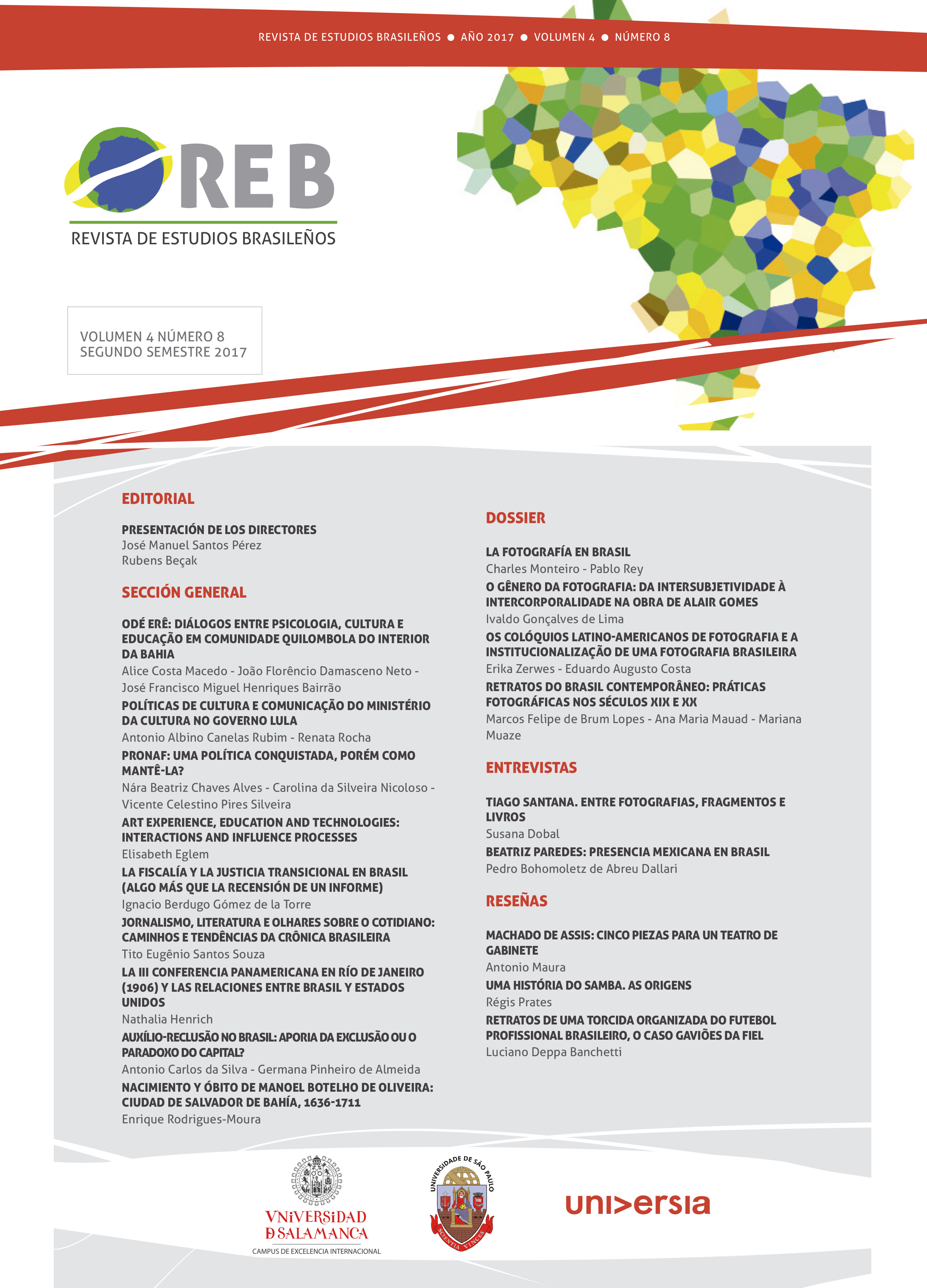
Vol. 4 No. 8 (2017)
With great joy comes the Revista de Estudio Brasileños to its eighth issue! A feat that should be celebrated and which demonstrates that the goals set at the time of its launch were and remain successful. The knowledge of what is important in Brazilian affairs, with the special treatment and dissemination of the editorial are a deserving celebration. -
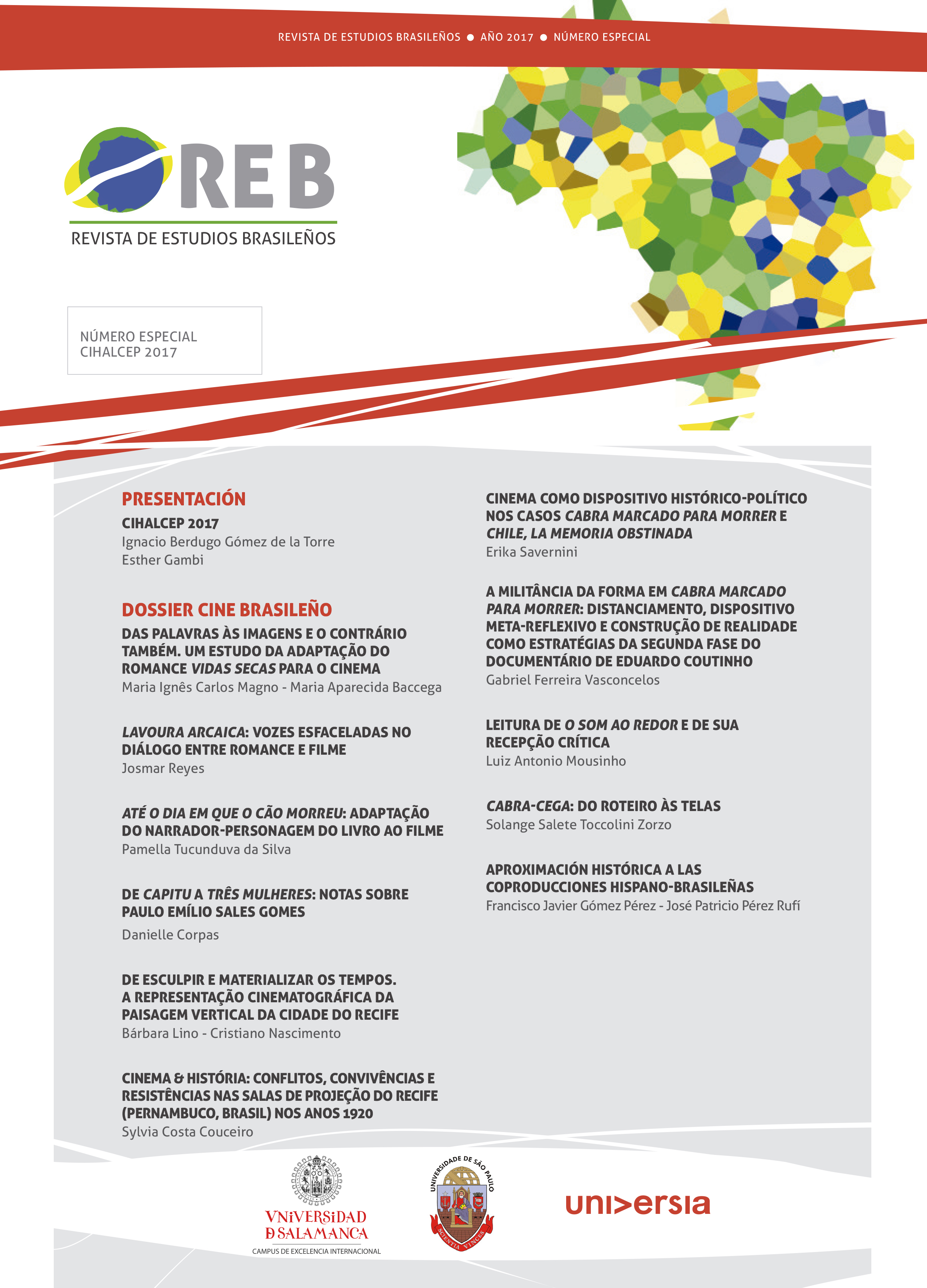
Special Issue Brazilian cinema CIHALCEP 2017
Vol. 4 No. 7 (2017)Special issue dedicated to the Brazilian cinema, organized in collaboration with the IV Congreso Internacional de Historia, Arte e Literatura en el Cine en Español y Portugués (CIHALCEP 2017), of the Centro de Estudios Brasileños of Salamanca`s University, that took place in Salamanca, between June 28th and 30th 2017. -

Vol. 4 No. 6 (2017)
This issue presents as “Dossier`s” theme “Una aproximación al conocimiento del territorio brasileño y a sus relaciones con España”, coordinated by Professor Valentín Cabero, professor of Geography at the University of Salamanca, who also conducted an interview with Professor George Gurgel, from the Federal University of Bahia, who was deeply knowledgeable about the reality of sustainable development in Brazil.
The Revista de Estudos Brasileños, in this way, contributes in its number 6 to the great debate that occurs on a global scale, and more concretely in Brazil, on the environmental challenge that humanity has raised and whose resolution will be vital for a development Stable and durable in the coming years.
The number 6 also publishes in its “General Section” texts of varied topics ranging from academic mobility between Spain and Brazil in recent years, the specificities of the Brazilian statistical system, coalition presidentialism or public policies of education in the vision Of young political activists.
-
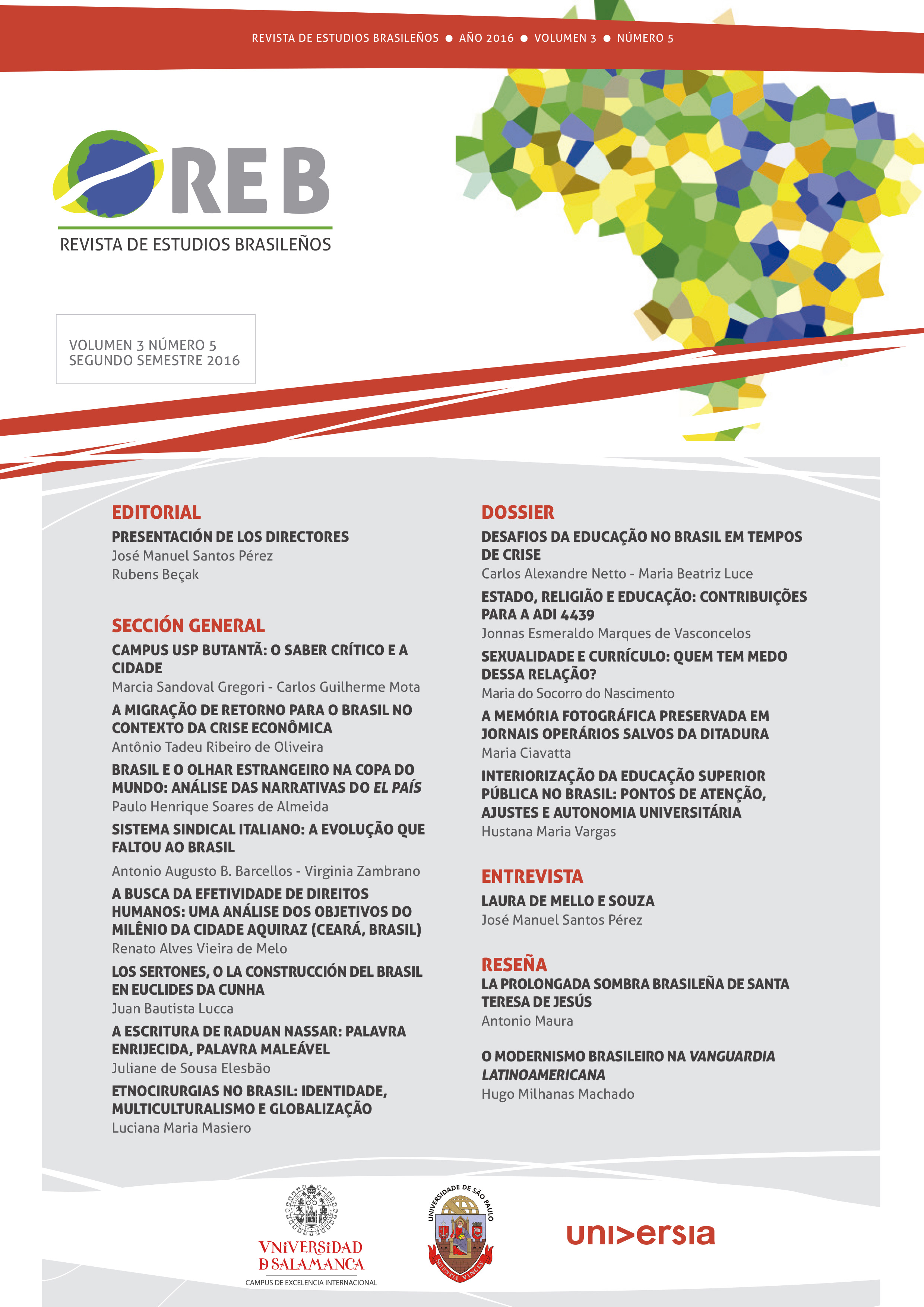
Vol. 3 No. 5 (2016)
The Revista de Estudios Brasileños presents its fifth number in its third year of publishing life. Over the years, the REB had the invaluable collaboration of authors, reviewers, proofreaders and, in particular, readers that allowed the magazine to be consolidated as a reference in the dissemination of scientific knowledge produced in and about Brazil.
In this issue, the "Dossier", "Education" in Brazil, was coordinated by Professors Carlos Alexandre Netto and Maria Beatriz Luce, both from the Federal University of Rio Grande do Sul (Brazil). The current Brazilian context and past experiences in the field of Education imposed the choice of the theme and its consequences: the discussion on secularity, sexuality and curriculum, training for employment and memory, and finally the process of internalization of higher education institutions.
In the "Interview" section, the director of the Revista de Estudios Brasileños and Professor at the University of Salamanca, José Manuel Santos Pérez, spoke with the historian Laura de Mello e Souza, a Professor at the Paris IV University - Sorbonne.
We appreciate all the people who contributed to this issue publication and we take opportunity to reaffirm our commitment to disclosure and disseminate scientific knowledge about Brazil.
-

Vol. 3 No. 4 (2016)
The magazine Brazilian Studies reaches its third year of publishing life with this No. 4 , while maintaining the commitment to act as a "knowledge bridge" between the countries involved, to do justice to the long tradition of Spanish-Brazilian cooperation, especially, the dissemination of scientific and academic diversity and affirming so, step by step, as refereed journal.
-
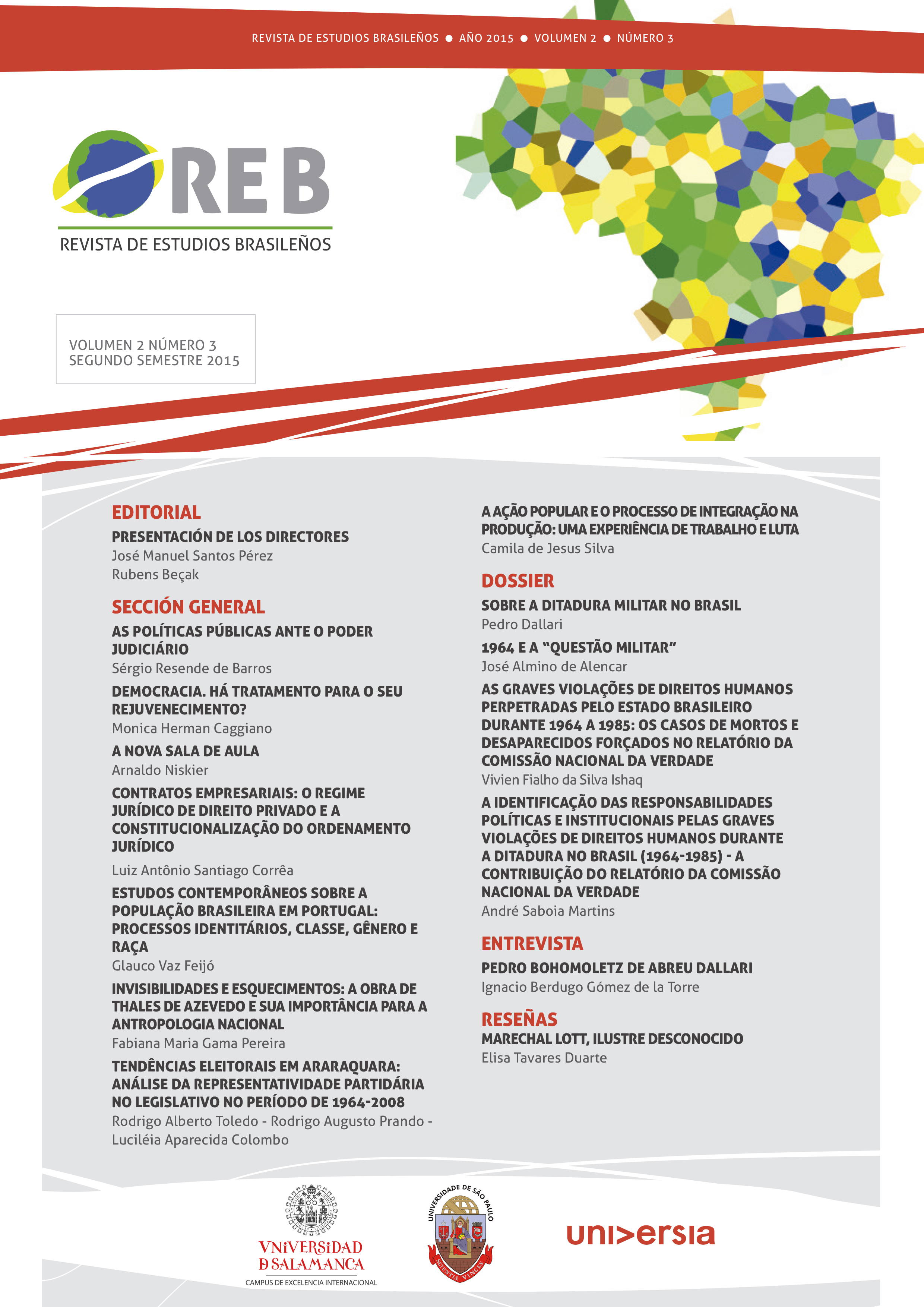
Vol. 2 No. 3 (2015)
The magazine Brazilian Studies released its number 3 edition, leaving behind the embryonic stage, consolidating itself as a reference for specialized studies about Brazil in different areas of knowledge. And it does it in a big way: We released a special issue in which the National commission of truth, that has given its final report to President Dilma Rousseff on December 2014, is the biggest protagonist. On the other hand, the director of the Brazilian Study Center from Salamanca’s university, Professor. Dr. Ignacio Berdugo has interviewed the professor from São Paulo Law University, Dr. Pedro Dallari, who is the commission coordinator and responsible for the final report. On the other hand, professor Dallari coordinates the dossier fully devoted to the military period containing articles from José Almino de Alencar, Vivien Ishaq and André Saboia Martins.
-

Vol. 2 No. 2 (2015)
This issue of the Journal of Brazilian Studies (REB) highlights in particular the 2014 elections in Brazil. The Dossier was coordinated by Dr. Manuel Alcántara, Professor of Political Science of the University of Salamanca. In its eagerness to approach the different aspects of Brazilian reality, REB also contains in this issue articles addressing matters in Economics, History, Language, Literature and other areas, in addition to an interview with the Emeritus Professor of History from the Universidade de São Paulo, Carlos Guilherme Mota, and a section of reviews and news. The call for papers put out in October was received with such enthusiasm that we were forced to make a selection from the many submissions. We are quite proud and thankful for the interest in REB that authors have shown.
-

Vol. 1 No. 1 (2014)
Internationalization is a characteristic of our society, impinging on politics, culture, economic affairs and education. In fact, there is no single aspect of society that is not governed or at least influenced by this phenomenon.
Universities must react to this current world trend through internationalization policies, which should not be limited to student exchanges or relations between researchers –which are by the way bountiful- but must also pass through institutional relations and the detection of the identifying features of other countries. Gaining in-depth insight into the cultures and knowledge of other realities is an indication of the quality of a university, since such cultures and knowledge help to train professionals in all spheres of human endeavour, and these professionals will therefore be better able to carry out their professional activities in a globalized world.
The Revista de Estudios Brasileños reflects the commitment of three institutions to the challenges currently faced by universities. These are the Universities of Salamanca and Sao Paolo, emblematic in their respective countries, and Universia, which represents the new technologies in the service of Higher Education institutions throughout Latin America.
-

Second semester
Vol. 11 No. 24 (2024)Presentation of Issue 24 of the Journal of Brazilian StudiesThe Journal of Brazilian Studies (Revista de Estudos Brasileños – REB) publishes its 24th issue, reaffirming its commitment to the dissemination of scholarly knowledge about Brazil from an interdisciplinary and international perspective. This issue brings together research addressing historical, social, political, cultural, educational, and public health topics, reflecting the thematic and methodological diversity that currently characterizes Brazilian Studies.
The articles published in this issue originated from papers presented at the 3rd International Conference on Social Sciences and Humanities, "Brazil 1824–2024: Between Centralization and Decentralization," organized by the Center for Brazilian Studies of the University of Salamanca in June 2024. The conference brought together researchers from Brazil, Spain, and other countries to reflect on the bicentennial of the Brazilian Constitution of 1824 and to discuss the many ways in which the tensions between centralization and decentralization have shaped the country's history and contemporary reality.
The high scholarly quality of the papers presented at the conference, together with the breadth and diversity of the topics discussed, made it possible to prepare two consecutive issues of REB devoted to publishing a selection of the conference contributions. This issue represents the first installment of that editorial project, while Issue 25 will continue disseminating new research derived from the conference.
The articles included in this issue examine topics as diverse as the internationalization of higher education, academic cooperation, international student mobility, educational policies, the construction of the Brazilian state, public health, children's participation, the memory of the Brazilian civil-military dictatorship, gender relations, contemporary Afro-Brazilian literature, and the incorporation of new technologies into education and healthcare. Drawing on different disciplinary perspectives—including history, sociology, education, political science, public health, and literary studies—the authors provide rigorous analyses that contribute to expanding our understanding of some of the historical processes and contemporary challenges that define present-day Brazil.
The issue also includes a review of the book E se uma cobra picar? Tem o soro para tratar!: obra que conecta literatura infantojuvenil, ciência e educação não formal, which examines the role of the Butantan Institute in promoting science communication for children and fostering scientific culture through non-formal educational strategies.
The publication of this issue also reflects the consolidation of the International Conference on Social Sciences and Humanities as one of the leading forums for the academic community devoted to Brazilian Studies. Throughout its successive editions, the conference has strengthened interdisciplinary dialogue, fostered new international research networks, and promoted the circulation of studies that enrich knowledge about Brazil from multiple and complementary perspectives.
With this new issue, the Journal of Brazilian Studies reaffirms its mission as a platform for disseminating high-quality research and fostering dialogue among scholars from different countries and academic disciplines. At the same time, it announces the continuation of this editorial initiative with the publication of Issue 25, which will feature a second selection of papers presented at the 3rd International Conference on Social Sciences and Humanities, further advancing a collective effort to strengthen research and international academic cooperation in the field of Brazilian Studies.
-

First Semester
Vol. 12 No. 25 (2025)The Revista de Estudios Brasileños (REB) publishes its 25th issue as a continuation of the papers presented at the III Congresso Internacional de Ciências Sociais e Humanas "Brasil 1824–2024: entre centralismo e descentralização", organized by the Centro de EStudios Brasileños at the Universidad de Salamanca in June 2024. This volume reaffirms the journal's commitment to disseminating interdisciplinary research that contributes to a broader understanding of Brazil from historical, political, social, and cultural perspectives.
Inspired by the bicentenary of the 1824 Constitution, the articles gathered in this issue examine the many expressions of the tensions between centralization and decentralization that have shaped the Brazilian State since Independence and continue to influence the country's contemporary challenges.
The opening studies revisit the development of Brazilian political thought by examining the role of the State in Alberto Torres's ideas and the historical context of Brazil's first Constitution. The discussion then turns to recent political developments through an analysis of the ideological foundations of Jair Bolsonaro's government and its electorate, as well as the transformations in State–society relations brought about by the digitalization of public administration through the Gov.br portal.
Territory, governance, and development are central themes throughout the volume. The articles investigate territorial development in the state of Bahia, political participation in the metropolitan outskirts of Rio de Janeiro, the historical formation of territories in the Amazon, and methodological approaches to mapping the health industrial complex on a global scale.
Public policies also receive particular attention. One study examines the role of Primary Health Care in responding to the COVID-19 pandemic in Northeastern Brazil, highlighting the impact of longstanding regional inequalities. In the field of education, the issue discusses Brazilian educational policies, scientific production within the Federal Institutes, and the effects of neoliberal reforms on initial teacher education.
The volume concludes with a historical analysis of the relationship between the Instituto de Organização Racional do Trabalho (IDORT), the newspaper O Estado de S. Paulo, and the Estado Novo, showing how industrialization, labor organization, and worker education became interconnected in the first half of the twentieth century.
Taken together, the contributions published in this issue demonstrate the vitality and diversity of contemporary Brazilian Studies and offer valuable insights into the historical and institutional processes that continue to shape Brazil, reinforcing the interdisciplinary dialogue that lies at the heart of the Revista de Estudos Brasileiros.