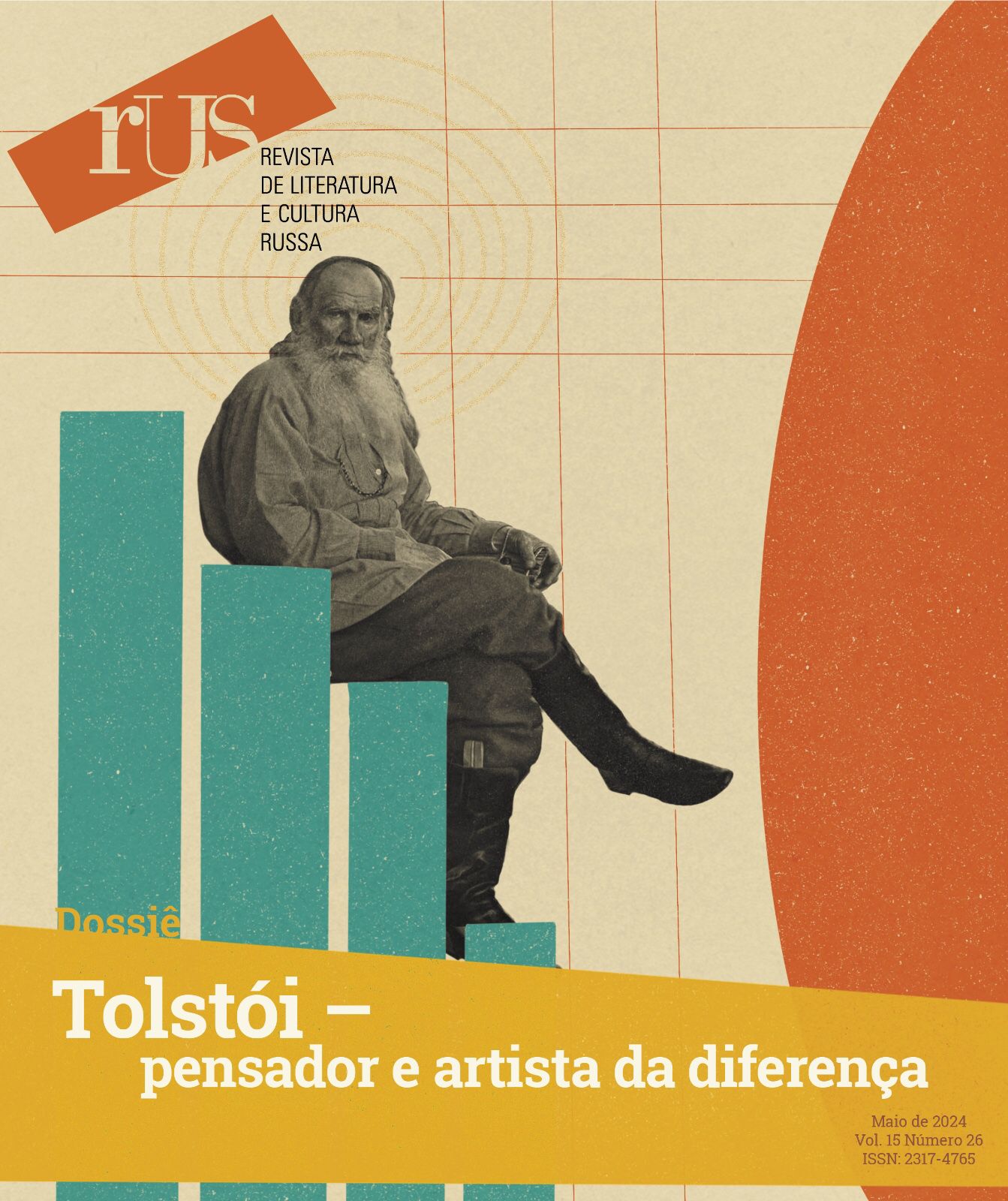
Tolstoy Against Things: Ostranenie, Pragmatic Conversions and Natural Attitude
DOI:
https://doi.org/10.11606/issn.2317-4765.rus.2024.224584Keywords:
Viktor Shklovsky, Lev Nikolaevich Tolstoy, OstranenieAbstract
The article discusses Viktor Shklovsky's concept of defamiliarization (ostranenie) from a broad perspective, including criticisms of it, its contemporary ramifications and even parallels, such as the Brechtian V-effekt. The author then moves on to a broad approach of Lev Tolstoy's work from the perspective of the previous considerations regarding the shklovskian term, bringing to light various particularities of Tolstoyan poetics that tension Shklovsky's formulations.
Downloads
References
ANKERSMIT, Franklin R. Sublime historical experience. Standford: Standford university press, 2005.
AUCOUTURIER, Michel. Tolstoï. Paris : Seuil. 1996.
BERLINA, Alexandra. “Ostranenie: To Give Back the Sensation of Life“. RUS Revista de Literatura e Cultura Russa. V. 11, Nº16, 2020. 45-66.
TCHUDAKOV, A. P. Poetika Tchekhova. Moskvá: Naúka, 1971.
GINZBURG, Carlo. “Straniamento: Preistoria di un procedimento lettarario“. In : Nove reflessoni sulla distanza. Milano: Feltrinelli. 1998. 15-39.
GOURFINKEL, Nina. Tolstoï sans tolstoïsme. Paris: Ed. du Seuil. 1946.
ILLICH, Ivan. Tools for conviviality. London: Calder & Boyars, 1973
GÜNTHER, Hans. “Verfremdung: Brecht und Sklovskij“. In: S. K. Frank (ed.). Gedächtnis und Phantasma. Festschrift für Renate Lachmann. München: Sagner. 2001. 137-145.
JAMESON, Frederic. The prison-house of language: a critical account of structuralism and Russian formalism. Princeton, N.J.: Princeton University Press. 1972.
JURGENSON, Luba. “L’usage de la citation et la problématique du sens chez Tolstoï”. Cahiers Léon Tolstoï, 4, 2003, 57-66.
LACHMANN, Renate. „Die ‚Verfremdung” und das ‚neue Sehens” bei Viktor Šklovskij“. Poetica, 3, 1970. 226-249.
ORWIN, Donna Tussing. Tolstoy’s art and thought, 1847-1880. Princeton University Press: Princeton. 1993.
PAVEL, Thomas. La Pensée du roman (nouvelle édition revue et refondue). Paris : Gallimard. 2014.
RANCIERE, Jacques. Le Partage du sensible : esthétique et politique. Paris : La Fabrique. 2000.
ROBINSON, Douglas. Estrangement and the Somatics of Literature. Tolstoy, Shklovsky, Brecht. Baltimore: The John Hopkins University Press. 2008.
CHKLOVSKI, V. B. “ Iskusstvo kak priiem”, in : Gamburgskii stchiot: stat’i, vospominaniia, essie: 1914-1933. Moskvá: Sovietskii pisatiel’, 1990. 58-72.
CHKLOVSKI, V. B. “О fakturie i kontrrel’efakh.” In: Gamburgskii stchiot: stat’i, vospominaniia, essie: 1914–1933. Moskva: Sovetskii pisatel’, 1990.
SOCHKIN, Evgueni.“Priiemy ostraneniia: opyt unifikatsii.” In: NLO, 114 (2), 2012.
SPIEGEL, Simon. “Things Made Strange: On the Concept of ‚Estrangement”. In: Science Fiction Theory. Science Fiction Studies 35(3), 2008. 369-385.
SUVIN, Darko. Metamorphoses of science fiction: on the poetics and history of a literary genre. New Haven; London: Yale University Press, 1979.
VOLPERT, Megan A. Face Blindness. Buffalo: Blaze Vox Books, 2007.
WILLIAMS, Bernard. Truth and truthfulness: an essay in genealogy. Princeton ; Oxford : Princeton University Press. 2002
ZENKIN, S. N. “Tam, gde kontchaetsia slovo. Ob odnoi tendentsii v filologii 1920–1930-kh godov.” In: Zenkin, S. N.; Chumilova, E. P. Russkaia intellektual’naia revoliutsiia 1910–1930-kh godov: materialy mejdunarodnoi konferentsii (Moskva, RANKhiGS, 30–31 oktiabria 2014 g.). Moskva: Novoe litieraturnoe obozrenie, 2016. p. 91–101.
ZENKIN, S. N. “Energetitcheskie intuitsii russkogo formalizma.” In: Levtchenko, Ia. S.; Pilschikov, I. A. Epokha ‘ostranieniia’: russkii formalizm i sovriemennoie gumanitarnoe znanie: kollektivnaia monografiia. Moskva: Novoe literaturnoe obozrenie, 2017. p. 71–94.
Downloads
Published
Issue
Section
License
Copyright (c) 2024 Guilhem Pousson

This work is licensed under a Creative Commons Attribution-NonCommercial-ShareAlike 4.0 International License.
Authors who publish in RUS agree to the following terms:
a. Authors retain copyright and grant the journal right of first publication with the work simultaneously licensed under a Creative Commons Attribution 4.0 International License (CC BY-NC-SA 4.0) that allows others to share the work with an acknowledgement of the work’s authorship and initial publication in this journal.
b. Authors are able to enter into separate, additional contractual arrangements for the non-exclusive distribution of the journal’s published version of the work (e.g., post it to an institutional repository or publish it in a book), with an acknowledgement of its initial publication in this journal.
c. Authors are permitted and encouraged to post their work online (e.g., in institutional repositories or on their website) prior to and during the submission process, as it can lead to productive exchanges, as well as earlier and greater citation of published work (See The Effect of Open Access).