
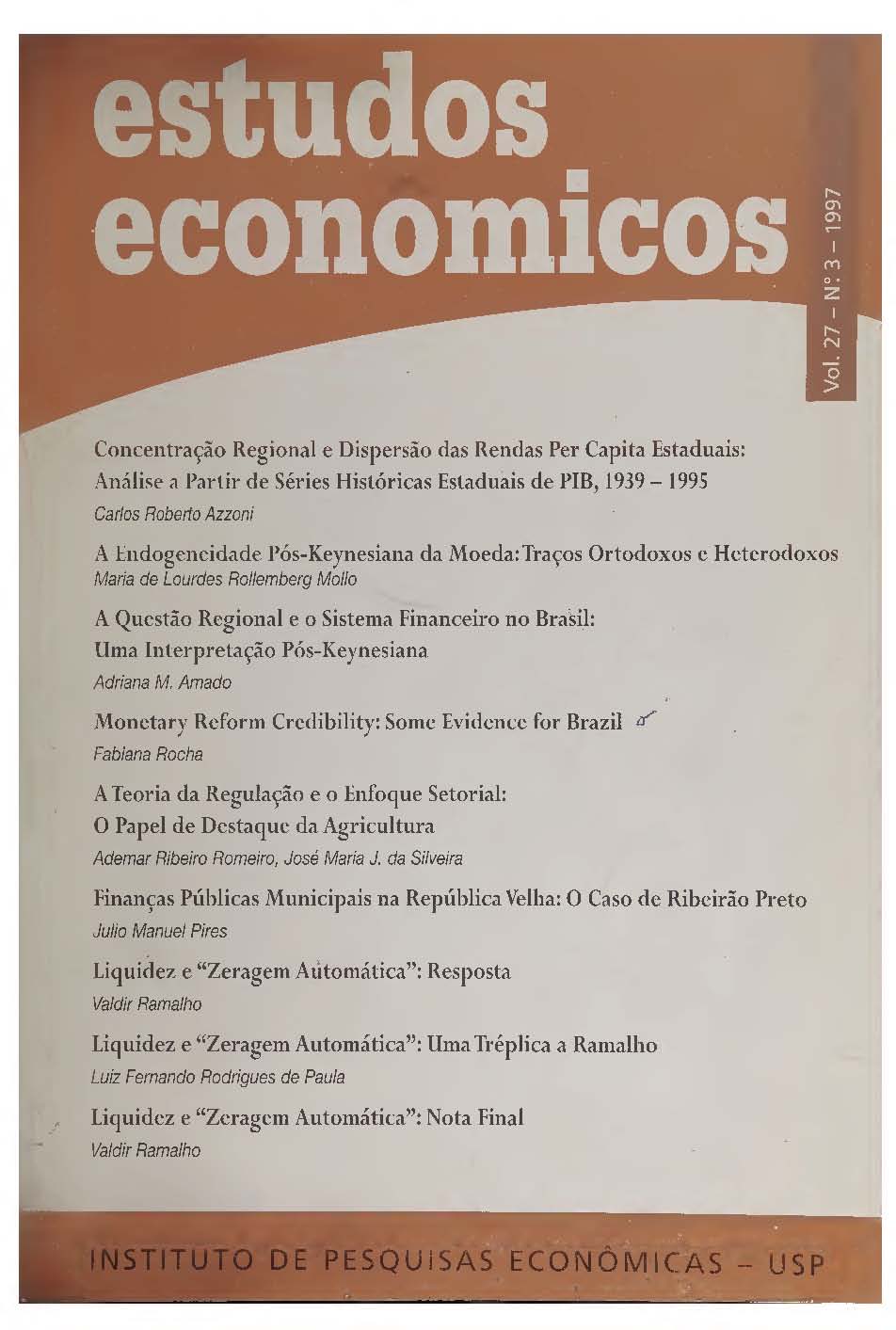
Monetary reform credibility: some evidence for Brazil
DOI:
https://doi.org/10.11606/1980-53572734frKeywords:
credibility, goverment budget constraint, subjective probability, cruzado and collorAbstract
This paper discusses the credibility of two disinflationary reforms adopted in Brazil, the Cruzado and Collor Plans. The source of the credibility problem is assumed to lie in the interaction between the monetary and fiscal authorities established by the government
budget constraint. Credibility is defined as the subjective probability that the government is following the announced policies. The results obtained indicate that both monetary reforms encouraged a policy for the monetary authority that would be appropriate for a Ricardian regime but advocated plans for taxes and expenditures that
could only be feasible under a fiscal dominance regime. Such monetary and fiscal policies are, however, incompatible. It is not feasible to carry out both at the same time, and this explains the overall low credibility, and ultimate failure, of these two economic reforms.
Downloads
References
AGENOR, P. R. & TAYLOR, M. P. Testing for credibility effects. IMF Staff Papers^ 39, p. 545-71, 1992.
BACKUS, D. & DRIFILL, J. Rational expectations and policy credibility following a change in regime. Review ofEconomic Studies, 52, p. 211-22, 1985a.
AGENOR, P. R. Inflation and rcpnteEon-American EconomicReview, 75, p. 503-38,1985b.
BARRO, R. J. & GORDON, D. B. A positive theory ofmonetary policy in a natural rate modc. Journal ofPolitical Economy, 91, p. 589-610, 1983a.
BARRO, R. J. Rules, discretion and reputation in a model ofmonetary policy.Journal ofMonetary Economics, 12, p. 101-22, 1983b.
BARRO, R. J. Developments in the theory of rules versus discretion. In:
BARRO, R. ]. Macvoeconomicpolicy. Harvard University Press, 1990.
BAXTER, M. The role ofexpectations in stabilization policy.Journal ofMonetary Economics, 15, p. 343-62, 1985.
BLACKBURN, K. & CHRISTENSEN, M. Monetary policy and policy credibility: theories and evidence. Journal ofEconomic Literature, v. XXVTI, p. 1-45, 1989.
BLANCHARD, O. J. The Lucas critique and the Volcker dtftzxion.American Economic Review, 74, p. 211-15,1984.
CHRISTENSEN, M. Disinflation, credibility and price inertia. Applied Economics, 19, p. 1353-66, 1987a.
BLANCHARD, O. J. On interest rate determination, testing for policy credibility, and the Lucas cr'tcuc. EuropeanJournal ofPoliticalEconomy, 3, p. 369-88,1987b.
CROUSHORE, D. & KOOT, R. S. A measure of Federal Reserve credibility Federal Reserve Bank of Philadelphia, Working Paper n. 91-1, 1991.
CUKIERMAN, A. Central Bank behavior and credibility: some recent theoretical developments. Federal Reserve Bank ofSt. Louis Review, 68, p. 5-17,1986.
CUKIERMAN, A. Central Bank strategy, credibility, and independence: theory and evidence. The MIT Press, 1992. '
CUKIERMAN, A., KIGUEL, M. & LIVIATAN, N. How much to commit to an exchange rate rule: balancing credibility andflexibility. The World Bank, July, WPS 931, 1992.
CUKIERMAN, A., WEBB, S. & NEYAPTI, B. Measuring the independence of Central Banks and its effects on policy outcomes. The World Bank Economic Review, 6, p. 353-98, 1992.
FISCHER, S. Rules versus discretion in monetary policy In: FRIEDMAN,
B. M. & HAHN, F. H. (eds.), Handbook ofmonetary economics, vol. 11. Elsevier Science Publishers, 1990.
GEWEKE, J. Exact inference in the inequality constrained normal linear regression model. Journal ofApplied Econometrics, 1, p. 127-41, 1986.
GRIFFITHS,W E. Bayesian econometrics and how to get rid ofthose wrong signs. Review ofMarketing andAgricultural Economics, 56, p. 36-56,1988.
JUDGE, G., HILL, R., GRIFFITHS, W, LUTKEPOHL, H. & LEE, T. Introduction to the theory andpractice ofeconometrics. Wiley, 1988.
KYDLAND, F. & PRESCOTT, E. C. Rules rather than discretion: the inconsistency of optimal plans. Journal ofPolitical Economy, 85, p. 473- 91, 1977.
MASCIANDARO, D., & TABELLINI, G. Monetary regimes and fiscal deficits: a comparative analyisis./w; CHENG, H. S. (ed.),Monetarypolicy inpacific basin countries. Doredrecht: Kluwer Academic Publishers, 1988.
NOVAES, A. D. Essays on inflation and stabilization in Brazil. Doctoral dissertation, University of California at Berkeley 1990.
PASTORE, A. C. Deficit publico, a sustentabilidade do crescimento das dividas interna e externa, senhoriagem e infla^ao: uma analise do regime monetario hrasilciro. Revista de Econometria, 14, p. 135-154, 1995.
ROCHA, E F. Monetary regimes and macroeconomicpolicy: an empirical analysis ofthe Brazilian economy. Doctoral dissertation, University of Illinois at Urbana-Champaign, 1995.
SARGENT, T. J. & WALLACE, N. Some unpleasant monetarist arithmetic. Federal Reserve Bank ofMinneapolisQuartely Review, Fall, p. 1-17, 1981.
SARGENT, T J. Reaganomics and credibility. In: SARGENT, T. {cd.). Rational expectations and inflation. Second Edition. Harper Collins College Publishers, 1993.
Downloads
Published
Issue
Section
License
Copyright (c) 1997 Estudos Econômicos (São Paulo)

This work is licensed under a Creative Commons Attribution-NonCommercial 4.0 International License.
By submitting an article, the author authorizes its publication and attests that it has not been submitted to any other journal. The original article is considered final. Articles selected for publication are proofread for grammatical and orthographic errors. The journal does not pay rights for published articles. The Institute of Economic Research from the School of Economics, Business and Accounting of the University of São Paulo (Instituto de Pesquisas Econômicas da Faculdade de Economia, Administração e Contabilidade da Universidade de São Paulo) owns the journal's copyright.


 Atualizado em 14/08/2025