A língua italiana entre purismos identitários, beletrismo e globalização: um debate crítico de Manzoni às políticas de Meloni
DOI:
https://doi.org/10.11606/issn.2238-8281.v0i52p08-32Palavras-chave:
Políticas linguísticas italianas, Purismo linguístico, Manzoni, O fascismo e a língua, O governo MeloniResumo
O presente artigo, a partir de uma análise das políticas linguísticas italianas desde 1800 até os dias de hoje, pretende analisar algumas das tendências principais que coexistem e se alternam no debate linguístico, enucleáveis em duas linhas proeminentes. A primeira está ligada a uma visão de língua como norma, declinada ou como purismo linguístico de cunho beletrista, ou como conservadorismo identitário; a questão da língua está, nesse caso, a serviço da ideologia. A segunda está, por sua vez, ligada à língua como expressão social, conferindo, portanto, dignidade às diversas variantes e formas, incluindo a oral. Essas tendências serão analisadas do ponto de vista do significado atribuído à norma e do seu valor social em cada época, colocando-as em diálogo comparativo com a visão crítica elaborada por Marcos Bagno (2003) a propósito do uso da linguagem normativa como forma de domínio social. Tentar-se-á também entender qual é a tendência dominante, hoje em dia, na política linguística italiana do governo de Giorgia Meloni (2022-2025) a partir da globalização e dos fenômenos migratórios, frisando elementos de conexão com aspectos das políticas linguísticas durante o fascismo.
Downloads
Referências
BAGNO, Marcos. A norma oculta. Língua e poder na sociedade brasileira. São Paulo: Parábola editorial, 2003.
CALVET, Louis-Jean. As políticas linguísticas. Tradução de Isabel De Oliveira Duarte, Jonas Tenfen, Marcos Bagno. São Paulo: Parábola editorial, 2021.
CARA Italia (Prod. Charlie Charles). Youtube: Ghali Ghali, 2018. Disponível em <https://www.youtube.com/watch?v=z3UCQj8EFGk>. Acesso em: 5 abr. 2023
CASTELLS, Emanuel. A era da informação: economia, sociedade e cultura. Volume 2. 3ª Edição. São Paulo: Paz e Terra, 1999.
CIOCIA, Paolo. “Il mancato inserimento dell’italiano quale lingua ufficiale nella costituzione: ragioni storico-giuridiche ed attualità della scelta". In: Cammino Diritto - Rivista di informazione giuridica. IUS/08-Diritto Costituzionale. 23 mar. 2023, p. 1-22. Disponível em: <https://rivista.camminodiritto.it/public/pdfarticoli/9433_3-2023.pdf>. Acesso em: 8 abr. 2025.
COUNCIL OF EUROPE – Modern Languages Divisions Strasbourg. Quadro comune europeo di riferimento per le lingue: apprendimento insegnamento valutazione. Tradução do inglês de Franca Quartapelle e Daniela Bertocchi. Milano: La nuova Italia / OXFORD, 2002 [2001].
DBLIT, Dicionário bibliográfico de literatura italiana traduzida no Brasil. Disponível em: <https://dblit.ufsc.br/documentos/?id=229208>. Acesso em: 15 mar. 2025.
DELLA VALLE, Valeria; PATOTA, Giuseppe. La nostra lingua italiana. Le origini, la storia, i protagonisti, le curiosità. Un’avventura lunga undici secoli. Milano: Sperling & Kupfer, 2019.
ETHNOLOGUE. Italian Language. Disponível em: <https://www.ethnologue.com/language/ita/>. Acesso em: 5 abr. 2025.
GLISSANT, Edouard. Poética da relação. Tradução de Eduardo Jorge de Oliveira e Marcela Vieira. Rio de Janeiro: Bazar do tempo, 2021.
ITALIA. Camera dei deputati. Proposta di leggi n. 734, de 2022. Disponível em: <https://documenti.camera.it/leg19/pdl/pdf/leg.19.pdl.camera.734.19PDL0017640.pdf>. Acesso em 09 abr 2025.
ITALIA. Legge n. 2042, 23 dicembre 1940. Divieto dell'uso di parole straniere nelle intestazioni delle ditte e nelle varie forme pubblicitarie. GU n.76 del 29-03-1941. Disponível em: <https://www.normattiva.it/uri-res/N2Ls?urn:nir:stato:legge:1940-12-23;2042@originale>. Acesso em 09 abr 2025.
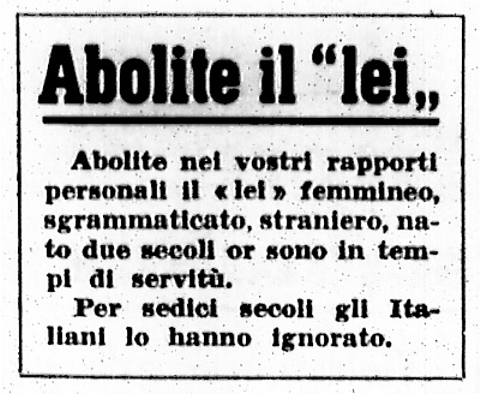
ITALY SEGRETA: The Italian Culture Magazine. Firenze. Disponível em: <https://italysegreta.com/wp-content/uploads/2022/07/aboliteillei.jpeg>. Acesso em: 4 abr. 2025.
KLEIN, Gabriella. La politica linguistica del fascismo. Bologna: Il Mulino, 1986.
MANZONI, Alessandro. “Lettera di Manzoni al Fauriel.” In: MANZONI, Alessandro. Scritti linguistici. A cura di Maurizio Vitale. Classici Italiani. Collezione fondata da Ferdinando Neri e Mario Fubini. E-book. Novara: Utet, 2013, S/p.
MANZONI, Alessandro. Capítulo III de I promessi sposi, 1840. Disponível em:
<https://it.wikisource.org/wiki/I_promessi_sposi_(1840)/Capitolo_III>. Acesso em: 5 abr. 2025.
MELONI: Da FdI pdl costituzionale per riconoscere l'italiano come lingua ufficiale della Repubblica. Youtube: Fratelli d’Italia, 25 de mar. de 2021. 1m24s. Disponível em: <https://www.youtube.com/watch?v=oIAeISle2sQ>. Acesso em: 4 abr. 2025.
MOSELEY, Christopher. Atlas of the world’s Languages in Danger. Paris: Unesco publishing, 2010. Disponível em: < https://unesdoc.unesco.org/ark:/48223/pf0000187026>. Acesso em: 11 out. 2025.
NENCIONI, Giovanni. "Cultura e poesia in Alessandro Manzoni". In: Terzoprogramma, 1, 1974, p. 63, 72. Disponível em: <https://nencioni.sns.it/fileadmin/template/allegati/pubblicazioni/1974/Manzoni_1974.pdf>. Acesso em: 3 abr. 2025.
PATOTA, Giuseppe. La questione della lingua. Módulo ICoN - Italian culture on the net, 2011.
RASO, Tommaso; BRANDÃO LINS, Jacyntho. “As línguas da África”. In: DUCHOWNY, Teles Alexa et Al. Apostila: fundamentos de linguística comparada. Belo Horizonte: Universidade de Minas Gerais, 2015, p. 142-160.
TETRO. In: Treccani. Disponível em: <https://www.treccani.it/vocabolario/tetro/>. Acesso em: 5 abr. 2025.
UFFICIO FEDERALE DI STATISTICA. Disponível em: https://www.bfs.admin.ch/bfs/it/home/statistiche/popolazione/lingue-religioni/lingue.html#:~:text=Lingue%20a%20casa,e%20l'8%25%20italiano. Acesso em: 27 mar. 2025.
VECCHI, Luciano. Il Governo Meloni contro gli italiani all’estero (e non solo). Breve analisi sul Bilancio dello Stato 2024 e altri provvedimenti. Gente d’Italia. 24 de fevereiro de 2024. Disponível em: <https://www.genteditalia.org/2024/02/04/il-governo-meloni-contro-gli-italiani-allestero-e-non-solo-breve-analisi-sul-bilancio-dello-stato-2024-e-altri-provvedimenti/>. Acesso em 05 abr. 2025.

Downloads
Publicado
Edição
Seção
Licença
Direitos autorais (c) 2025 Revista de Italianística

Este trabalho está licenciado sob uma licença Creative Commons Attribution-NonCommercial-NoDerivatives 4.0 International License.
A revista retém os direitos patrimoniais dos artigos e os publica simultaneamente sob uma Licença Creative Commons-Atribuição-Não Comercial-Sem Derivações.